


United States Human Growth Hormone Market Size and Forecast 2026–2034
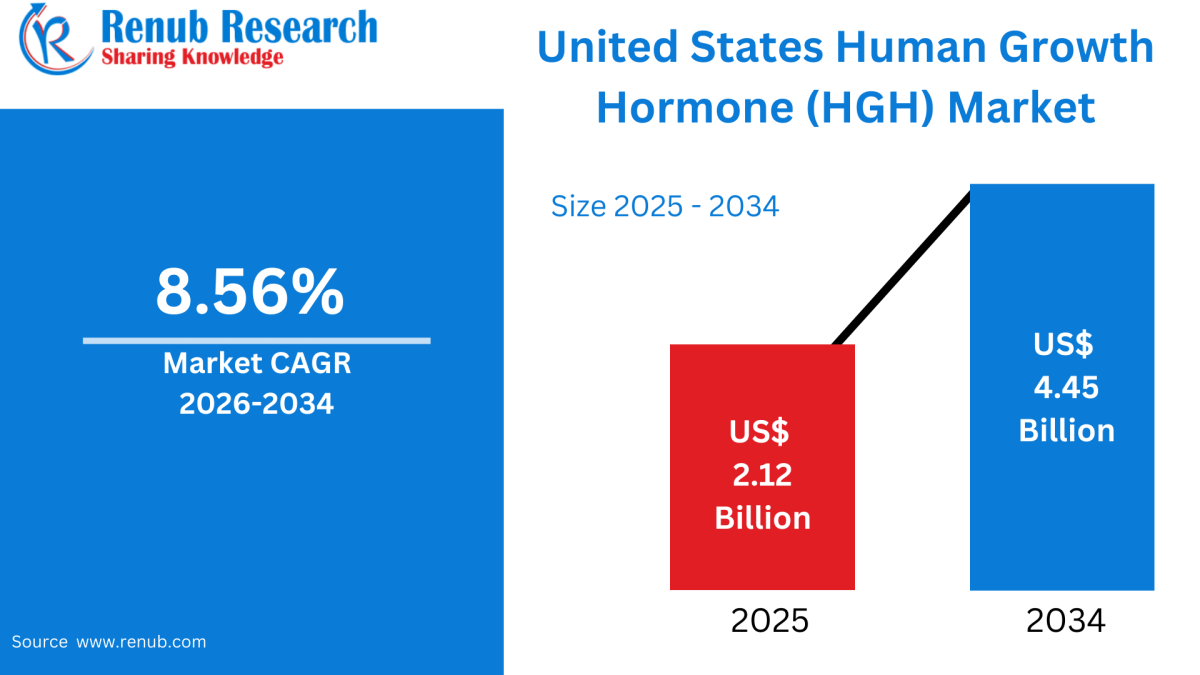
According to Renub Research United States Human Growth Hormone (HGH) market is positioned for robust expansion over the forecast period, driven by increasing diagnosis rates of hormone-related disorders, technological progress in recombinant biotechnology, and rising healthcare expenditure. The market, valued at approximately US$ 2.12 billion in 2025, is projected to reach around US$ 4.45 billion by 2034, registering a strong compound annual growth rate (CAGR) of 8.56% from 2026 to 2034. This sustained growth reflects the widening clinical adoption of HGH across pediatric and adult indications, alongside growing interest in hormone optimization and personalized medicine within regulated medical frameworks.
United States Human Growth Hormone Market Outlook
Human Growth Hormone, also known as somatotropin, is a peptide hormone naturally secreted by the pituitary gland and plays a critical role in physical growth, tissue regeneration, bone density, muscle development, and metabolic regulation. Clinically, synthetic or recombinant HGH is prescribed for conditions such as growth hormone deficiency in children and adults, Turner syndrome, Prader-Willi syndrome, idiopathic short stature, chronic kidney disease–related growth failure, and muscle wasting disorders. Its well-established therapeutic value has made HGH a cornerstone of modern endocrinology.
In the United States, awareness of hormonal health has increased significantly, supported by advances in diagnostic tools, broader access to specialized healthcare, and growing patient education. While pediatric growth disorders remain a key application area, adult HGH therapy has gained prominence for managing metabolic imbalance, muscle loss, reduced bone density, and diminished quality of life associated with aging or chronic illness. Although non-medical and anti-aging uses remain tightly regulated, the broader conversation around wellness, vitality, and personalized healthcare continues to influence patient interest and clinical research in the HGH space.
Download Free Sample Report:https://www.renub.com/request-sample-page.php?gturl=us-human-growth-hormone-market-p.php
Growth Drivers of the United States Human Growth Hormone Market
One of the most influential drivers of the U.S. HGH market is the rising number of diagnosed growth and hormone deficiency disorders. Pediatric healthcare providers increasingly use growth charts, genetic testing, and early screening protocols to identify conditions such as Turner syndrome, Prader-Willi syndrome, and childhood-onset growth hormone deficiency at earlier stages. Early diagnosis allows timely intervention, improving clinical outcomes and extending treatment duration, which directly supports market growth.
Among adults, heightened awareness of hormonal imbalance linked to aging, obesity, and chronic diseases has expanded the eligible patient population for HGH therapy. Adults experiencing fatigue, muscle loss, reduced bone mass, and metabolic slowdown are more likely to seek endocrine evaluation. This shift has significantly increased demand for HGH beyond traditional pediatric use, strengthening overall market momentum.
Technological advances in recombinant DNA technology and drug delivery systems are also transforming the HGH market. Modern recombinant techniques enable the production of highly purified, bioidentical HGH with improved safety and efficacy profiles. In parallel, innovation in long-acting formulations, sustained-release therapies, and needle-free or patient-friendly injection devices has improved treatment adherence, particularly among children requiring long-term therapy. Once-weekly HGH analogs reduce injection burden and enhance quality of life, making therapy more accessible and acceptable.
The growing emphasis on personalized medicine further supports HGH market expansion. Hormone therapy is inherently individualized, with dosing and treatment plans tailored to age, gender, body composition, lifestyle, and clinical history. Advances in precision medicine and patient monitoring technologies allow clinicians to optimize HGH therapy outcomes while minimizing adverse effects. As the U.S. population continues to age and chronic disease prevalence rises, personalized hormone therapies such as HGH are expected to gain further clinical relevance.
Challenges in the United States Human Growth Hormone Market
Despite its positive growth outlook, the U.S. HGH market faces notable challenges. High treatment costs remain a major barrier, particularly because HGH therapy often requires long-term or lifelong administration. Insurance coverage varies widely, with many providers limiting reimbursement to specific pediatric conditions and excluding adult deficiency or non-classical indications. Out-of-pocket expenses can therefore be substantial, restricting access for certain patient groups and slowing adoption.
Another critical challenge is the risk of misuse and the ethical concerns surrounding HGH. Due to its association with athletic performance enhancement, bodybuilding, and anti-aging claims, HGH is one of the most tightly regulated hormones in the United States. The U.S. Food and Drug Administration strictly restricts HGH prescriptions to approved medical indications. Physicians and pharmacies face significant administrative and compliance burdens to ensure appropriate use, while heightened scrutiny by regulatory and law enforcement agencies can discourage prescribing even in legitimate cases. These regulatory complexities continue to shape market dynamics and limit expansion into broader wellness applications.
United States Turner Syndrome Human Growth Hormone Market
Turner syndrome represents one of the largest and most stable pediatric indications for HGH therapy in the United States. Affecting females with partial or complete absence of one X chromosome, the condition commonly results in short stature and delayed growth. Early diagnosis and initiation of HGH therapy significantly improve height outcomes and overall development. Pediatric endocrinology centers follow structured treatment protocols that include long-term HGH administration, making this segment a consistent contributor to market revenues.
United States Prader-Willi Syndrome Human Growth Hormone Hospital Pharmacy Market
Prader-Willi syndrome is a complex genetic disorder requiring multidisciplinary clinical management, with HGH therapy playing a central role. HGH helps improve muscle tone, reduce fat mass, and support linear growth in affected patients. Due to associated complications such as respiratory issues and metabolic abnormalities, HGH treatment for Prader-Willi syndrome is primarily managed through hospital-based endocrinology programs. This drives consistent demand through hospital pharmacies, reinforcing their importance in the HGH distribution landscape.
United States Human Growth Hormone Online Pharmacy Market
Online pharmacies are emerging as a significant distribution channel for HGH in the United States, supported by the expansion of telehealth and digital healthcare services. Patients undergoing long-term hormone therapy value the convenience, privacy, and home delivery offered by licensed online pharmacies. Strict verification systems and electronic prescriptions ensure regulatory compliance and minimize misuse. As digital health adoption continues to rise, online pharmacies are expected to play an increasingly important role in HGH accessibility and patient adherence.
United States Intravenous Human Growth Hormone Market
Intravenous HGH administration is a niche segment used primarily in specialized clinical settings. It is typically reserved for acute hormone deficiency states, post-surgical recovery, or closely monitored metabolic conditions. While limited in volume compared to other routes, IV HGH remains essential in critical care and research applications, contributing to steady but specialized demand within the U.S. healthcare system.
United States Intramuscular Human Growth Hormone Market
Intramuscular injection remains a traditional and widely accepted route of HGH administration. It provides reliable absorption and stable hormone levels, making it suitable for long-term therapy in both pediatric and adult patients. Advances in injection device design, including shorter needles and user-friendly pens, have improved patient comfort and enabled safe self-administration at home. Continued expansion of hormone therapy programs supports sustained demand for intramuscular HGH delivery.
United States Oral Human Growth Hormone Market
Oral HGH formulations and hormone-stimulating peptides represent an emerging area of innovation. Although true oral bioavailable HGH remains under development, these products aim to stimulate endogenous hormone production and improve patient compliance by eliminating injections. While still in early stages, ongoing research suggests long-term potential for oral alternatives in metabolic and age-related hormone management.
California Human Growth Hormone Market
California is one of the largest HGH markets in the United States, supported by a large population, advanced healthcare infrastructure, and high concentration of endocrinologists and biotechnology companies. The state also has a strong culture of wellness and personalized medicine, which increases adult HGH utilization under regulated medical supervision. Telemedicine adoption further enhances treatment accessibility, reinforcing California’s leadership in HGH demand.
New York Human Growth Hormone Market
New York’s HGH market is driven by its extensive hospital network, academic medical centers, and strong patient awareness. Pediatric endocrinology departments diagnose and treat a substantial number of growth disorder cases annually, while adult specialty clinics address metabolic and hormonal deficiencies. Robust insurance frameworks and digital health integration support therapy adoption, making New York a key contributor to national market growth.
Washington Human Growth Hormone Market
Washington state shows notable growth in HGH utilization due to advanced healthcare delivery systems, strong biotechnology presence, and widespread adoption of online healthcare solutions. High diagnostic rates, combined with efficient patient monitoring and pharmacy distribution, support consistent demand. The state’s emphasis on innovation and digital health positions it as an important regional HGH market.
United States Human Growth Hormone Market Segmentation
The United States HGH market is segmented by application into growth hormone deficiency, Turner syndrome, idiopathic short stature, Prader-Willi syndrome, small for gestational age, and other conditions. By distribution channel, the market includes hospital pharmacies, retail pharmacies, online pharmacies, and others. Routes of administration include intravenous, intramuscular, subcutaneous, and oral. Geographically, major contributing states include California, Texas, New York, Florida, Illinois, Pennsylvania, Washington, and several others, highlighting the broad national footprint of HGH demand.
Competitive Landscape of the United States Human Growth Hormone Market
The competitive landscape of the U.S. HGH market is characterized by strong participation from global pharmaceutical and biotechnology companies focused on innovation, long-acting formulations, and improved delivery systems. Key players include Eli Lilly and Company, EMD Serono Inc., F. Hoffmann-La Roche AG, Ferring B.V., Genentech Inc., Ipsen, Merck KGaA, Novartis AG, Novo Nordisk, and Pfizer Inc.. These companies compete through product innovation, clinical research, strategic partnerships, and expanded patient access programs, shaping the future trajectory of the U.S. Human Growth Hormone market through 2034.
renubresearch