
Edible Offal Market Size and Forecast 2025–2033
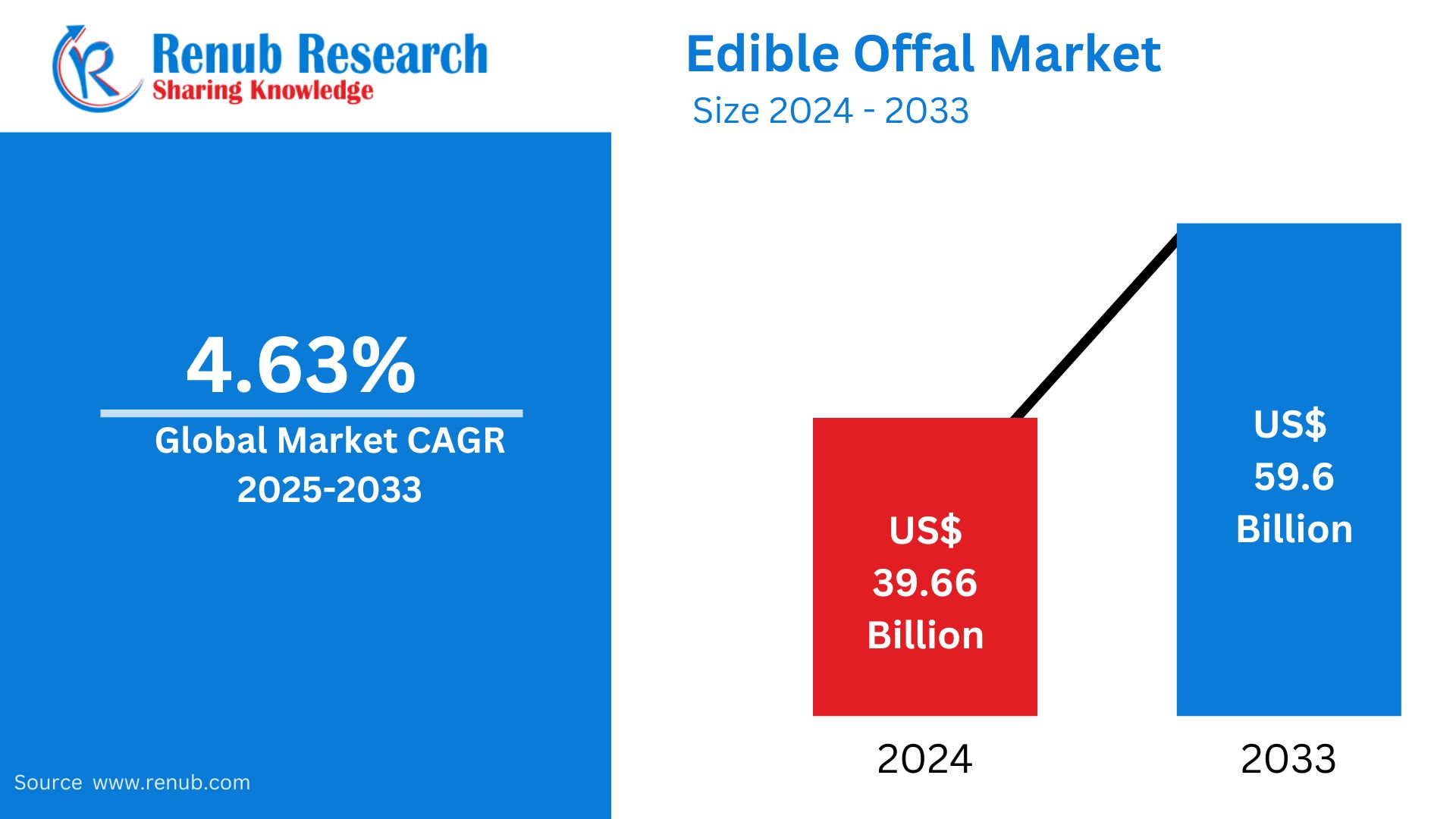
According to Renub Research global edible offal market is witnessing steady and resilient growth, supported by rising demand for affordable, nutrient-dense protein sources and increasing awareness of sustainable food consumption. Valued at US$ 39.66 billion in 2024, the edible offal market is projected to reach US$ 59.60 billion by 2033, expanding at a compound annual growth rate (CAGR) of 4.63% from 2025 to 2033.
Market expansion is being driven by growing meat consumption worldwide, strong cultural and culinary traditions in Asia, Africa, the Middle East, and Latin America, and renewed interest in nose-to-tail eating practices. In addition, rising awareness of food waste reduction and sustainability is encouraging both consumers and foodservice operators to utilize the entire animal, positioning edible offal as an economically and environmentally viable protein source.
Edible Offal Market Overview
Edible offal refers to the internal organs and entrails of animals that are suitable for human consumption. Common types include liver, kidneys, heart, tongue, tripe, brain, and intestines derived from cattle, pigs, sheep, poultry, and other livestock. These products are rich in essential nutrients such as protein, iron, zinc, vitamin A, and B-complex vitamins, making them highly nutritious compared to many conventional muscle cuts.
Historically, edible offal has been an integral part of traditional cuisines around the world. Dishes featuring organ meats are deeply rooted in cultural and regional food practices, particularly in Asia, Africa, Latin America, and the Middle East. While offal consumption declined in some Western countries due to changing preferences and perceptions, it is now experiencing a revival driven by sustainability trends, culinary innovation, and growing interest in traditional and ethnic foods.
Advancements in meat processing, cold-chain logistics, and food safety standards have significantly improved the quality, shelf life, and accessibility of edible offal products. These developments are helping expand offal consumption beyond traditional markets and supporting growth in both retail and foodservice channels globally.
Request a free sample copy of the report:https://www.renub.com/request-sample-page.php?gturl=edible-offal-market-p.php
Key Growth Drivers of the Edible Offal Market
Rising Global Demand for Affordable Protein
One of the most important drivers of the edible offal market is the increasing global demand for affordable protein sources. Rapid population growth, urbanization, and rising food prices are prompting consumers—particularly in developing economies—to seek cost-effective alternatives to premium meat cuts.
Edible offal offers a highly nutritious and economical solution. Organ meats provide high protein content along with essential vitamins and minerals at a lower price point than conventional muscle meat. In times of inflation and economic uncertainty, offal becomes especially attractive to low- and middle-income households seeking to maintain nutritional intake without increasing food expenditure.
The affordability of offal, combined with its widespread use in traditional cooking, ensures consistent demand and long-term market stability.
Culinary Innovation and Evolving Food Trends
The edible offal market is also benefiting from evolving culinary trends and growing experimentation in global cuisine. Chefs, food enthusiasts, and culinary professionals are increasingly exploring organ meats for their distinctive flavors and textures.
High-end restaurants and modern eateries are incorporating offal into gourmet dishes, elevating its status from a byproduct to a premium ingredient. Liver pâté, grilled heart, braised tripe, and tongue-based dishes are gaining popularity as part of both traditional and contemporary menus.
The rise of the nose-to-tail eating philosophy, which emphasizes the use of every edible part of an animal, is further supporting this trend. Media exposure through cooking shows, social platforms, and celebrity chefs has helped reshape consumer perceptions and encouraged experimentation with offal at home and in restaurants.
Growing Awareness of Sustainable and Ethical Eating
Sustainability is becoming a central consideration in global food consumption, and edible offal aligns closely with environmentally responsible eating habits. Utilizing the entire animal reduces food waste, improves resource efficiency, and supports circular food systems.
Consumers who prioritize ethical and sustainable food choices are increasingly recognizing offal as a responsible alternative to wasteful meat consumption. Additionally, offal’s high nutrient density appeals to health-conscious consumers seeking functional foods that deliver maximum nutritional value.
Foodservice operators and meat processors are responding to this shift by incorporating offal into menus and product lines, further accelerating market growth.
Challenges in the Edible Offal Market
Cultural and Perception Barriers
Despite its benefits, cultural perceptions remain a significant challenge in certain regions, particularly in parts of North America and Europe. In these markets, offal is sometimes viewed as unappealing, outdated, or associated with lower socioeconomic status.
Younger consumers and urban populations may be unfamiliar with offal preparation or hesitant to try organ meats due to taste, texture, or visual concerns. In addition, religious or cultural dietary restrictions can limit consumption of specific types of offal in certain markets.
Overcoming these barriers requires targeted education, innovative product formats, and marketing strategies that emphasize nutritional value, sustainability, and culinary versatility.
Regulatory and Food Safety Challenges
Edible offal is highly perishable and requires strict handling, processing, and storage standards to ensure food safety. Regulations governing offal processing, labeling, and trade vary significantly across countries, creating complexity for producers and exporters.
Compliance with stringent hygiene standards, import-export regulations, and certification requirements can increase operational costs, particularly for small and medium-sized producers. Navigating these regulatory frameworks remains a challenge for achieving smooth global market expansion.
Edible Offal Market by Source
Offal derived from beef, pig, sheep, and poultry represents the core of the global market. Beef and pork offal account for a significant share due to large-scale livestock production and widespread culinary usage. Poultry offal is also gaining traction due to its affordability and growing poultry meat consumption worldwide.
Each source category offers distinct nutritional profiles and culinary applications, contributing to diversified demand across regions and cultures.
Edible Offal Market by Application
Fresh Offal
Fresh edible offal dominates consumption in traditional markets, where local slaughtering and immediate preparation are common. Fresh offal is widely used in home cooking and foodservice establishments, particularly in Asia, Africa, and the Middle East.
Processed Offal
Processed offal products, including frozen, canned, and value-added forms, are gaining popularity in urban and export markets. Processing enhances shelf life, improves safety, and supports distribution through modern retail channels. This segment is expected to grow steadily as cold-chain infrastructure improves globally.
Distribution Channel Analysis
Food Service
The foodservice sector plays a vital role in driving offal consumption, especially through restaurants, street food vendors, and catering services. Culinary innovation and ethnic dining experiences are expanding the use of offal-based dishes across casual and fine-dining formats.
Retail
Retail distribution includes butcher shops, wet markets, supermarkets, and specialty meat stores. Growing consumer interest in cooking traditional and sustainable meals at home is supporting retail sales, particularly in regions with strong cultural acceptance of offal.
Regional Analysis of the Edible Offal Market
United States Edible Offal Market
The U.S. edible offal market is experiencing gradual growth, supported by rising interest in sustainable eating, nose-to-tail cooking, and ethnic cuisines. Chefs and specialty restaurants are leading adoption, while consumers are becoming more aware of offal’s nutritional benefits. This evolving perception is creating new opportunities for producers and retailers.
Germany Edible Offal Market
Germany has a strong tradition of offal consumption, particularly in regional cuisines. Traditional restaurants, artisanal butchers, and specialty food stores continue to support demand. At the same time, modern chefs are reintroducing offal to younger consumers through innovative recipes, balancing tradition with contemporary tastes.
India Edible Offal Market
India’s edible offal market is deeply rooted in regional culinary traditions. Organ meats are commonly used in flavorful dishes across various states. Urban food startups and modern chefs are reviving interest in offal by combining traditional flavors with modern presentation, supporting market expansion.
Saudi Arabia Edible Offal Market
In Saudi Arabia, edible offal plays an important role in traditional cuisine and festive meals. Strong cultural acceptance, combined with rising awareness of sustainability and whole-animal utilization, supports consistent demand. Local production and foodservice consumption continue to drive market growth.
Recent Developments in the Edible Offal Market
Recent research highlights the role of food neophobia in influencing consumer willingness to purchase edible offal, emphasizing the importance of education, innovative packaging, and chef-led promotion. Strategic acquisitions and geographic expansions by major meat processors are also strengthening supply chains and market reach.
Competitive Landscape and Key Players
The edible offal market includes a mix of specialized offal producers, meat processors, and diversified food companies. Competitive analysis typically covers company overviews, leadership, recent strategies, SWOT analysis, and sales performance.
Key players operating in the market include JBS Food Canada, Sure Good Foods Ltd., Cenfood International Inc., Yoma International, and Organic Meat Company, alongside several niche offal-focused brands.
Conclusion
The global edible offal market is positioned for sustained growth through 2033, driven by affordability, nutritional value, cultural relevance, and sustainability considerations. While cultural perceptions and regulatory challenges persist in certain regions, increasing culinary innovation, education, and ethical eating trends are reshaping consumer attitudes. As demand for resource-efficient and nutrient-rich protein continues to rise, edible offal is expected to play an increasingly important role in the global meat and food industry.
renubresearch