
Global Aquaculture Market Size and Forecast 2025–2033
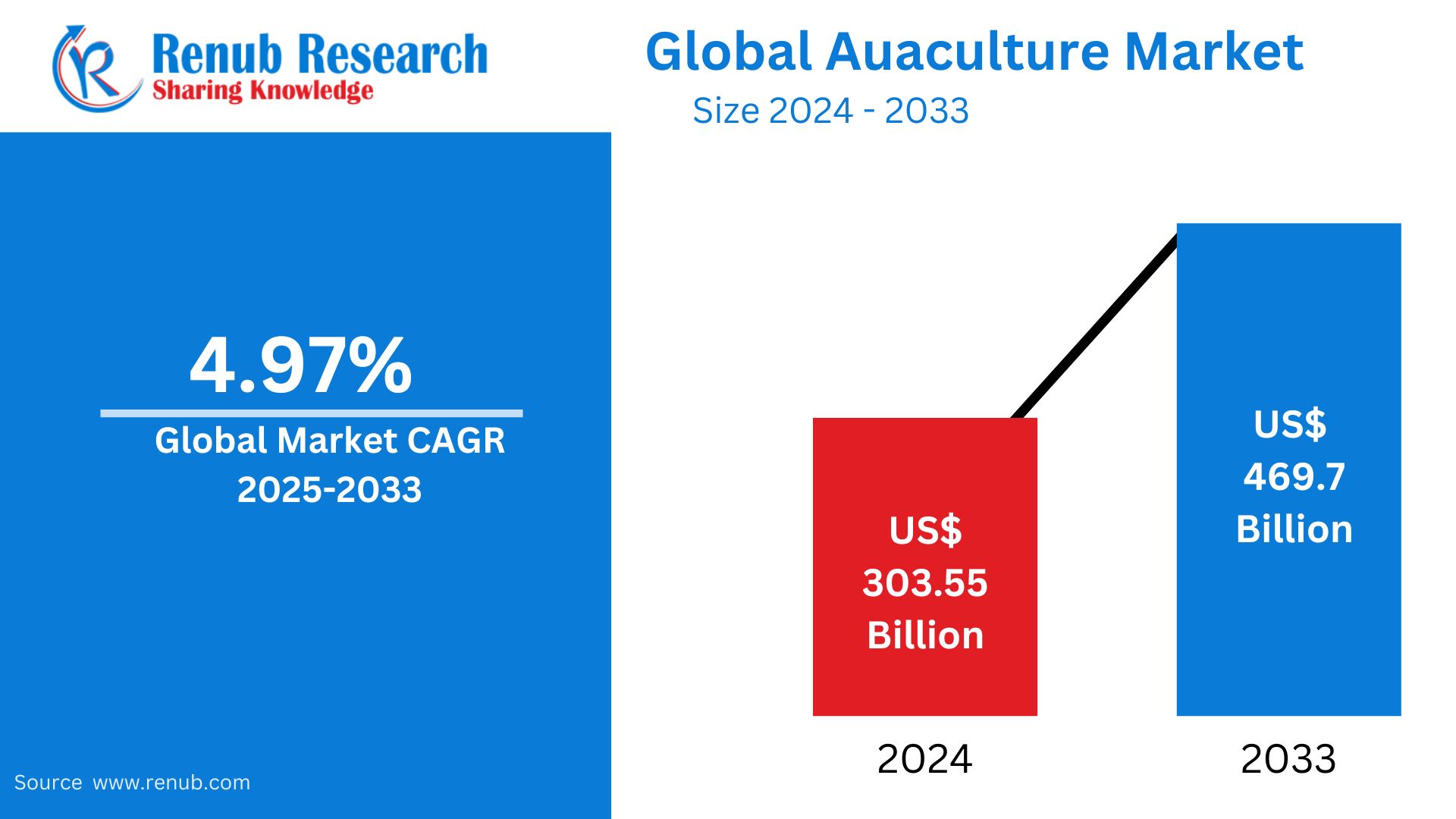
The global aquaculture market is experiencing sustained expansion as it becomes a critical solution for meeting the world’s rising demand for seafood and aquatic-based products. Valued at US$ 303.55 billion in 2024, the market is projected to reach US$ 469.7 billion by 2033, growing at a CAGR of 4.97% from 2025 to 2033. This growth is supported by increasing fish consumption, heightened awareness of the nutritional benefits of seafood, rapid technological innovation, declining wild fish stocks, and growing emphasis on sustainable food systems.
Aquaculture has evolved from a supplementary food source into a cornerstone of global food security. As capture fisheries face overexploitation and climate-related disruptions, aquaculture provides a scalable, controlled, and increasingly sustainable alternative. Governments, private investors, and research institutions are accelerating efforts to modernize aquaculture practices, making the sector one of the most strategically important segments of the global agri-food economy.
Aquaculture Market Overview
Aquaculture, also known as aquafarming, refers to the controlled cultivation of aquatic organisms such as fish, crustaceans, mollusks, seaweed, and aquatic plants. Production takes place in diverse environments, including freshwater ponds, brackish water systems, coastal areas, offshore cages, and advanced land-based facilities. The industry supports food supply, employment, rural development, and export earnings across both developed and emerging economies.
Modern aquaculture incorporates a wide range of production systems, from traditional pond farming to highly sophisticated recirculating aquaculture systems (RAS). Sustainable aquaculture practices aim to minimize environmental impact, improve animal health, enhance feed efficiency, and ensure long-term ecosystem balance. Through innovation and responsible management, aquaculture is increasingly positioned as a reliable answer to protein security challenges posed by population growth and urbanization.
The market’s expansion is also supported by rising consumer preference for healthy diets rich in omega-3 fatty acids, lean protein, and essential micronutrients. Species such as salmon, shrimp, tilapia, and shellfish continue to see strong global demand, reinforcing aquaculture’s role in global nutrition.
Request a free sample copy of the report:https://www.renub.com/request-sample-page.php?gturl=aquaculture-market-p.php
Growth Drivers for the Aquaculture Market
Growing Pharmaceutical Industry Demand for Aquatic Plants and Organisms
One of the emerging drivers of aquaculture market growth is the rising demand from the pharmaceutical and biotechnology industries. Marine organisms and aquatic plants contain bioactive compounds with antioxidant, anti-inflammatory, antimicrobial, and anticancer properties. Seaweed, algae, sponges, and certain fish species are increasingly explored as sources of novel drugs, nutraceuticals, and medical therapies.
Aquaculture enables a stable and sustainable supply of these valuable organisms, reducing pressure on natural ecosystems. Controlled cultivation ensures consistency in quality and composition, which is essential for pharmaceutical research and commercial drug development. The growing emphasis on natural and sustainable sources of therapeutic compounds further strengthens the link between aquaculture and healthcare innovation.
Growing Uptake of New Technology
Technological advancement is one of the most powerful forces shaping the aquaculture market. Automation, artificial intelligence, biotechnology, and data analytics are transforming traditional farming methods into highly efficient, precision-based operations. Automatic feeding systems optimize feed usage and reduce waste, while real-time water quality sensors enable continuous monitoring of oxygen, temperature, and pH levels.
Selective breeding and biotechnology have improved growth rates, disease resistance, and feed conversion efficiency. AI-powered analytics support predictive modeling for disease outbreaks, harvest timing, and supply chain optimization. Recirculating aquaculture systems, which recycle water and minimize environmental discharge, are gaining traction due to their efficiency and suitability for land-based farming. These innovations collectively enhance productivity, sustainability, and profitability, driving widespread adoption across the industry.
Growing Interest in Seafood Products
Global consumption of seafood continues to rise due to its recognized health benefits and shifting dietary preferences. Fish and shellfish are valued for their high-quality protein, low saturated fat content, and rich omega-3 fatty acid profiles, which support heart and brain health. As awareness of these benefits grows, consumers are incorporating seafood more frequently into daily diets.
Rising disposable incomes, particularly in emerging economies, are enabling broader access to seafood products. Aquaculture fills the supply gap left by declining wild fisheries, offering consistent availability of popular species. The industry’s ability to produce a wide variety of aquatic species under controlled conditions supports diversification and market resilience, positively influencing overall market value.
Challenges in the Aquaculture Market
Disease Outbreaks and Biosecurity Risks
Disease outbreaks remain one of the most significant challenges facing the aquaculture industry. High stocking densities can facilitate the rapid spread of bacterial, viral, and parasitic infections, leading to substantial economic losses. Managing disease outbreaks requires robust biosecurity measures, including vaccination programs, water quality management, and controlled movement of stock.
Excessive reliance on antibiotics poses additional risks, including antimicrobial resistance and regulatory scrutiny. Implementing comprehensive biosecurity protocols can be costly and operationally complex, particularly for small-scale producers. Failure to effectively manage these risks can undermine market confidence and long-term sustainability.
Regulatory and Compliance Hurdles
Aquaculture operations are subject to complex and often fragmented regulatory frameworks that vary across countries and regions. Producers must comply with environmental regulations, food safety standards, animal welfare requirements, and trade policies. Obtaining permits and approvals can be time-consuming and expensive, particularly for new projects.
Small and medium-sized producers often face difficulties meeting evolving regulatory standards due to limited financial and technical resources. Inconsistent international regulations can also restrict cross-border trade and investment. Streamlining compliance processes and promoting regulatory harmonization are essential for fostering innovation and market growth.
United States Aquaculture Market
The United States aquaculture market focuses on high-value species such as salmon, shrimp, and shellfish, driven by demand for locally sourced and sustainably produced seafood. Technological innovation, including land-based RAS and offshore farming, is improving productivity while reducing environmental impact.
Government initiatives and research funding support industry modernization and sustainability. Although the U.S. contributes a relatively small share of global aquaculture output, strong consumer demand, premium pricing, and sustainability commitments position the market for steady growth.
Germany Aquaculture Market
Germany’s aquaculture market is evolving steadily, driven by consumer preference for sustainable and locally produced seafood. As wild fish stocks decline, aquaculture offers an alternative that aligns with environmental values. The country is also exploring innovative approaches such as cell-based seafood and advanced land-based systems.
Strong regulatory oversight ensures high quality and safety standards, while investments in research and alternative protein technologies highlight Germany’s commitment to sustainable food systems. These factors support moderate but stable market expansion.
India Aquaculture Market
India is one of the fastest-growing aquaculture markets globally, supported by favorable climatic conditions, extensive freshwater and coastal resources, and strong domestic demand. Fish and shrimp farming dominate production, with increasing adoption of technologies such as biofloc systems and RAS to improve efficiency.
Government programs aimed at modernization, export promotion, and farmer training are strengthening the value chain. Aquaculture also plays a critical role in rural employment and income generation. Despite challenges related to disease control and environmental management, India’s market holds significant long-term growth potential.
Saudi Arabia Aquaculture Market
Saudi Arabia’s aquaculture industry is expanding rapidly as part of the nation’s strategy to enhance food security and diversify its economy. Limited freshwater resources have driven investment in advanced technologies such as offshore farming and recirculating systems.
Strong government support, favorable policies, and large-scale investment initiatives are positioning Saudi Arabia as a regional leader in sustainable marine aquaculture. The market benefits from rising seafood consumption and increasing interest in domestic production.
Recent Developments in the Aquaculture Market
The aquaculture industry has witnessed notable investments and strategic partnerships in recent years. In June 2024, Huon Aquaculture announced a major expansion of its Tasmanian operations with the integration of advanced RAS technology. In March 2024, Cognizant renewed and expanded its digital transformation partnership with Cermaq Group, supporting smart aquaculture initiatives across multiple regions.
In January 2024, Cooke Aquaculture and AquaChile reached agreements with government authorities to relocate farming operations away from environmentally sensitive areas, reinforcing sustainability commitments. These developments reflect the industry’s focus on responsible growth, innovation, and environmental stewardship.
Aquaculture Market Segmentation
By Environment
The market is segmented into freshwater, marine water, and brackish water systems. Freshwater aquaculture dominates global production, while marine and brackish systems are expanding rapidly due to strong demand for high-value species.
By Type
Key segments include fish, crustaceans, mollusks, seaweed, aquatic plants, and others. Fish remains the largest segment, while seaweed and aquatic plants are gaining importance due to applications in food, pharmaceuticals, and biofuels.
By End Use
End-use segments include the food industry, agriculture, animal feed, and others. The food industry accounts for the largest share, driven by rising global seafood consumption.
Key Players Analysis
The global aquaculture market is moderately fragmented, with major players focusing on scale, sustainability, and technological integration. Key companies include Cermaq ASA, Cooke Aquaculture Inc., Huon Aquaculture Group Pty Ltd., Nireus Aquaculture S.A., Selonda Aquaculture S.A., and Blue Ridge Aquaculture.
These companies compete through capacity expansion, digital transformation, sustainable farming practices, and strategic partnerships. SWOT analysis, revenue performance, and innovation strategies shape the competitive landscape.
Conclusion
The global aquaculture market is set for steady and resilient growth through 2033, driven by rising seafood demand, technological innovation, and sustainability imperatives. While challenges related to disease management and regulatory complexity persist, continued investment in advanced farming systems and responsible practices is strengthening industry fundamentals. As aquaculture becomes increasingly central to global food security and economic development, it will remain a vital pillar of the future agri-food system.
renubresearch