


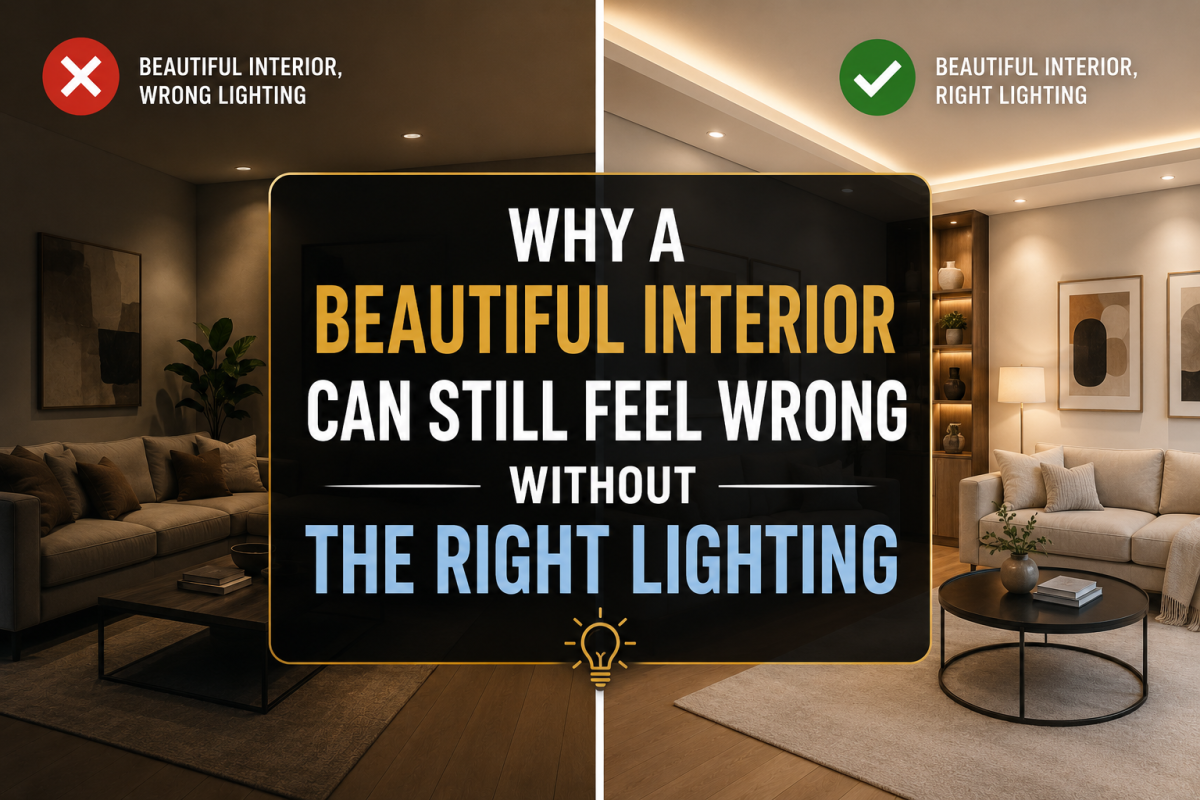
A room can have beautiful furniture, carefully selected colors, expensive finishes, and thoughtful architecture, yet still feel uncomfortable.
Sometimes the problem isn’t the design itself.
It’s the lighting.
Lighting affects how people perceive color, space, texture, proportion, and even mood. A room with excellent daylight and carefully positioned artificial lighting can feel open and inviting, while the same room with poorly positioned fixtures can appear flat, harsh, or unnecessarily dark.
This is why lighting should be considered part of interior design rather than something added at the end.
Lighting Changes How We See a Room
The human eye doesn’t experience a room in isolation from its lighting conditions.
A warm light can make wood, beige, and earthy finishes feel richer. A cooler light can create a cleaner appearance. Strong directional lighting can emphasize texture, while soft illumination can make surfaces appear smoother.
This means the same interior can look noticeably different depending on how it is illuminated.
For designers and homeowners, this is important because selecting furniture and finishes without considering the eventual lighting can produce unexpected results.
Natural Light Comes First
Before choosing artificial fixtures, it’s worth understanding how much natural light the room receives.
A south-facing room may receive strong daylight for much of the day, while another room may depend heavily on artificial lighting. Windows, skylights, neighboring buildings, curtains, and surrounding trees can all influence how much daylight enters a space.
Natural light also changes throughout the day.
Morning light can feel very different from afternoon sunlight, while cloudy weather can dramatically reduce the amount of available illumination.
Artificial lighting therefore needs to work alongside natural light rather than simply replacing it.
One Fixture Rarely Does Everything
A common mistake is expecting one ceiling fixture to illuminate an entire room effectively.
It may technically make the room bright enough to see, but that doesn’t necessarily mean the lighting is comfortable or visually interesting.
Different areas of a room have different needs.
A kitchen countertop requires focused illumination. A reading chair may need a nearby task light. Artwork might benefit from accent lighting, while the rest of the room needs general illumination.
This is why layered lighting is such an important concept in interior design.
Understanding the Main Lighting Layers
Although lighting plans can become quite sophisticated, the basic concept is relatively simple.
Ambient Lighting
Ambient lighting provides general illumination throughout a room. Ceiling fixtures, recessed lights, chandeliers, and other broad sources can contribute to this layer.
Its purpose is to establish the overall brightness of the space.
Task Lighting
Task lighting is more focused.
It provides additional illumination where people perform specific activities, such as cooking, reading, working, grooming, or studying.
Under-cabinet kitchen lighting and desk lamps are common examples.
Accent Lighting
Accent lighting is primarily used to draw attention to something.
Artwork, architectural details, shelving, textured walls, plants, and decorative objects can all become focal points through carefully positioned accent fixtures.
Decorative Lighting
Decorative fixtures can contribute both illumination and visual character.
Pendant lights, chandeliers, wall sconces, and statement fixtures can become design elements in their own right.
These categories can overlap. A pendant, for example, may provide useful task lighting above a kitchen island while also acting as a decorative feature.
Color Temperature Can Change the Atmosphere
Brightness isn’t the only characteristic that matters.
Color temperature influences how warm or cool light appears. Warmer lighting often creates a relaxed atmosphere, making it popular in bedrooms, dining areas, and living spaces.
Cooler light can create a crisp appearance and may be useful in workspaces, kitchens, utility areas, and certain commercial environments.
The ideal temperature depends on the room, finishes, function, and personal preference.
A fixture that looks excellent in a showroom may produce a very different impression once installed in a particular interior.
Shadows Are Part of the Design
Lighting isn’t only about what becomes visible.
It’s also about what remains in shadow.
Shadows create depth and can make architectural surfaces more interesting. However, harsh shadows in the wrong location can make a space uncomfortable or make certain tasks more difficult.
For example, a poorly positioned kitchen light can cause a person to cast a shadow directly across the countertop where they are working.
Good lighting design considers both illumination and shadow.
The Importance of Fixture Placement
Even a high-quality fixture can perform poorly if it is positioned incorrectly.
Recessed lights that are too far apart may leave dark areas between them. Fixtures placed too close to walls may create unwanted hotspots. Pendant lights positioned too low can obstruct views, while those mounted too high may lose their visual impact.
Furniture placement should also be considered.
A lighting plan created before the room layout is understood can require adjustments later.
Lighting Should Support the Room’s Purpose
Different rooms naturally require different lighting strategies.
A bedroom usually benefits from comfortable, softer illumination. A kitchen needs stronger task lighting. A home office may require lighting that reduces visual fatigue. A dining room may need a combination of ambient and decorative lighting.
Commercial spaces add another layer of complexity because lighting may also need to support branding, customer movement, merchandise presentation, and workplace requirements.
The purpose of the room should therefore influence the lighting plan from the beginning.
Why Lighting Decisions Should Happen Early
Waiting until the final stage of an interior project to think about lighting can create unnecessary problems.
Electrical locations may already be determined. Ceiling layouts may be fixed. Furniture positions may have been finalized. Wall finishes may already be selected.
Planning lighting earlier gives designers more flexibility.
It allows them to coordinate fixture positions with furniture, ceiling details, architectural features, and electrical requirements.
This doesn’t mean every fixture must be selected immediately. It simply means lighting should have a place in the design conversation before the major decisions are locked in.
A Practical Way to Plan Interior Lighting
For homeowners or designers starting a new interior project, a simple process can help:
- Identify the primary purpose of each space.
- Evaluate existing natural light.
- Determine where general illumination is needed.
- Identify areas that require task lighting.
- Decide which architectural or decorative features should be highlighted.
- Choose appropriate fixture types.
- Consider color temperature and light quality.
- Review fixture positions alongside the furniture layout.
- Test lighting levels before finalizing the installation where possible.
For a more complete explanation of the different approaches and fixture categories used in residential and commercial interiors, this complete guide to types of lighting in interior design provides a useful reference for planning a balanced lighting scheme.
The Best Lighting Often Goes Unnoticed
Interestingly, successful lighting design doesn’t always draw attention to the fixtures themselves.
Instead, people notice that the room feels comfortable.
They can read without struggling. Kitchen surfaces are properly illuminated. Artwork stands out without excessive glare. Furniture looks natural, and the space has enough variation to avoid feeling flat.
That’s the real goal of good lighting.
The fixtures are tools. The experience of the room is the result.
Final Thoughts
Interior lighting has a much greater influence on design than simply determining whether a room is bright or dark.
It affects atmosphere, functionality, color perception, architectural detail, and the way people move through and experience a space.
By combining natural light with appropriate ambient, task, accent, and decorative sources, designers can create interiors that feel more comfortable and purposeful.
The best lighting plan isn’t necessarily the one with the most fixtures. It’s the one that understands what each part of the room needs and provides the right type of light at the right place.
raaihajannat