
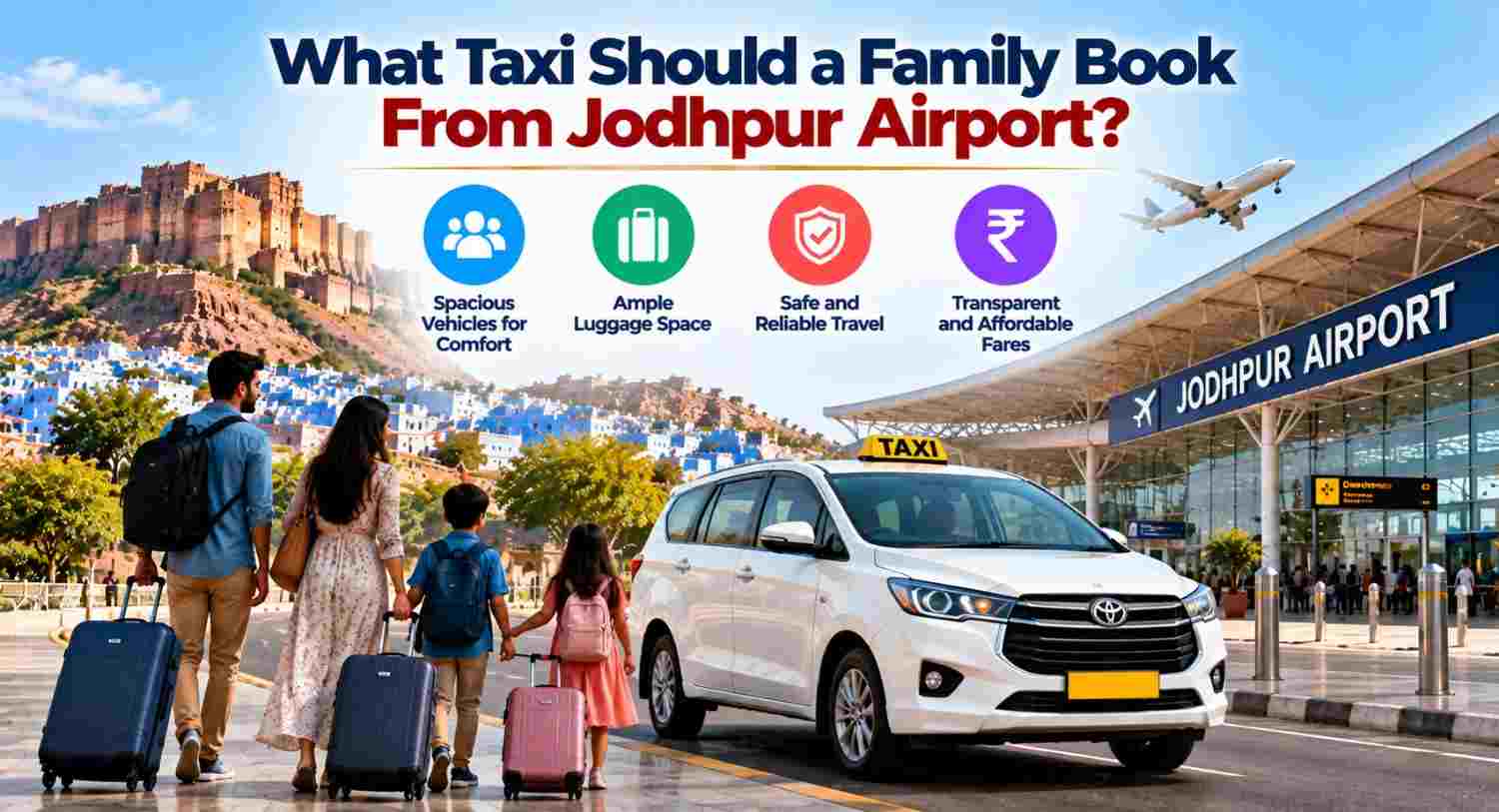
Families arriving at Jodhpur Airport should choose a taxi by matching the vehicle to the people, luggage, destination, and journey length. Passenger count alone can be misleading because luggage or travel equipment can reduce usable space. A sedan may suit a smaller family travelling light, while an SUV, MUV, or larger passenger vehicle may suit a bigger group or longer road journey. The practical choice depends on usable seating, luggage room, boarding comfort, fare structure, and confirmed pickup arrangements rather than the vehicle label alone.
Start With Passengers and Luggage, Not Vehicle Names
A family should count adults, children, senior members, large suitcases, cabin bags, strollers, and any other equipment before comparing vehicle categories. A car may technically have enough seats yet still feel cramped once baggage occupies the boot and part of the cabin.
For a useful booking request, share:
- number of adults;
- number of children;
- number of senior passengers;
- number and approximate size of bags;
- any stroller or bulky equipment;
- destination after the airport;
- expected journey type;
- need for planned stops.
This information allows taxi services in jodhpur to suggest a category that matches practical space requirements instead of relying only on passenger numbers.
When a Sedan May Suit a Small Family
A sedan-type taxi can work well for a smaller family carrying limited luggage, particularly for a city transfer or a moderate onward journey. Two adults with one or two children may find this category practical when the bags fit comfortably in the available boot space.
However, sedan space differs between vehicles. Several large suitcases can make an otherwise suitable car feel restrictive, and rear seating can become uncomfortable if passengers also need to keep bags inside the cabin.
A sedan may therefore suit families that prioritise a compact vehicle and have modest luggage. Before confirming, ask about usable luggage space and make sure the provider knows the full passenger and baggage count.
Why an SUV or MUV Can Make More Sense
Larger passenger vehicles may suit families that need more cabin room, greater seating flexibility, or additional luggage space. They can be particularly practical for a larger family, an outstation journey, or a group travelling with children, senior relatives, and several bags.
However, extra size does not automatically mean unlimited luggage room. If every seat is occupied, luggage capacity can still become tight. Vehicle layouts also differ considerably, so families should ask about the specific category being offered.
A larger vehicle may also carry a higher fare. Compare the additional space with the family’s actual needs rather than choosing a bigger category automatically.
When a Larger Passenger Vehicle Is More Practical
Extended families, wedding groups, and multiple families travelling together may need a vehicle larger than a standard sedan or SUV. This can simplify coordination because more passengers may travel together under one pickup arrangement.
Still, seating configuration and luggage room vary. A group carrying many suitcases, garment bags, or event equipment may need more space than the passenger count suggests.
For very large groups, one bigger vehicle is not always the only practical choice. Two smaller vehicles may provide better luggage distribution, different drop-off options, or additional personal space. The decision should reflect the group’s movement plan as well as cost.
Count Usable Space, Not Just Advertised Seats
Advertised seating does not always describe how comfortable a family will be once everyone and their luggage are inside. A technically available seat may not provide suitable space for a long journey, especially if bags occupy footwells or shared seating areas.
Consider:
- how many seats will actually be occupied;
- where large luggage will be stored;
- whether children need extra equipment;
- whether senior passengers need easier access;
- how long the group will remain in the vehicle;
- whether planned stops require frequent boarding.
For longer road journeys, practical cabin space can matter more than squeezing into the smallest possible category.
Travelling With Children Changes the Space Calculation
Families travelling with children should consider boarding ease, cabin room, luggage, strollers, and other child travel accessories. Even a small stroller can alter the amount of usable boot space, especially when combined with large suitcases.
For longer journeys, planned breaks can also influence the choice because frequent entry and exit may be easier in some vehicle layouts than others.
If the family needs a child seat or another restraint arrangement, confirm availability before booking. Do not assume that such equipment is automatically included with an airport taxi.
Senior Family Members Need Practical Boarding Comfort
A vehicle should suit the boarding needs of senior passengers as well as the total group size. Useful considerations include legroom, ease of entering and leaving the vehicle, seat access, luggage placement, and the ability to take breaks during a longer road journey.
A taller SUV may provide more cabin space, but greater vehicle height may not suit every senior traveller. Conversely, a lower sedan may be easier for some passengers but offer less luggage flexibility.
Discuss the family’s practical requirements before confirmation rather than selecting a category solely because it is larger.
Confirm Airport Pickup Details Before Arrival
An airport pickup works better when the family and driver have precise information. Confirm the arrival date, expected arrival time, passenger name, contact number, passenger count, luggage, destination, and driver communication procedure.
Useful details to check include:
- agreed meeting point;
- pickup contact number;
- destination address or location;
- procedure if the flight is delayed;
- when driver details will be shared;
- what happens if the vehicle cannot be located.
Airport arrangements can vary, so rely on the provider’s confirmed pickup instructions instead of assuming a particular meeting process.
Ask What Happens if the Flight Is Delayed
Flight delays can affect driver waiting, pickup timing, and possibly the final fare. Families should ask how the provider handles a later arrival before paying.
Clarify whether the driver will monitor the updated arrival time, how communication should happen, and whether additional waiting can create an extra charge. Policies differ between providers, so do not assume that waiting is free or unlimited.
Keeping an active contact number available after landing can also make revised pickup coordination easier.
Outstation Journeys Increase the Importance of Comfort
A family travelling directly from the airport to another city, pilgrimage destination, village, resort, or regional location will spend longer inside the vehicle. That increases the importance of legroom, luggage placement, seating arrangement, air-conditioning where applicable, and planned breaks.
Before booking an outstation trip, share any intended food, rest, or pickup stops. Also confirm whether the journey is one-way or return because the booking structure can affect fare terms.
For a longer drive, choosing slightly more usable space can be more practical than filling every available seat.
Wedding and Event Groups Need Extra Planning
Jodhpur airport arrivals for weddings or family events can involve several passengers, large suitcases, garment bags, and relatives landing on different flights. One vehicle may simplify coordination when everyone arrives together, but separate vehicles may work better when arrival times or destinations differ.
Traditional clothing and event luggage can also take more space than ordinary cabin bags.
Before booking, list passenger groups, flight timings, luggage, and final destinations. This information helps determine whether one larger vehicle or multiple smaller vehicles will handle the movement more efficiently.
One Large Vehicle Versus Two Smaller Taxis
One larger vehicle can keep the family together, simplify communication, and create a single pickup arrangement. It may also make shared luggage handling easier when the vehicle has enough baggage space.
Two smaller taxis can make sense when:
- the group is very large;
- luggage volume is substantial;
- passengers have different destinations;
- relatives arrive at different times;
- the family wants more cabin space.
Compare total fare, coordination effort, luggage distribution, and destination plans before choosing either arrangement. Neither option works better for every family.
Estimate Luggage Before Confirming the Vehicle
Do not describe luggage simply as “a few bags”. Tell the provider how many large suitcases, medium bags, cabin bags, strollers, garment bags, or unusually large items the family will carry.
This matters because passenger seating and luggage capacity are separate issues. Four passengers with four large suitcases may require a different category from four passengers with two cabin bags.
If luggage increases after booking, contact the provider before arrival and ask whether the confirmed vehicle still suits the group.
Compare Fare Structure by Vehicle Category
Vehicle category can influence the quoted fare, but it is only one cost factor. Local or outstation use, one-way or return travel, waiting, parking, tolls, additional stops, night charges where applicable, and driver allowance where applicable may also affect the total.
Ask for a clear quotation and identify which items remain outside it.
Larger vehicles can cost more, but choosing the smallest category simply to reduce the base fare may be impractical if luggage or passenger space becomes insufficient.
Compare the Final Payable Amount
A family should compare the expected total cost rather than only an advertised starting fare.
Check:
- included distance or booking scope;
- additional kilometre conditions;
- airport-related charges where applicable;
- toll and parking treatment;
- waiting terms;
- extra-stop charges;
- driver allowance where applicable;
- taxes where applicable.
Use the same itinerary, vehicle category, passenger count, and luggage details when comparing different quotations.
Balance Budget With Practical Suitability
The lowest-cost category may not provide enough room for every family, while the largest available vehicle may add unnecessary expense for a small group carrying little luggage.
Balance six factors:
- passenger count;
- luggage;
- journey length;
- boarding needs;
- desired space;
- final fare.
A small family heading to a nearby hotel may favour a sedan. The same family carrying several large bags for an outstation journey may find a larger category more practical.
Questions to Ask Before Confirming the Vehicle
Ask practical questions before paying:
- Which vehicle category will be provided?
- Will our passengers and luggage fit comfortably?
- How much luggage space is available?
- Is air-conditioning included?
- What does the quoted fare include?
- Are parking or waiting charges additional?
- What happens if the flight is delayed?
- When will driver details be shared?
- Can the vehicle category be changed if luggage increases?
- What happens if the booked vehicle becomes unavailable?
- Are additional stops allowed?
- What are the cancellation terms?
Common Vehicle-Selection Mistakes
Choosing only by the lowest fare can result in insufficient passenger or luggage space. Similarly, selecting a vehicle by advertised seating alone ignores how bags affect usable room.
Other common mistakes include failing to mention children, overlooking senior passengers, assuming child seats are automatically available, ignoring the length of an outstation journey, and leaving pickup instructions vague.
Families should also avoid assuming every fare includes parking, waiting, or additional stops. Clarifying these points early reduces the chance of disagreements after arrival.
A Practical Vehicle-Selection Framework
Use these questions before deciding:
- How many adults are travelling?
- How many children are travelling?
- Are senior passengers joining?
- How many large bags are there?
- Is a stroller or extra equipment being carried?
- Is the journey local or outstation?
- How long will passengers remain in the vehicle?
- Will there be additional stops?
- Does the proposed category provide practical luggage space?
- What does the final fare include?
The answers should determine the vehicle category rather than a general assumption that every family needs the same type.
Conclusion
The appropriate family taxi from Jodhpur Airport depends on usable passenger space, luggage, journey length, boarding needs, destination, and confirmed fare terms. A sedan may suit a smaller group travelling light, while an SUV, MUV, larger passenger vehicle, or multiple taxis may fit more demanding requirements. Avoid selecting solely by the vehicle label, advertised seating, or lowest base fare. Share the full family and luggage details before booking, compare the final payable amount, and confirm pickup, waiting, vehicle, and payment arrangements before arrival.
FAQs
Which taxi category may suit a family of four?
A family of four may fit a sedan, SUV, MUV, or another category depending on how many adults and children are travelling and how much luggage they carry. For a short transfer with limited baggage, a sedan may work. Several large suitcases or a longer journey may justify more space.
Is a sedan enough when the family has several suitcases?
Possibly, but luggage volume matters as much as passenger count. Ask the provider about usable boot space for the quoted vehicle category. If large bags, cabin luggage, or a stroller will not fit comfortably, moving to a larger category can be more practical than placing luggage inside the passenger area.
When should a family consider an SUV or MUV?
A larger category may suit families carrying more luggage, travelling with additional passengers, taking an outstation journey, or wanting greater cabin flexibility. However, space varies between models, and full seating can reduce luggage capacity. Confirm the actual arrangement rather than assuming every SUV or MUV provides the same room.
What vehicle may suit an extended family?
An extended family may need a larger passenger vehicle or more than one taxi, depending on group size, luggage, arrival times, and destinations. One larger vehicle can simplify coordination, while two smaller vehicles can provide more space or serve different drop points. Compare both arrangements before booking.
Should families pre-book an airport pickup?
Pre-booking can help families confirm the vehicle category, luggage requirements, fare terms, pickup procedure, and driver-contact process before arrival. However, booking does not guarantee that every requested category will always remain available. Confirm the reservation details and any substitution procedure close to the journey.
What should families do if their flight is delayed?
Contact the booking provider or driver using the agreed communication process and share the revised arrival information. Before travel, ask how flight delays affect waiting, pickup timing, and possible charges. Policies differ, so families should confirm these terms instead of assuming that unlimited waiting is included.
Are child seats automatically provided in airport taxis?
Do not assume that a child seat or restraint arrangement comes automatically with the taxi. If the family requires one, ask about availability before confirming the vehicle. The provider should clarify what can be supplied, while the family can plan an alternative arrangement if the requested equipment is unavailable.
How should a family estimate luggage requirements?
Count large suitcases, medium bags, cabin bags, strollers, garment bags, and any bulky equipment separately. Share those details with the provider rather than saying only that the family has luggage. The same passenger count can require very different vehicle categories depending on the size and number of bags.
Is one large taxi better than two smaller taxis?
Neither arrangement suits every group. One larger taxi can simplify coordination and keep the family together, while two vehicles may suit excessive luggage, separate destinations, different flight arrivals, or a preference for more cabin room. Compare total fare, luggage distribution, pickup coordination, and destination requirements before deciding.
What should families confirm before making payment?
Confirm the travel date, arrival time, pickup location, destination, passenger count, luggage, vehicle category, quoted fare, inclusions, exclusions, waiting terms, payment conditions, cancellation policy, and driver-contact procedure. Also ask how a replacement vehicle will be handled if the originally planned category becomes unavailable.
New Rajasthan Tours