
Businesses should consider the recipient, product quality, brand identity, packaging, budget, and practical use when designing premium corporate gifts. A well planned gift reflects the company’s values while giving clients, employees, and business partners something useful and memorable. The aim is to create a thoughtful experience rather than simply distribute branded merchandise.
Premium Corporate Gifts Design requires a balance between presentation and purpose. From selecting suitable products to adding personalised details, every decision should reflect the relationship between the business and the recipient. Companies working with a professional gifting studio, such as Studio ABD, can plan gifts that match their brand identity, occasion, and business objectives.
1. Understand Who Will Receive the Gift
The first step is to understand the recipient. A gift intended for a senior client may need a different approach from a welcome kit for new employees or a festive gift for business partners.
Businesses should consider the recipient’s role, preferences, work environment, and relationship with the company. A practical desk accessory may suit an employee, while a carefully assembled collection of premium products may be more appropriate for a valued client.
Before selecting products, ask:
- Is the gift intended for clients, employees, partners, or event attendees?
- Will recipients use it at work or outside the office?
- Does the occasion call for a formal, festive, or personal touch?
- Are there dietary, cultural, or accessibility considerations?
These details help businesses avoid gifts that look impressive but have little relevance to the people receiving them.
2. Match the Gift With Your Brand Identity
Corporate gifts are an extension of a company’s identity. Their colours, materials, design, and presentation should feel consistent with how the business communicates with its audience.
For example, a technology company may prefer functional accessories with a clean design, while a luxury hospitality brand may choose refined materials and carefully arranged gift boxes. The product does not need to carry a large logo to communicate the brand’s character.
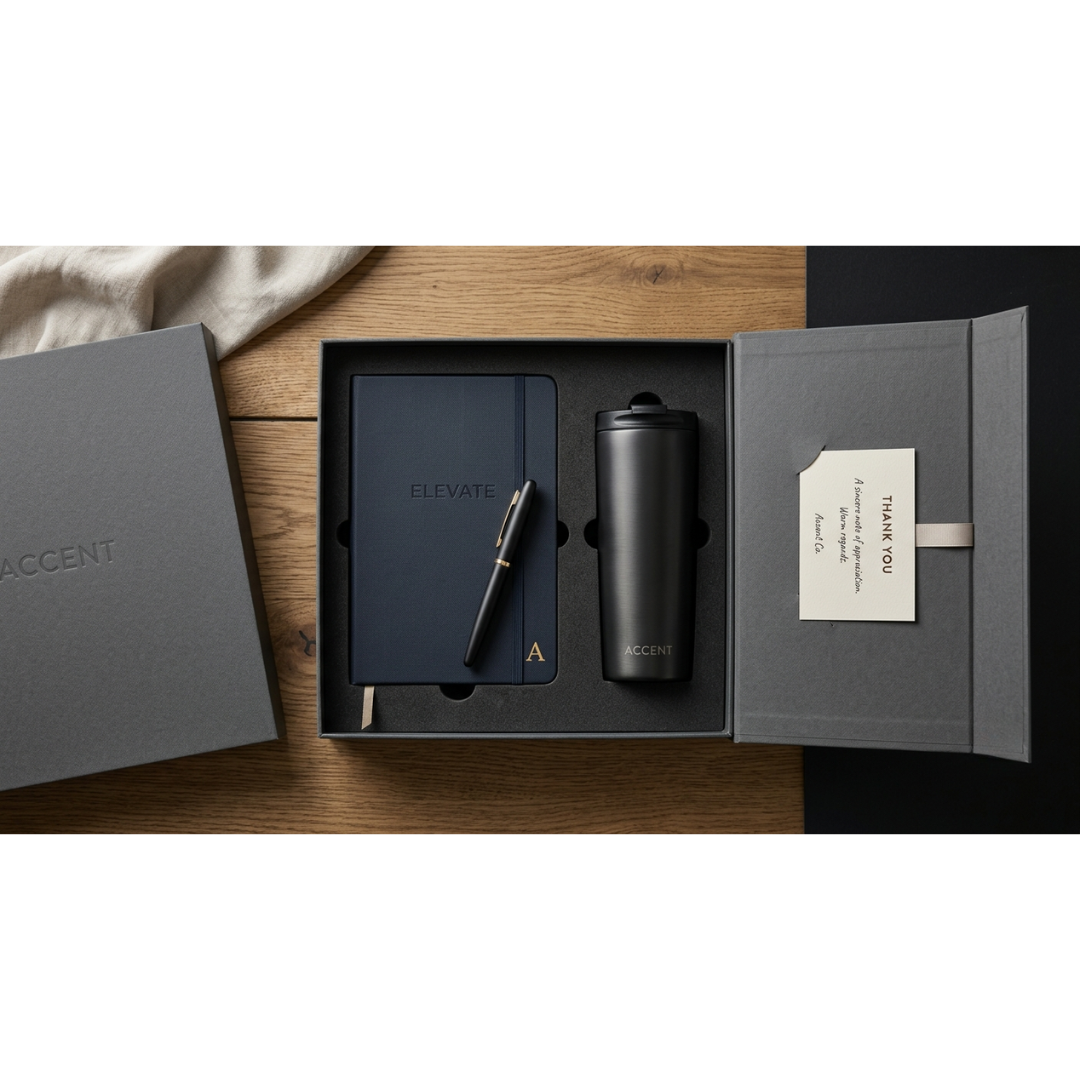
Premium Corporate Gifts Design should reflect the company’s visual identity without making the gift feel like an advertisement. Subtle branding on a notebook, personalised packaging, or a small logo on a useful accessory can create a more professional impression than placing the company name on every item.
Businesses should also consider whether the proposed design fits their existing brand guidelines, including approved colours, typography, logo placement, and tone.
3. Choose Quality Materials and Useful Products
Product quality affects how recipients perceive the business. Poor stitching, weak packaging, damaged finishes, or unreliable accessories can undermine an otherwise thoughtful gift.
The right product depends on the budget and intended use. Common options include premium stationery, drinkware, technology accessories, travel essentials, lifestyle products, and curated gift sets.
When assessing products, businesses should check:
- Material quality and finish.
- Durability under regular use.
- Practical value for the intended recipient.
- Consistency across multiple units.
- Availability of replacement stock if required.
It is also important to inspect samples before approving a large order. A product that looks good in a catalogue may feel different in person. Sample checks help teams assess weight, colour accuracy, packaging fit, and overall presentation before committing to production.
4. Pay Attention to Packaging and Presentation
Packaging shapes the recipient’s first impression. Even a useful product can feel ordinary when it arrives in poorly fitted packaging, while thoughtful presentation can make a simple collection feel carefully planned.
Consider the complete unboxing experience. The outer box, internal arrangement, protective inserts, message card, and product placement should work together. Items should remain secure during transport and arrive without scratches, dents, or damaged corners.
Packaging should also suit the occasion. A formal client gift may call for restrained colours and a clean layout, whereas an annual celebration may allow more festive details.
Businesses ordering gifts in large quantities should request a finished packaging sample. This helps confirm that the approved design can be reproduced consistently across the entire order.
5. Personalise Without Making the Gift Complicated
Personalisation can make corporate gifting feel more considered. However, adding too many customised elements may increase production time, cost, and the risk of errors.
Useful options include a recipient’s name, a short handwritten message, a customised sleeve, or a card explaining the purpose of the gift. For employee welcome kits, a message from the team can make the package feel more personal. For important clients, a note acknowledging the professional relationship may be more appropriate.
Keep personalisation readable and relevant. Check spelling, names, logo files, and artwork before production begins. For larger orders, maintain an approved list of recipients and their individual details to reduce mistakes.
6. Set a Realistic Budget and Production Timeline
The cost of corporate gifting includes more than the product itself. Packaging, printing, personalisation, assembly, delivery, and taxes can all affect the final amount.
Businesses should establish a budget per recipient and calculate the total cost for the complete order. They should also reserve some flexibility for shipping changes, sample revisions, or last minute quantity adjustments.
Production timing deserves equal attention. Festive gifting, annual conferences, employee onboarding, and client events often have fixed delivery dates. Late approvals can affect product availability, printing schedules, and dispatch.
A practical timeline should include product selection, sample approval, artwork confirmation, production, quality checks, and delivery. Sharing the required delivery date at the beginning helps the gifting partner recommend realistic options.
7. Consider Sustainability and Responsible Sourcing
Many businesses now consider the environmental impact of their corporate gifts. This can influence product materials, packaging choices, supplier selection, and the useful life of each item.
Reusable products, durable materials, recyclable packaging, and locally sourced options may be appropriate, depending on availability and the purpose of the gift. Businesses should ask suppliers for clear information about material claims rather than relying on labels alone.
Avoid unnecessary fillers, oversized boxes, and products that recipients are unlikely to use. A smaller collection of well made items can be more practical than a large assortment assembled only to fill a box.
8. Work With a Corporate Gifting Partner
Managing corporate gifting internally can involve several suppliers, repeated approvals, artwork coordination, packaging checks, and delivery arrangements. A gifting partner can help bring these tasks together and keep the process organised.
When evaluating a studio, review its design approach, product range, customisation options, sample process, production capacity, and ability to manage the required quantity. Ask how it handles quality issues, delivery schedules, and changes after approval.
Studio ABD can be considered by businesses seeking a design focused approach to corporate gifting. Before proceeding, discuss the audience, occasion, budget, quantity, and branding requirements so the proposed gift collection suits the actual brief.
A clear process from initial concept to final delivery makes it easier to maintain consistency and reduce avoidable production issues.
9. Measure the Value of Corporate Gifting
Corporate gifting can support client relationships, employee recognition, and business events, but its value should not be judged by appearance alone.
Businesses can assess the response through recipient feedback, employee participation, client appreciation, and the usefulness of the products over time. For event gifts, teams can also review whether the items suited the audience and whether delivery was completed as planned.
For future orders, record which products were well received, which packaging choices worked, and where costs or timelines could be improved. These observations help businesses make better gifting decisions without repeating the same mistakes.
Conclusion
Designing effective corporate gifts requires more than selecting expensive products. Businesses need to understand their recipients, maintain consistent branding, choose dependable materials, plan packaging, and account for production costs and delivery schedules.
A thoughtful Premium Corporate Gifts Design approach brings these details together while keeping the recipient’s experience at the centre. Working with a design focused gifting partner such as Studio ABD can help businesses develop gift collections that reflect their identity and suit specific professional occasions. The most successful gifts are those that combine quality, usefulness, and thoughtful presentation.
Frequently Asked Questions
Q.1 What makes a corporate gift feel premium?
Ans. High quality materials, useful products, careful packaging, neat finishing, and relevant personalisation help a corporate gift feel premium. The overall experience matters more than the price alone.
Q.2 How should businesses choose corporate gifts for clients?
Ans. Businesses should consider the client’s professional role, preferences, relationship with the company, and the occasion. Practical, well presented gifts with subtle branding are often a suitable choice.
Q.3 How much should a company spend on premium corporate gifts?
Ans. The budget depends on the recipient group, order quantity, occasion, and product selection. Companies should account for packaging, customisation, assembly, and delivery in addition to the product cost.
Q.4 Why is packaging important in corporate gifting?
Ans. Packaging protects the products during delivery and shapes the recipient’s first impression. Good packaging also keeps the gift organised and creates a consistent brand experience.
Q.5 When should businesses start planning corporate gifts?
Ans. Businesses should start planning as soon as the occasion, quantity, and budget are known. Early planning allows enough time for product selection, samples, artwork approval, production, and delivery.
Q.6 What should businesses look for in a corporate gifting studio?
Ans. Look for relevant product options, thoughtful design, customisation capabilities, clear pricing, sample approvals, quality checks, and reliable delivery planning. These factors help businesses manage the order with fewer surprises.
Rita Sharma