
Walk into any high-volume dessert operation, and you’ll notice one thing: consistency matters.
Whether it’s a hotel restaurant serving 200 guests a night or a patisserie offering signature frozen desserts, the quality needs to stay the same across every batch.
That’s where prepared base formulations come in.
This blog explains what these formulations are, how they function in commercial production, and where they fit into a professional operation.
What Exactly Is a Ice Cream Mix for Frozen Desserts?
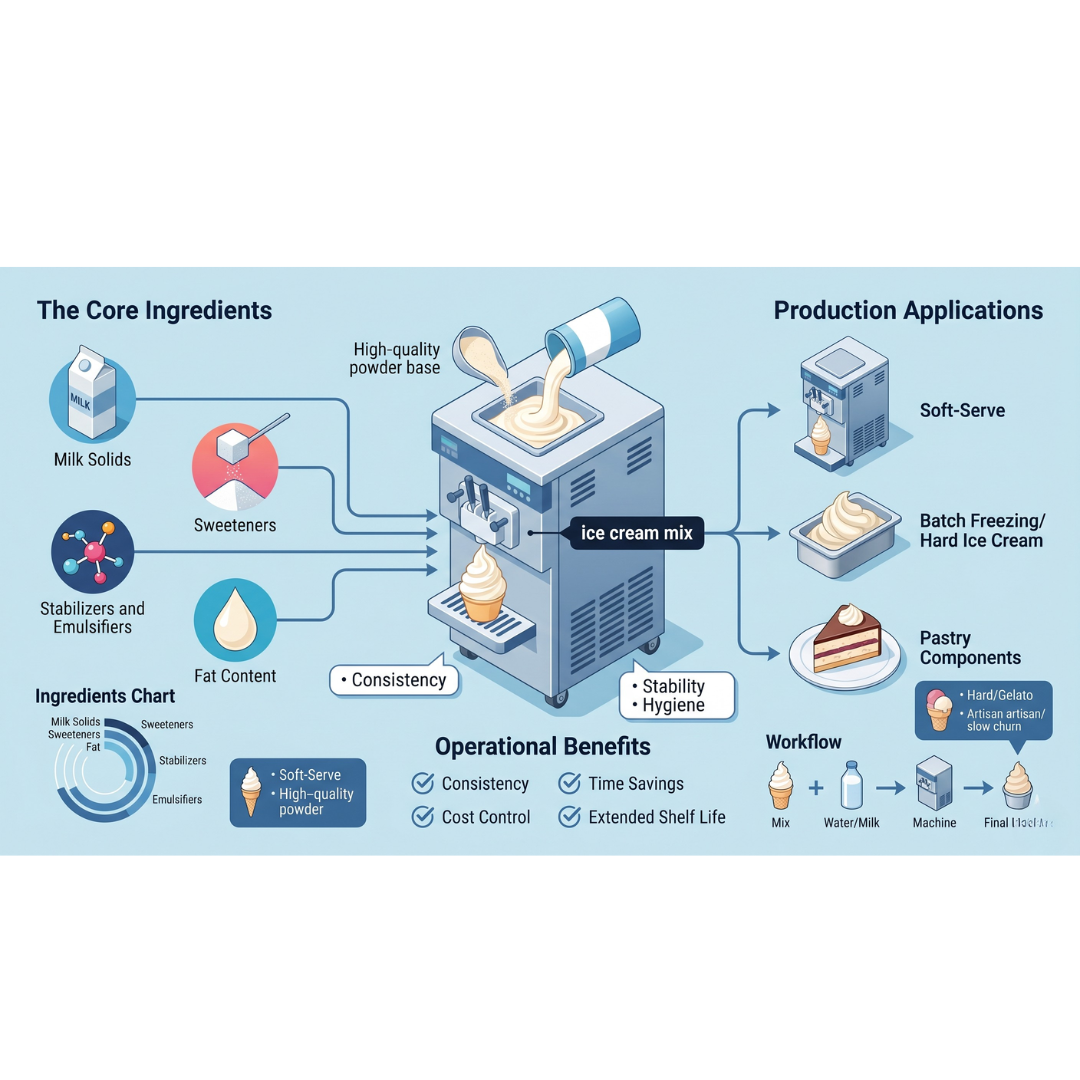
In simple terms, an ice cream mix or a soft serve mix is a ready-to-use powder or liquid formulation that contains milk solids, sugar, stabilizers, emulsifiers, and sometimes fat.
It replaces the need to source and measure each ingredient separately.
The formulation is designed to be mixed with water or milk, then processed through a batch freezer or soft-serve machine.
It allows faster production without compromising texture or shelf stability.
For chefs and production teams working under time constraints, it reduces prep time and eliminates guesswork.
Core Ingredients in a Commercial Frozen Dessert Base
Understanding what goes into the formulation of a soft serve mix helps you assess product quality and adjust processes when needed.
Most commercial bases include the following:
- Milk solids: These provide body and contribute to a creamy texture.
- Sweeteners: Usually sucrose or a blend that controls freezing point and sweetness.
- Stabilizers: Guar gum, locust bean gum, or carrageenan help prevent ice crystal formation.
- Emulsifiers: Mono- and diglycerides improve air incorporation and smoothness.
- Fat content: May be included or added separately depending on the product type.
Some formulations are neutral and meant to be flavored post-mixing.
Others come pre-flavored with vanilla, chocolate, or fruit bases.
How These Formulations Are Used in Production
The application varies based on equipment and output volume.
Soft-Serve Operations
Soft-serve machines are common in quick-service dessert counters and buffet setups.
The mix is reconstituted according to label instructions, poured into the machine hopper, and dispensed on demand.
Because the product is served immediately, these mixes are formulated for a slightly higher overrun and softer consistency.
Batch Freezing for Hard Ice Cream
In patisseries and hotels with gelato or premium frozen dessert programs, batch freezers are the standard.
The prepared base is blended, aged if needed, then churned in a controlled environment.
This method allows for tighter control over texture, density, and flavor infusion.
Pastry Components and Plated Desserts
Chefs also use frozen bases to create components like semifreddos, parfaits, and molded inserts.
The same formulation that works in a machine can be adapted for manual production when portioned and frozen in molds.
Why Commercial Operations Prefer an Ice Cream Mix ?
Time savings is the most obvious benefit, but it’s not the only one.
- Consistency across batches becomes easier to maintain. When every scoop tastes the same, customer expectations are met without constant supervision.
- Inventory management simplifies. Instead of stocking six or seven separate dry ingredients, you handle one SKU. This reduces supplier coordination and storage complexity.
- Labor costs drop. Junior team members can handle preparation with minimal training. That frees up experienced pastry chefs for more technical work.
- Shelf life extends. Powdered mixes, when stored properly, last longer than fresh dairy. This reduces waste and allows bulk purchasing.
What to Look for When Selecting a Base
Not all products perform the same way. Here are a few factors worth checking before committing to a supplier.
- Fat content: Higher fat usually means richer mouthfeel but also higher cost. Choose based on your target product profile.
- Overrun capability: Some formulations are built for high air incorporation. Others are denser. Match this to your equipment and style.
- Flavor neutrality: If you plan to add your own flavoring, make sure the base doesn’t have a strong residual taste.
- Reconstitution ratio: Check how much water or milk is needed. This affects your yield per kilogram and final cost per serving.
- Allergen profile: Dairy content, soy lecithin, and nut derivatives may be present. Verify this for transparency with your service team.
Adjusting Recipes Around a Commercial Base
Even though the formulation is standardized, there’s room for customization.
You can:
- Fold in fruit purees, chocolate chunks, or nut pastes after the initial churn.
- Infuse the liquid mix with tea, spices before freezing.
Texture can be modified by adjusting churn time or tempering protocols.
If you want a denser gelato-style product, reduce overrun and age the mix longer before processing.
Just be mindful that adding too much inclusion or liquid flavoring may affect freeze point and structure.
Common Misconceptions About Prepared Bases
Some professionals assume that using a pre-formulated base means sacrificing quality. That’s not accurate.
Premium ice cream mixes are used by Michelin-listed restaurants and award-winning pastry chefs. The difference lies in how the product is handled, flavored, and presented.
Another misconception is that all mixes taste the same. Formulations vary widely. Blind taste tests often show significant differences in sweetness, creaminess, and aftertaste.
Lastly, some believe these products are only for high-volume, low-margin operations.
In reality, they’re equally useful in boutique settings where consistency and speed support a curated menu.
Storage and Handling Best Practices
Powdered soft serve mix or ice cream mixes should be stored in a cool, dry area away from moisture and strong odors. Once opened, reseal tightly or transfer to airtight containers.
Liquid mixes require refrigeration and should be used within the timeframe indicated on packaging or need to be used as per the directions if using a commercial soft serve machine.
After reconstitution, treat the mixture like any other dairy product.
Keep it chilled, avoid cross-contamination, and don’t let it sit at room temperature for extended periods.
If you’re using a soft-serve machine, clean and sanitize it daily.
Residual product can affect flavor and create bacterial growth.
Final Thoughts
Using a standardized base formulation doesn’t limit creativity.
It provides a reliable foundation that supports consistency, cost control, and faster turnaround in commercial production.
Whether you’re running a patisserie with daily gelato offerings or managing dessert service in a high-volume hotel, understanding how these products work helps you make smarter decisions.
Choose based on your equipment, volume, and product vision.
Test before committing.
And don’t be afraid to treat the base as a starting point rather than a finished product.
Frequently Asked Questions
Q.1 Can a powdered base be used in both soft-serve and batch freezers?
Ans: Yes, but performance may vary. Some formulations are tailored for specific equipment. Check the product label or consult your supplier to confirm compatibility with your machine type.
Q.2 How long can reconstituted mix be stored before use?
Ans: Most reconstituted mixes should be used within 24 to 48 hours if kept refrigerated or depends as per the soft serve machine. Always refer to manufacturer guidelines, as formulations differ in stability and dairy content.
Q.3 Does using a prepared base affect the final overrun?
Ans: The base itself doesn’t dictate overrun. Your machine settings, churn time, and mix temperature control that. However, some formulations are engineered to support higher or lower air incorporation.
Q.4 Can I add liquid flavorings to the ice cream mix?
Ans: Yes, but do so carefully. Alcohol lowers the freezing point, which can result in a softer texture. Limit additions to small percentages and test before scaling up production.
Q.5 Are there vegan or dairy-free versions available?
Ans: Yes. Many suppliers now offer plant-based formulations using coconut milk powder, almond derivatives, or oat solids. Performance and flavor differ, so sample before committing to menu integration.
Rita Sharma