
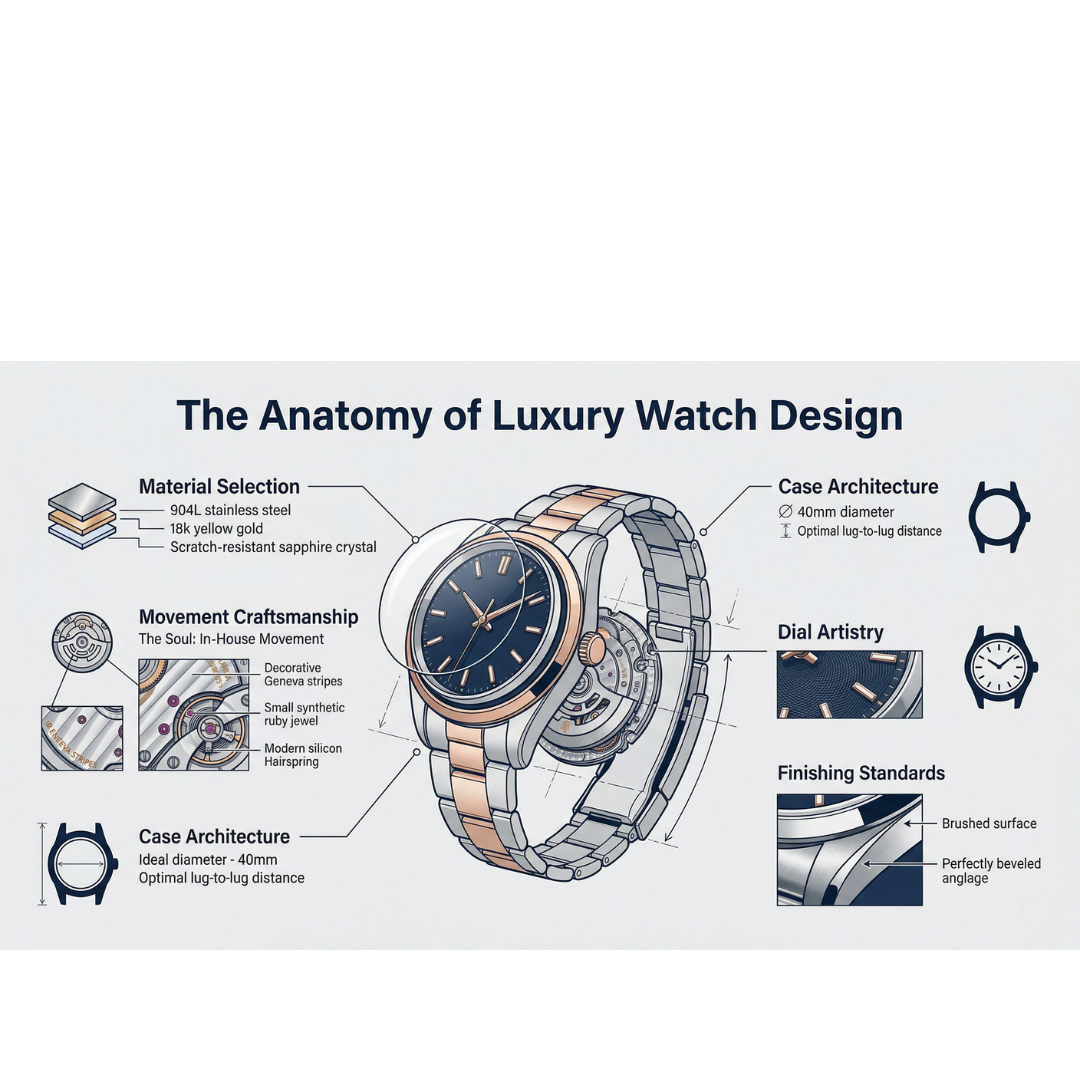
Luxury watch design is defined by a combination of material quality, movement craftsmanship, case architecture, dial artistry, and finishing standards that separate fine timepieces from mass produced alternatives.
It is not about adding diamonds or inflating a price tag. It is about discipline in design, precision in engineering, and restraint in execution.
Let me walk through each of these elements in detail so you understand what actually makes a timepiece worthy of that designation.
Material Selection Sets the Foundation
The choice of materials tells you almost everything about a watchmaker’s intent. Steel is common, but the grade matters. Most reputable manufacturers use 904L stainless steel or proprietary alloys that resist corrosion and hold a polish far better than standard 316L steel used in lower tier watches.
Beyond steel, you will find:
- 18k gold in white, rose, or yellow variations
- Platinum, which is heavier and more difficult to machine
- Titanium, preferred for its strength to weight ratio
- Ceramic, used for scratch resistance on bezels and cases
- Sapphire crystal, which is nearly impossible to scratch under normal wear
Material choice also affects how a watch ages.
A well made gold case develops a patina over decades. Cheap plating peels within months. That difference is felt, not just seen.
Movement: The True Measure of Quality
If materials are the body, the movement is the soul. In serious watchmaking, movements are designed, assembled, and tested in house.
This is what separates brands like Patek Philippe, A. Lange & Söhne, and Jaeger LeCoultre from fashion brands using generic Swiss or Japanese calibers.
Key Movement Characteristics in Fine Timepieces
- Hand finished bridges and rotors with Geneva stripes or perlage
- Jeweled bearings to reduce friction at critical points
- Free sprung balance wheels for more precise timekeeping
- Silicon hairsprings that resist magnetic interference
- Power reserves often exceeding 60 hours
A finished movement is meant to be seen. That is why many high end watches feature exhibition case backs.
The decoration on a movement is not cosmetic. It reflects the care taken during assembly and serves as proof that the maker invested real hours into something most owners will rarely look at.
Case Architecture and Proportions
A well designed case is about proportion, not size.
The trend toward oversized watches peaked around 2015. Today, informed buyers favor cases between 36mm and 41mm, a range that sits comfortably on most wrists.
But dimensions alone do not tell the full story.
Lug to lug distance, case thickness, and the angle at which lugs curve toward the wrist all affect wearability.
A 40mm watch with short, downward curving lugs will wear better than a 38mm piece with flat, extended lugs.
Water resistance, crown guards, bezel construction, and case back finishing also contribute to the overall architecture.
Each of these must be designed together, not treated as separate components bolted on.
Dial Craftsmanship Is Where Art Meets Function
The dial is where luxury watch design becomes immediately visible.
Techniques like grand feu enamel, guilloché engraving, meteorite finishing, and hand painted indices are time intensive and require trained artisans.
A simple looking white dial on a Calatrava, for example, involves multiple layers of lacquer, each applied and dried separately before printing.
Sunburst finishes on sports models are achieved through precise radial brushing that catches light differently at every angle.
Applied hour markers, rather than printed ones, add depth.
When those markers are individually machined and polished, the dial gains a three dimensional quality that flat printing cannot replicate.
Bracelet and Strap Integration
A watch is only as comfortable as its bracelet or strap.
Poorly finished bracelets with loose tolerances ruin even the best designed cases.
In well made pieces:
- Bracelets are designed to articulate smoothly
- Each link is polished on multiple surfaces
- Clasp mechanisms are engineered to sit flush with the bracelet
- Rubber and leather straps are shaped to follow the natural curve of the wrist rather than lying flat
Brands that take this seriously often design proprietary quick release systems and micro adjustment clasps so owners can fine tune the fit without tools.
Finishing Standards Most Buyers Overlook
The level of finishing on a timepiece is one of the clearest indicators of its tier.
Beveled edges on the case, polished screw heads, brushed surfaces alternating with mirror polished accents: these are details you feel when you hold the watch.
On the movement side, anglage (beveling of edges by hand) is one of the most labor intensive tasks in watchmaking.
A single bridge can take hours to finish properly.
This is why watches from independent makers like F.P. Journe or MB&F command the prices they do.
Why All of This Matters for the Buyer
Understanding these elements helps buyers make informed decisions.
A watch priced at $10,000 should demonstrate a clear advantage in at least three of the areas listed above when compared to one priced at $2,000.
If it does not, you are paying for branding, not substance.
Luxury watch design in the modern market rewards those who look closely.
The best pieces are not always the most expensive.
They are the ones where every decision, from the alloy of the case to the texture of the crown, reflects a coherent design philosophy backed by real craftsmanship.
Conclusion
The defining elements of a fine timepiece go well beyond brand recognition or price.
Material integrity, movement finishing, case proportions, dial artistry, and bracelet quality each play a measurable role.
Buyers who understand these factors spend more wisely and appreciate their watches on a deeper level.
The real value of luxury watch design lies in the accumulation of small, deliberate choices made by skilled people.
Frequently Asked Questions
Q.1 What makes a watch movement “in house”?
An in house movement is designed, manufactured, and assembled by the brand itself rather than sourced from a third party supplier.
This gives the maker full control over quality and performance.
Q.2 Is a higher price always a sign of better quality?
Not necessarily.
Some brands charge premiums based on marketing and brand positioning.
A lesser known independent maker may offer superior finishing and movement quality at a lower price.
Q.3 How important is water resistance in a dress watch?
Most dress watches offer 30m to 50m of water resistance, which is sufficient for daily wear.
If you need a watch for swimming or diving, a purpose built sports model is the better choice.
Q.4 Does the size of a watch affect its value?
Size does not directly affect value, but proportions matter.
A well proportioned case that fits the wrist properly tends to hold its appeal and resale value better than oversized models driven.
Rita Sharma