
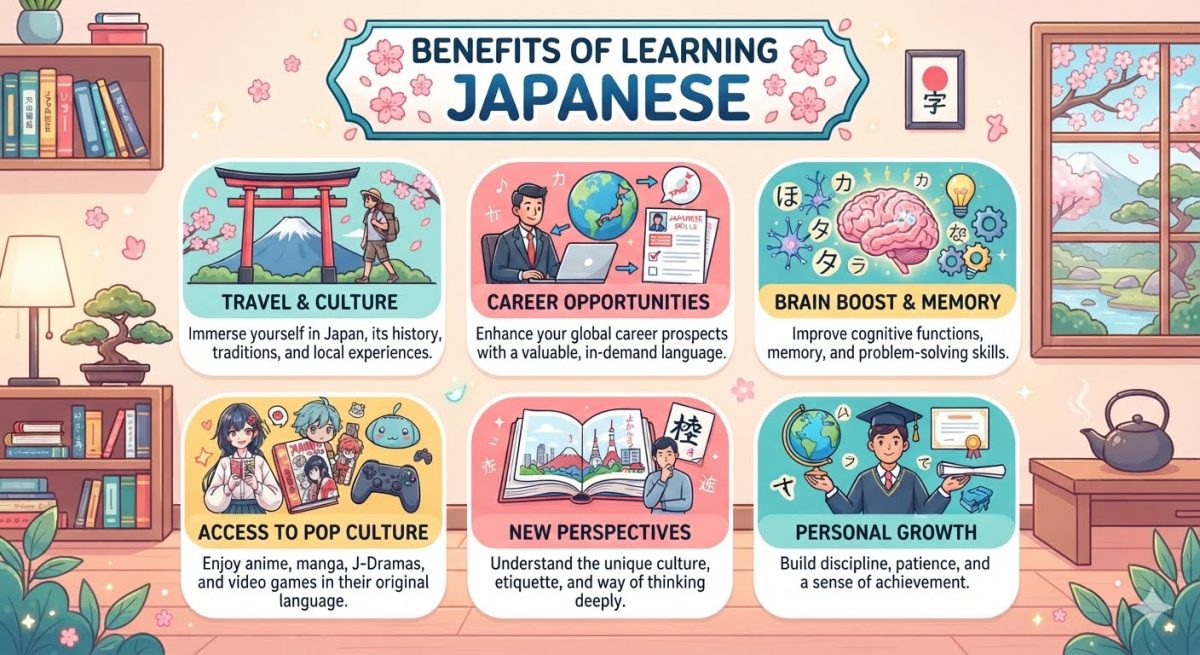
The benefits of learning Japanese for students include sharper memory, better career options in tech, business, and translation, access to top Japanese universities, and deeper cultural understanding. Quality Japanese language learning also builds discipline, boosts problem-solving skills, and opens doors to scholarships, exchange programs, and global job markets that most students never consider.
Why Japanese Language Skills Matter for Students Today
If you’re a student wondering whether Japanese is worth your time, you’re not alone. Thousands of students every year ask the same question before picking up a textbook or signing up for a class. And honestly, the benefits of learning Japanese go far beyond just being able to order ramen in Tokyo.
Japan is the third-largest economy in the world. It’s home to global giants like Toyota, Sony, Nintendo, and Honda. It also runs one of the most respected education systems on the planet. When you combine that with Japan’s unique writing system, rich history, and growing demand for bilingual professionals, it becomes clear why quality Japanese language learning is one of the smartest academic investments a student can make right now.
Top Benefits of Learning Japanese for Students
1. Academic Benefits
Learning Japanese isn’t just about vocabulary. It rewires how your brain handles information.
- Improved memory retention – Japanese uses three writing systems (Hiragana, Katakana, and Kanji), and memorizing thousands of Kanji characters strengthens long-term memory far more than learning alphabet-based languages.
- Better focus and discipline – Because Japanese grammar and script are so different from English, students naturally develop stronger study habits and patience.
- Higher scores in other subjects – Multiple studies on bilingual learners show that students studying a second language, especially a complex one like Japanese, tend to perform better in math, logic, and reading comprehension.
- Scholarship opportunities – Japan’s MEXT scholarship and many university exchange programs give priority to students who already show interest or basic proficiency in Japanese.
This is one of the most overlooked benefits of learning Japanese: it doesn’t just teach you a language, it trains your brain to learn everything else faster.
2. Career and Professional Benefits
This is usually the biggest motivator for students, and for good reason.
- Access to Japanese companies – Japan actively recruits foreign talent fluent in Japanese for roles in engineering, IT, gaming, animation, robotics, and manufacturing.
- Translation and localization jobs – With anime, manga, and Japanese tech products in global demand, skilled translators and localizers are consistently needed.
- Higher salary potential – Bilingual employees with Japanese proficiency often earn 10–20% more than monolingual peers in similar roles, especially in trade, diplomacy, and tech sectors.
- Competitive edge in job applications – A resume listing JLPT (Japanese Language Proficiency Test) certification instantly stands out to recruiters in international companies.
Quality Japanese language learning at the student stage means you’re building a career advantage years before your competition even starts thinking about it.
3. Cognitive and Brain Benefits
Neuroscience research consistently shows that learning a structurally different language like Japanese offers unique brain benefits:
- Strengthens problem-solving and multitasking abilities
- Delays cognitive decline and improves memory in later life
- Enhances creativity by exposing the brain to new sentence structures and logic patterns
- Builds better listening and pattern-recognition skills, useful in coding, music, and math
4. Cultural and Personal Benefits
Beyond grades and job offers, there’s a personal side to this too.
- Deeper appreciation of anime, manga, and Japanese cinema without relying on translations
- Confidence to travel independently across Japan
- Stronger cross-cultural communication skills, valuable in any global career
- Access to Japanese literature, philosophy, and history in their original form
Benefits of Learning Japanese at a Glance
| Category | Key Benefit | Long-Term Impact |
|---|---|---|
| Academic | Improved memory & focus | Better grades overall |
| Career | Access to Japanese companies | Higher salary potential |
| Cognitive | Sharper problem-solving | Delayed cognitive decline |
| Cultural | Understanding media & history | Global mindset |
| Travel | Independent navigation in Japan | Confidence & networking |
What Makes Quality Japanese Language Learning Different
Not all Japanese courses are created equal, and this is where many students go wrong. Quality Japanese language learning isn’t about memorizing random phrases from an app for ten minutes a day. It involves:
Structured Curriculum
A good program follows the JLPT levels (N5 to N1) in order, ensuring you build a strong foundation in grammar, Kanji, and conversation before moving to advanced topics.
Native-Level Instruction
Learning from certified native speakers or teachers trained in Japanese pedagogy ensures correct pronunciation, natural sentence flow, and cultural context that self-study often misses.
Practical Application
Quality programs include speaking practice, listening exercises, and real-world scenarios, not just textbook grammar drills.
Consistent Feedback
Regular assessments and corrections help students avoid forming bad habits early on, which are much harder to fix later.
How Students Can Start Quality Japanese Language Learning
- Set a clear goal – Are you learning for travel, career, or academic credit? Your goal shapes your study plan.
- Choose a structured course – Whether it’s a school program, online course, or certified tutor, structure matters more than speed.
- Practice daily, even briefly – 20–30 minutes of consistent practice beats a 3-hour cram session once a week.
- Use immersion tools – Japanese podcasts, anime with Japanese subtitles, and language exchange apps reinforce classroom learning.
- Track progress with JLPT prep – Even if you don’t plan to take the exam, JLPT materials are excellent for measuring real progress.
FAQ’s:-
1. What is the biggest benefit of learning Japanese as a student?
The biggest benefit is the combination of cognitive growth and career opportunity. Students who learn Japanese often see improved memory and problem-solving skills alongside real job prospects in tech, translation, and international business.
2. How long does it take a student to become fluent in Japanese?
On average, reaching conversational fluency takes 2–3 years of consistent study, while academic or business fluency (JLPT N2/N1) can take 3–5 years depending on study intensity.
3. Is Japanese hard to learn for beginners?
Japanese has a reputation for being challenging due to Kanji and grammar structure, but with quality Japanese language learning methods and consistent practice, most students find steady progress within the first few months.
4. Can learning Japanese help with scholarships?
Yes. Programs like Japan’s MEXT scholarship and various university exchange programs favor applicants with demonstrated Japanese language ability, even at a basic level.
5. What careers benefit most from Japanese language skills?
IT, engineering, translation, international trade, tourism, gaming, and animation industries are the top sectors actively seeking Japanese-speaking professionals.
6. Do I need to learn Kanji to speak Japanese well?
While basic conversation is possible without Kanji, reading and writing fluently requires learning Kanji, especially for academic or professional use in Japan.
7. Is online Japanese learning as effective as classroom learning?
Quality Japanese language learning can be highly effective online if the course is structured, includes speaking practice, and offers feedback from qualified instructors.
8. What is the JLPT and why does it matter?
The Japanese Language Proficiency Test (JLPT) is the internationally recognized standard for measuring Japanese ability, from N5 (beginner) to N1 (advanced), and is often required for jobs or university admission in Japan.
About the Author
This article was written by an education content specialist with experience researching language-learning methodologies and student career development. Content is reviewed for accuracy using publicly available data from language education researchers and official Japanese language proficiency resources.
About Us
We create research-backed educational content to help students make informed decisions about language learning, career paths, and academic growth. Our goal is simple: original, trustworthy, and genuinely helpful information.
Contact
Have a question about this article or a topic you’d like us to cover? Reach out through our contact page, and our editorial team will get back to you.

james05