
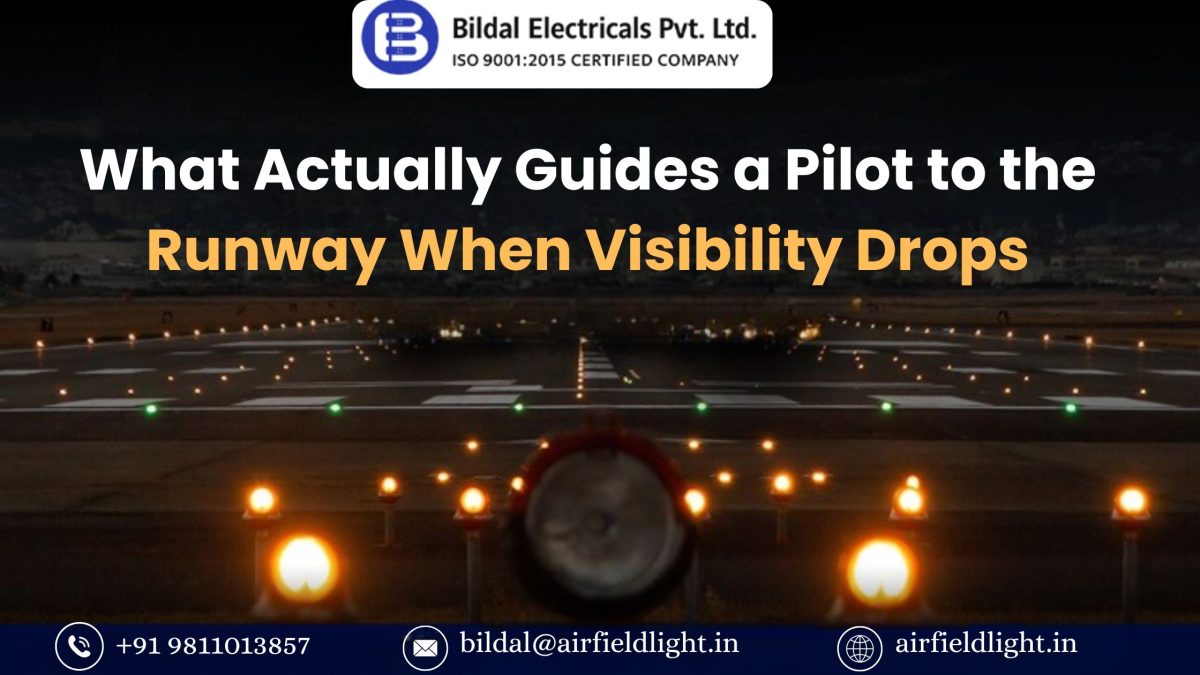
Fog rolls in fast. Visibility drops from kilometres to meters in minutes. And somewhere up there, a pilot on approach is making decisions based entirely on what they can see — or more accurately, what the lighting on the ground is telling them.
This is what airport lighting aids actually do. Not decoration. Not compliance theatre. Real spatial information delivered through light, in real time, when everything else is unreliable.
The Lights That Make the Difference
Airport visibility aids cover more ground than most people realize. Approach lighting sequences pull pilots from instrument flight toward visual contact with the runway. Airport landing lights mark the threshold — where the usable surface begins. Runway landing lights define the edges and centerline so pilots know exactly what width they’re working with during touchdown.
Every colour, every flash pattern, every intensity level is deliberate. White, red, green — each tells the pilot something different about position, alignment, and clearance. Get any of it wrong, and the information pilots depend on becomes misleading rather than helpful.
Pilot-Controlled and Radio-Controlled Runway Lights
Smaller airports and remote airstrips often rely on pilot-controlled runway lights — systems the pilot activates directly via radio-frequency clicks from the cockpit. No tower, no ground crew needed. The pilot keys the mic a specific number of times, and the runway lights up.
Radio-controlled runway lights work on the same principle but with slightly different activation configurations depending on the system design. Both approaches give pilots operational control over lighting when permanent staffing isn’t practical, which covers a significant number of general aviation airports across India and globally.
Bildal Electricals supplies and installs these systems with the technical depth the application demands. Whether it’s a full approach lighting setup or a pilot-controlled system for a remote strip, the equipment is built and sourced to actual aviation standards — not approximations of them.
If your airfield lighting needs a proper review, Bildal Electricals is where that conversation starts.
Frequently Asked Questions
1. What are airport lighting aids used for?
They give pilots the spatial references needed to land safely — where the runway is, where it starts, how wide it is, and whether the approach angle is correct. Without them, low visibility conditions make visual approaches genuinely dangerous regardless of how good the aircraft’s instruments are.
2. How do pilot-controlled runway lights work?
The pilot keys the aircraft radio mic a set number of times on a designated frequency. The system detects the clicks and activates the runway lights automatically. No tower staff required, which makes it practical for smaller and remote airfields that don’t have 24-hour operations.
3. Why does equipment quality matter for runway landing lights?
because these systems operate continuously in outdoor conditions — heat, rain, dust, and physical impacts from ground vehicles — and still need to perform perfectly every single time. Bildal Electricals sources equipment built specifically for aviation applications, not adapted from general lighting stock. That difference shows up in reliability and compliance over the long term.
Bildal Electricals Pvt. Ltd.