
The hair extension industry relies on more than product quality alone. Presentation, protection, storage, and customer experience all influence how hair products are perceived and handled. Whether a business sells human hair extensions, synthetic wigs, clip-in extensions, or professional salon supplies, suitable packaging helps keep products organised while creating a consistent brand identity.
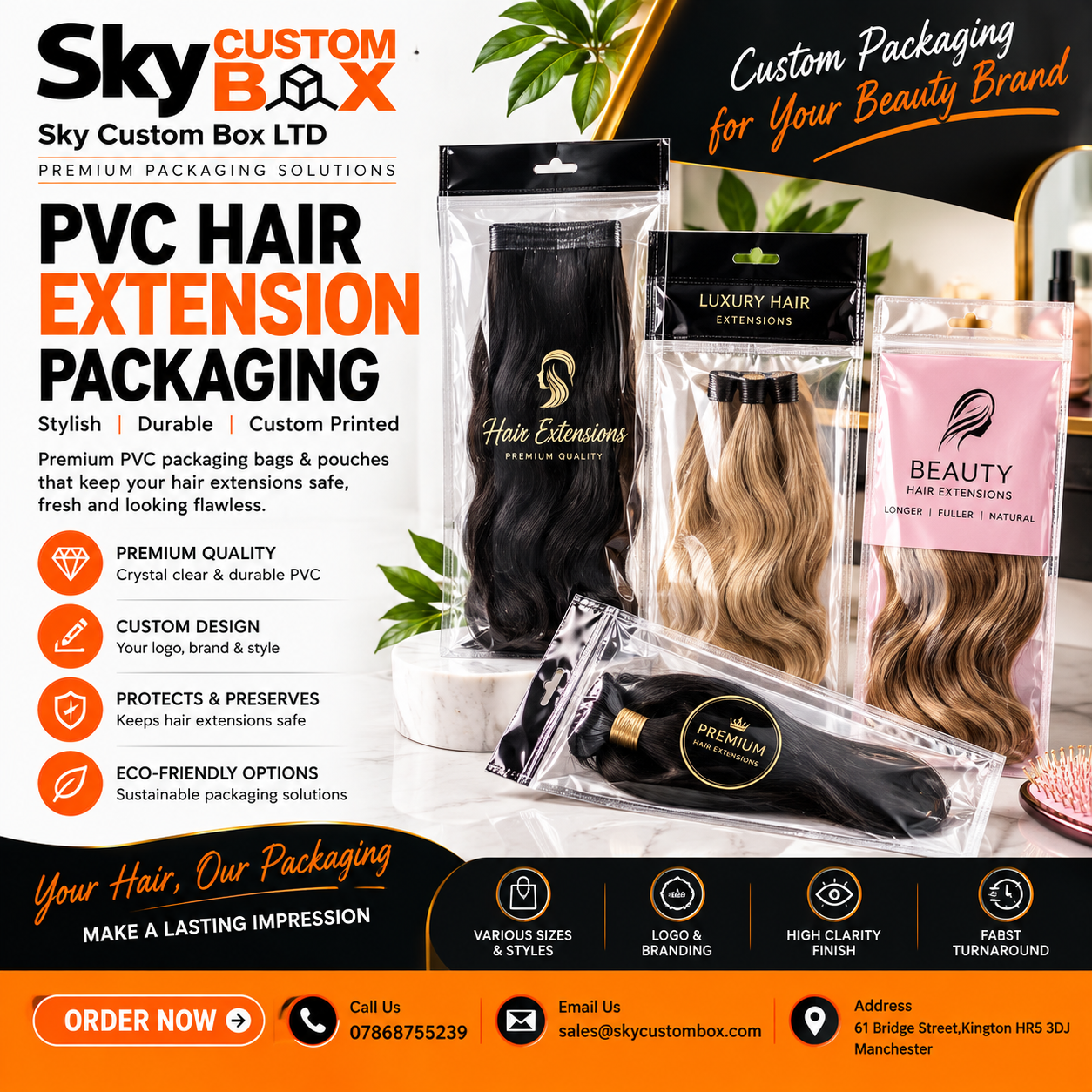
PVC hair extension packaging is one option for businesses looking for transparent packaging that allows customers to view the product before opening it. Clear plastic packaging can make hair colours, textures, lengths, and styles easier to identify, which is particularly useful for retailers, wholesalers, salons, and online hair businesses.
However, choosing the right packaging requires careful consideration of material quality, product dimensions, ventilation, presentation, sustainability, and storage requirements. Understanding these factors helps businesses select packaging that supports their products without adding unnecessary costs or waste.
1. What Is PVC Hair Extension Packaging?
PVC, or polyvinyl chloride, is a plastic material used in a variety of packaging applications. Depending on its formulation and construction, it can be produced in flexible or rigid forms. Transparent PVC packaging may be used to display hair extensions while helping protect them from dust, handling, and general storage conditions.
Hair extension packaging can take several forms, including clear pouches, bags, sleeves, display packs, and structured containers. The most appropriate format depends on the product type, intended market, and sales channel.
For example, clip-in extensions may require packaging that keeps individual pieces arranged neatly, while longer hair bundles may need bags or sleeves with sufficient space to prevent tangling and excessive folding.
Read More:
https://www.skycustombox.com/blog/
Common Applications
PVC-based packaging may be considered for:
- Human hair extension bundles
- Synthetic hair extensions
- Clip-in hair extension sets
- Ponytail extensions
- Wigs and hairpieces
- Hair products supplied to salons
- Retail display and wholesale distribution
Transparent packaging can make product identification easier for staff and customers. Retailers can inspect the hair’s visible colour and general appearance without opening every package, helping maintain an organised inventory system.
It is important to remember that packaging protects the product only to a certain extent. It does not replace proper hair preparation, hygienic handling, or suitable storage conditions.
2. Benefits of Transparent Packaging for Hair Extensions
Packaging decisions should reflect both practical requirements and customer expectations. Transparent materials can offer several advantages when used appropriately.
Improved Product Visibility
One of the main benefits of clear packaging is visibility. Customers can view the hair’s colour, texture, and arrangement before purchasing it.
This can be useful when displaying several similar products, such as straight, wavy, and curly extensions, or when offering different lengths within the same collection.
Visibility may also help retailers identify products quickly during order fulfilment. Clear labelling combined with transparent packaging can reduce confusion between similar shades or product variations.
Read More:
Professional Retail Presentation
Packaging contributes to the overall impression of a hair brand. A neatly arranged bundle, consistent labelling, and a clean package can communicate attention to detail.
Businesses can improve presentation by combining clear packaging with:
- A branded header card or label
- Product length and colour information
- Hair type and texture details
- Care instructions
- Batch or stock identification
- Website or customer support information
These details help customers understand what they are purchasing and support consistent presentation across different product lines.
Protection During Handling and Storage
A properly designed bag or pouch can help reduce exposure to dust, surface dirt, and direct handling. It may also help keep hair bundles together during storage and transportation.
However, protection depends on the package’s thickness, closure, seal quality, and overall design. Thin materials can tear, while poorly fitted packaging may allow products to move around excessively.
Businesses should evaluate the actual performance of the finished package rather than assuming that all transparent plastic materials provide the same level of protection.
3. Choosing the Right Material, Size and Design
Selecting suitable hair extension packaging requires more than choosing a clear bag. Material performance, product dimensions, and usability should all be considered before production.
Material Thickness and Durability
Packaging thickness influences flexibility, resistance to tearing, appearance, and handling. The appropriate specification depends on the weight and shape of the hair product, how frequently it will be handled, and whether it will travel through courier networks.
A lightweight pouch may work for small retail products, whereas heavier bundles or multi-piece sets may require a stronger construction.
When comparing packaging samples, check:
- Resistance to tearing around the seams
- Quality of the closure or seal
- Clarity of the material
- Flexibility and ease of handling
- Compatibility with labels and printed elements
- Suitability for the intended product weight
Samples should be tested with actual products before a large order is approved.
Accurate Sizing for Different Hair Products
Hair extensions vary considerably in length, volume, and weight. Packaging that is too small may compress the hair unnecessarily, while an oversized pouch can allow the bundle to shift and become disorganised.
Before selecting dimensions, measure the prepared product in its intended retail arrangement. Consider the length of the hair, the width of the bundle, any backing card, and space required for secure closure.
Longer extensions may need elongated bags or sleeves. Clip-in sets may benefit from backing cards that keep the pieces separated and easier to inspect.
The objective is to provide enough room for the product to sit neatly without excessive folding, pressure, or movement.
Branding and Product Information
Custom packaging can help a business establish a consistent visual identity. Transparent packaging is particularly versatile because the product remains visible while branding can be added through labels, inserts, printed sections, or header cards.
A practical design should prioritise readability. Include only the information customers need to identify and use the product.
Useful details may include:
- Brand name and logo
- Hair type, such as human or synthetic
- Length and colour
- Texture or style
- Product quantity or bundle details
- Care and storage instructions
- Contact or website information
Product claims should be accurate and supported by the supplier’s specifications. For example, descriptions of hair origin, composition, or processing should not be included unless they can be verified.
4. Sustainability and Common Packaging Challenges
Plastic packaging can offer visibility and practical protection, but businesses should also assess its environmental implications. Material selection should account for durability, waste generation, local recycling systems, and the complete packaging format.
Understanding PVC and Recycling
PVC is not accepted in every household recycling programme, and acceptance varies by location and collection service. Mixed materials, labels, adhesives, and decorative elements can further complicate recycling.
Businesses considering PVC packaging should check local waste-management guidance and request clear material information from their packaging supplier.
Depending on the product and business requirements, alternatives may include paper-based sleeves, cardboard backing cards, recyclable polyethylene bags where accepted locally, or other materials designed for the intended use.
No single material is automatically the most sustainable choice in every situation. A useful assessment considers material quantity, product protection, transport efficiency, expected damage rates, and the disposal options available to customers.
Read More:
Avoiding Tangling and Product Damage
Hair extensions can become tangled or lose their neat presentation if they are poorly arranged before packaging. Packaging alone cannot correct problems caused by inadequate preparation.
Businesses can reduce these issues by:
- Preparing and aligning the hair before packing.
- Using suitable ties or supports where appropriate.
- Selecting packaging that fits the bundle.
- Avoiding excessive compression.
- Checking closures and seals.
- Inspecting samples after simulated handling and transport.
These steps are especially useful for online retailers shipping orders over long distances.
Managing Packaging Costs
Packaging costs depend on dimensions, material thickness, printing, closures, order quantity, customisation, and shipping. Businesses should compare the total cost per packaged product rather than focusing solely on the price of an individual bag.
Standard sizes may be economical for common product ranges, while custom dimensions can be helpful for unusual lengths or premium collections.
Ordering larger quantities may reduce unit costs, but excessive stock can occupy valuable storage space and tie up working capital. Forecasting sales and testing samples before committing to bulk production can help reduce waste.
5. Industry Trends and Best Practices for Hair Brands
Hair product packaging continues to evolve as brands compete through presentation, customer convenience, and more considered material choices.
One important trend is minimalist branding. Clean layouts, readable labels, and restrained use of colour can create a professional appearance without making packaging unnecessarily complicated.
Another trend is improved product organisation. Retailers and wholesalers increasingly benefit from consistent labelling systems that identify length, texture, colour, and stock-keeping units. These details can make inventory management easier when product catalogues contain many similar variations.
E-commerce also makes packaging testing essential. A package that looks attractive on a display shelf may not perform well during courier handling. Hair businesses should test complete orders, including outer shipping cartons and internal protection, before launching a new packaging format.
For businesses exploring customised packaging options, Sky Custom Box is one example of a packaging provider that can be considered when researching formats and specifications. As with any supplier, businesses should evaluate material details, sample quality, production lead times, minimum order quantities, and suitability for their products.
The best packaging process combines design decisions with practical testing. Gathering feedback from customers, warehouse staff, and salon partners can also reveal whether a package is easy to open, store, identify, and reuse where appropriate.
Conclusion
Choosing suitable PVC hair extension packaging involves balancing product visibility, durability, presentation, cost, and environmental considerations. Transparent packaging can help customers inspect hair products while keeping bundles organised and reducing exposure to dust and handling.
CONTACT US:
ABOUT US:
Social Media:
https://www.facebook.com/Skycustombox/
https://www.instagram.com/skycustombox/
jony