
Power Quality Equipment Market Size and Forecast 2025–2033
According to Renub Research global power quality equipment market is witnessing steady growth as industries, utilities, and commercial facilities increasingly depend on stable and efficient electrical power. Power quality equipment is designed to minimize voltage fluctuations, harmonics, transients, and power interruptions that can disrupt sensitive electronic systems and cause operational losses.
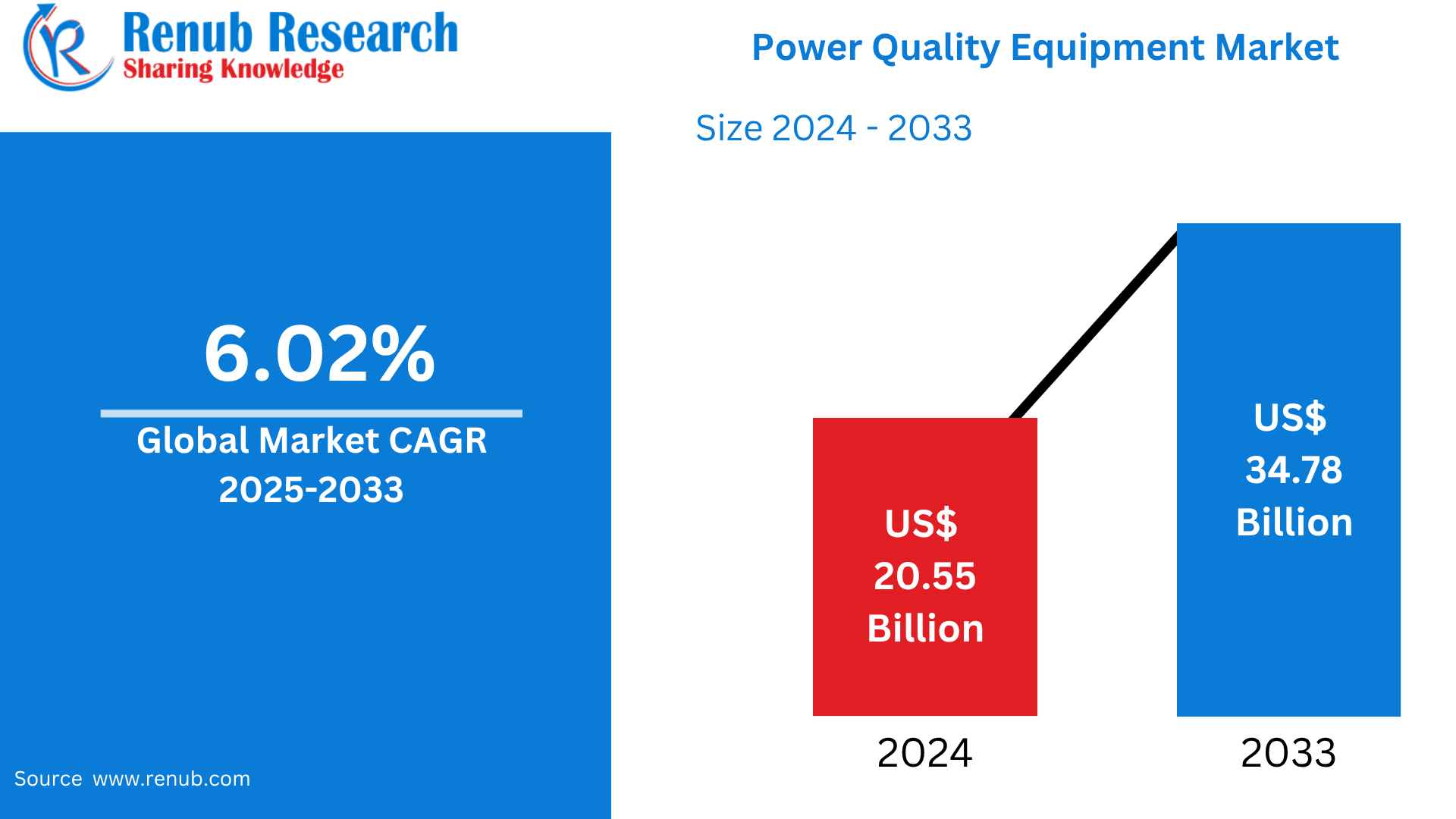
The market was valued at US$ 20.55 billion in 2024 and is projected to reach US$ 34.78 billion by 2033, expanding at a compound annual growth rate (CAGR) of 6.02% from 2025 to 2033. Rising dependence on digital infrastructure, growing industrial automation, renewable energy integration, and heightened awareness of energy efficiency are key factors driving market expansion. Utilities and end users are increasingly investing in power quality solutions to ensure minimal downtime, protect critical assets, and improve overall energy performance.
Power Quality Equipment Market Outlook
Power quality equipment refers to systems and devices that ensure the delivery of reliable and distortion-free electrical power. These solutions address issues such as voltage sags, surges, harmonics, flicker, and frequency variations that can negatively impact electrical systems and connected equipment. Common power quality equipment includes uninterruptible power supplies (UPS), voltage regulators, surge protection devices, harmonic filters, power conditioners, and power quality meters.
With rapid global digitalization, the adoption of automation, and the proliferation of sensitive electronic devices across industries, maintaining consistent power quality has become critical. Poor power quality can lead to equipment failure, data loss, reduced productivity, and financial losses. As a result, industries such as manufacturing, healthcare, IT & telecom, data centers, and utilities are increasingly prioritizing power quality management.
The growing integration of renewable energy sources such as solar and wind, which introduce variability into power systems, further amplifies the need for advanced power quality solutions. These factors collectively support consistent global market growth.
Request a free sample copy of the report:https://www.renub.com/request-sample-page.php?gturl=power-quality-equipment-market-p.php
Growth Drivers in the Power Quality Equipment Market
Industrial Automation and Digitization
The global shift toward Industry 4.0 has significantly increased automation across manufacturing, logistics, and service industries. Automated and digitally controlled systems rely heavily on uninterrupted, high-quality power to prevent system failures, downtime, and data corruption. Even brief power disturbances can result in substantial operational and financial losses.
Power quality equipment plays a vital role in stabilizing voltage, filtering harmonics, and ensuring uninterrupted power supply in automated environments. As automation expands in precision-driven sectors such as electronics, automotive manufacturing, pharmaceuticals, and semiconductors, demand for advanced power quality solutions continues to rise.
Proliferation of Renewable Energy Integration
The accelerating transition toward renewable energy sources is reshaping power grids worldwide. While wind and solar energy support sustainability goals, they also introduce challenges related to intermittency, voltage instability, and harmonic distortion. These fluctuations can adversely affect grid reliability and connected equipment.
Power quality equipment helps mitigate these issues by stabilizing voltage levels, correcting power factor imbalances, and improving compatibility between conventional and renewable power systems. As governments and utilities increase investments in clean energy infrastructure, the demand for resilient power quality solutions is expected to grow steadily.
Expansion of Data Centers and Cloud Infrastructure
Data centers are the backbone of cloud computing, artificial intelligence, and digital services, requiring continuous and high-quality power. Power disruptions in data centers can lead to service outages, data loss, and security risks, making power quality management mission-critical.
The rapid growth of hyperscale data centers, edge computing facilities, and AI-driven workloads has increased demand for UPS systems, harmonic filters, and voltage regulators. These solutions ensure uninterrupted operations, efficient load management, and optimized energy consumption. As global data generation continues to rise, data centers will remain a major driver of the power quality equipment market.
Challenges in the Power Quality Equipment Market
High Initial Investment and Operational Costs
Despite their long-term benefits, power quality systems require substantial upfront investment, particularly for industrial-scale installations. Costs associated with equipment procurement, installation, system integration, maintenance, and skilled labor can be significant, especially for small and medium-sized enterprises.
In addition, the return on investment may not be immediately visible, which can discourage adoption among cost-sensitive organizations. Economic uncertainty and budget constraints in emerging markets further limit market penetration, making affordability a persistent challenge.
Lack of Awareness and Skilled Workforce
In many developing regions, awareness of the importance of power quality and its long-term economic benefits remains limited. Power disturbances are often addressed reactively rather than through proactive system upgrades.
Moreover, the installation and maintenance of power quality equipment require specialized technical expertise, which is in short supply in several regions. The lack of trained professionals can affect system performance and reliability, hindering adoption. Addressing this challenge will require targeted education programs, training initiatives, and awareness campaigns.
UPS Power Quality Equipment Market
Uninterruptible Power Supply (UPS) systems form the backbone of power backup strategies in critical applications such as data centers, hospitals, financial institutions, and telecommunications facilities. UPS solutions protect sensitive equipment from sudden power outages and voltage irregularities, ensuring operational continuity and data integrity.
Technological advancements such as modular UPS systems, lithium-ion batteries, and energy-efficient designs have expanded their applicability. Growing reliance on digital infrastructure and increasing power reliability concerns are driving strong demand for UPS solutions across both large enterprises and small commercial users.
Power Quality Meters Market
Power quality meters play a crucial role in monitoring, measuring, and analyzing electrical parameters in real time. These devices help identify anomalies such as harmonics, voltage imbalances, and transient disturbances, enabling corrective actions and predictive maintenance.
Utilities, manufacturers, and commercial facilities increasingly rely on power quality meters to enhance energy efficiency, comply with regulatory standards, and prevent equipment damage. Integration with smart grids, IoT platforms, and advanced analytics is further accelerating adoption across industrial and energy-intensive sectors.
Single Phase Power Quality Equipment Market
Single-phase power quality equipment is widely used in residential and small commercial applications. Voltage fluctuations, surges, and power interruptions can damage household appliances, office equipment, and electronic devices.
The growing adoption of smart homes, HVAC systems, and connected appliances has increased demand for single-phase voltage stabilizers, surge protectors, and filters. These solutions help improve system efficiency, extend equipment lifespan, and enhance user safety, making this a fast-growing segment of the overall market.
Commercial Power Quality Equipment Market
Commercial buildings such as offices, shopping malls, hospitals, and educational institutions require uninterrupted and high-quality power for lighting, HVAC systems, elevators, and IT infrastructure. Power disturbances can disrupt operations, increase maintenance costs, and reduce energy efficiency.
The rise of smart commercial buildings and green infrastructure initiatives is driving investment in power quality equipment. Businesses increasingly recognize the importance of power quality management for operational continuity and cost optimization, supporting strong market growth in this segment.
Transportation Power Quality Equipment Market
Transportation infrastructure, including electric railways, metro systems, and electric vehicle charging networks, depends on stable power supply for safe and efficient operation. Power disturbances can cause system malfunctions, safety risks, and service delays.
Power quality equipment such as harmonic filters and voltage regulators is essential for maintaining reliability in transportation systems. With expanding urban transit networks and growing adoption of electric vehicles, demand for robust power quality solutions in the transportation sector is rising significantly.
United States Power Quality Equipment Market
The United States represents a major market for power quality equipment due to its highly digitalized economy, aging power grid infrastructure, and strong focus on industrial automation. Investments in renewable energy, data center expansion, and smart grid initiatives are driving demand across commercial, industrial, and utility sectors.
Government policies promoting energy efficiency and grid modernization further support market growth. Continuous investment in domestic manufacturing and power infrastructure strengthens the long-term outlook of the U.S. market.
France Power Quality Equipment Market
France is actively advancing clean energy integration and smart grid deployment. Increasing renewable energy penetration and stringent energy efficiency standards have heightened the importance of power quality management.
Demand for UPS systems, power quality meters, and voltage regulation solutions is growing across manufacturing, telecommunications, and utility sectors. France’s strong focus on energy transition and infrastructure modernization continues to support market expansion.
India Power Quality Equipment Market
India faces frequent power quality challenges due to rapid urbanization, grid congestion, and rising electricity demand. These issues have increased awareness and adoption of power quality solutions across industrial, commercial, and residential sectors.
Government initiatives supporting infrastructure development, manufacturing growth, and grid modernization are driving market expansion. Increased investments in power reliability and renewable energy integration further enhance growth prospects in India.
Saudi Arabia Power Quality Equipment Market
Saudi Arabia’s Vision 2030 initiative emphasizes economic diversification, renewable energy adoption, and infrastructure modernization. Large-scale investments in smart cities, industrial zones, and data centers are increasing the need for reliable power quality solutions.
Industries such as oil & gas, manufacturing, and utilities are key adopters of power quality equipment. As renewable energy capacity expands, demand for advanced power management systems is expected to grow steadily.
Power Quality Equipment Market Segmentation
By Equipment
- Uninterruptible Power Supply (UPS)
- Surge Protection Devices
- Voltage Regulators
- Power Quality Meters
- Harmonic Filters
- Others
By Phase
- Single Phase
- Three Phase
By End Use
- Industrial & Manufacturing
- Commercial
- Utilities
- Transportation
- Residential
By Region
- North America
- Europe
- Asia Pacific
- Latin America
- Middle East & Africa
Competitive Landscape and Key Players Analysis
The power quality equipment market is moderately consolidated, with leading players focusing on innovation, digital solutions, and global expansion. Key companies operating in the market include Hitachi Energy Ltd, Siemens AG, Eaton Corporation Plc, Emerson Electric Company, Schneider Electric SE, General Electric Company, Toshiba Corporation, and Schaffner.
These companies compete through technological innovation, strategic partnerships, and investments in smart and energy-efficient power quality solutions.
Conclusion
The global power quality equipment market is set for sustained growth from 2025 to 2033, driven by industrial automation, renewable energy integration, and expanding digital infrastructure. While high costs and limited awareness remain challenges, continuous innovation, smart grid adoption, and growing focus on energy efficiency are expected to unlock significant opportunities. Power quality equipment will continue to play a critical role in ensuring reliable, efficient, and resilient power systems worldwide.
renubresearch