
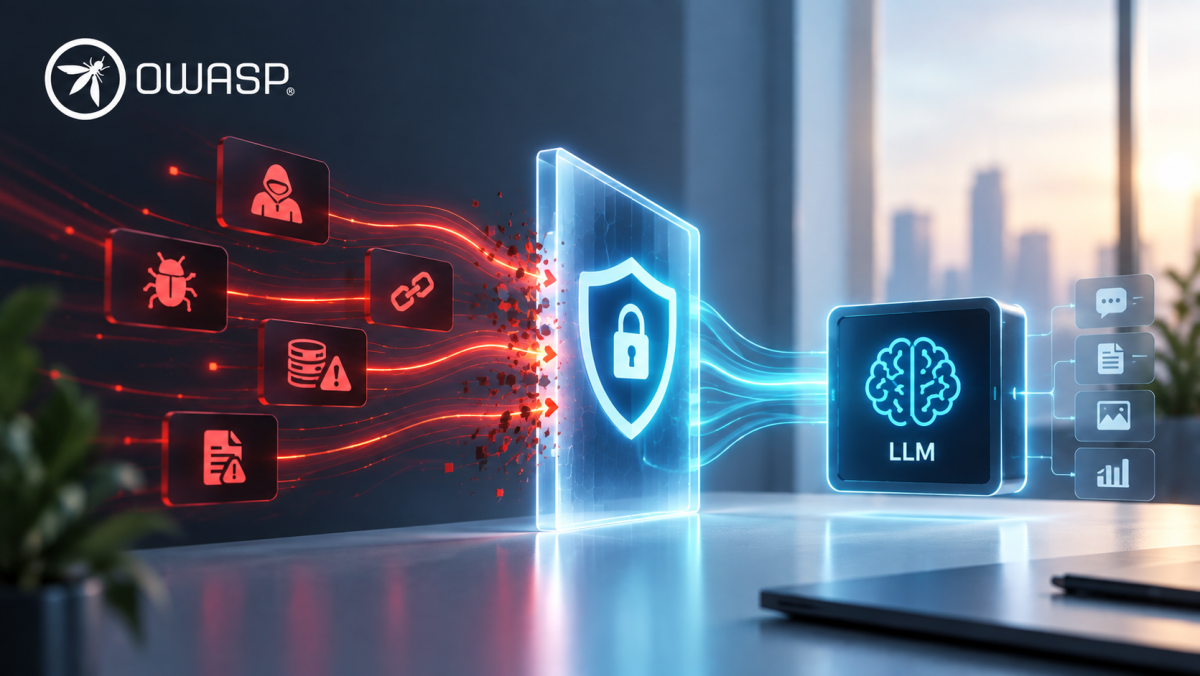
Every year, security teams wait for one list to settle a lot of internal arguments: OWASP’s Top 10 for LLM Applications. It’s the closest thing the industry has to a shared vocabulary for AI risk the reference procurement teams cite, the taxonomy red-team reports map to, and the checklist auditors increasingly ask about by name.
The 2026 refresh isn’t a minor reshuffle. Eight of the ten entries moved position, one risk was renamed outright, and for the first time the ranking wasn’t built on expert opinion alone. It blends structured practitioner input with real incident data pulled from thousands of documented vulnerabilities. That distinction matters: this list reflects what’s actually going wrong in production AI systems, not just what sounds dangerous in theory.
If you’re running any kind of LLM traffic through your organization, this update is worth more than a skim. Below is what changed, why it changed, and critically what kind of infrastructure actually closes each gap. Spoiler: reading a list of risks doesn’t reduce your risk. Enforcing controls against every item on it, in real time, on every call, does. That’s the job of an AI Security Gateway.
Why the 2026 List Looks So Different
Earlier versions of the OWASP LLM Top 10 leaned heavily on expert judgment a panel of practitioners ranking risks by severity and likelihood. That’s useful, but it’s also a bit like ranking diseases by how scary they sound rather than how often they actually put someone in the hospital.
The 2026 methodology changes that. It’s now a blend of expert consensus and observed incident data, and the effect shows up immediately in the reordering:
- Excessive Agency climbed sharply. As more organizations move from chatbots to autonomous agents that call tools, chain APIs, and execute multi-step tasks, real incidents involving over-permissioned agents have piled up fast enough to push this risk toward the top of the list.
- Unbounded Consumption jumped several positions. This is the “your AI bill exploded overnight” risk runaway loops, denial-of-wallet attacks, and resource exhaustion and it’s now being taken as seriously as data leakage, not treated as an afterthought.
- System Prompt Leakage was renamed Hidden Context Exposure. The new name reflects a broader problem: it’s not just system prompts that leak. Retrieved documents, tool outputs, memory stores, and other hidden context injected into a model’s window are all now recognized as exposure surfaces.
The takeaway for anyone building or buying AI infrastructure: the center of gravity has shifted from “what if the model says something wrong” to “what if the system around the model its tools, its context, its spend gets out of control.” That’s a systems problem, not a model problem, and it needs to be solved at the systems layer.
Where a Model-Level Fix Runs Out of Road
Prompt engineering, system prompt hardening, and model level safety training all help. But none of them can do what OWASP’s 2026 list is really asking for: consistent, auditable enforcement across every call, every model, and every tool an organization uses regardless of which team built the integration or which provider is on the other end.
That’s the structural gap an AI Security Gateway exists to close. Instead of asking every individual application, agent, or developer to independently implement redaction, access control, and monitoring, a gateway sits inline between your applications and every LLM you call, and enforces the same policy on all of it before a request leaves your perimeter, and after a response comes back.
Here’s how that maps directly to what moved on the 2026 list.
Excessive Agency → Role Based Model and Tool Access
An agent with too much unchecked authority is the modern version of an overprivileged service account. The fix isn’t smarter prompting it’s the same principle security teams have applied to every other system resource for decades: least privilege, enforced centrally.
An AI Security Gateway lets you define, by role and by team, which models an identity is allowed to call and which tools an agent is allowed to invoke not as a convention developers are supposed to remember, but as a policy enforced at the point every call has to pass through anyway.
Unbounded Consumption → Token Budgets and Spend Governance
Runaway agents and misconfigured retry loops don’t announce themselves — they show up as a finance ticket after the invoice arrives. A gateway with real-time spend tracking attributes every call’s token usage to a team, model, and feature as it happens, with hard and soft budget caps that trigger alerts before a loop turns into a five-figure surprise.
Hidden Context Exposure → Context-Aware, Bidirectional Redaction
The renamed risk is really an expansion: it’s not just the system prompt that can leak, it’s anything injected into context retrieved documents, prior tool outputs, memory. A gateway that only regex-matches known PII patterns in the outbound prompt misses most of this. What’s needed is inspection on both sides of the call prompt and response using an engine that understands meaning, not just pattern, so it catches an informally phrased name or a masked reference buried inside retrieved context just as reliably as an obvious 16-digit number.
Sensitive Information Disclosure → Real-Time PII and Secrets Masking
This one hasn’t moved off the list because it hasn’t gone away. Source code, trade secrets, customer PII, and confidential files still end up pasted into prompts by employees who never think twice. Inline masking applied before a request ever reaches an external model closes this without requiring every employee to become a security expert first.
Prompt Injection → Boundary-Level Defense, Not Just Model Training
Prompt injection remains the most cited LLM risk for a reason: it works, and it works regardless of how well the underlying model has been trained to resist it. A gateway inspects and enforces policy at the network boundary before a malicious instruction hidden in a document, email, or tool response ever reaches the model rather than relying entirely on the model itself to recognize and refuse it.
What This Means for Your 2027 Security Roadmap
If you’re mapping your current AI stack against the 2026 list, a useful exercise is to ask, honestly: for each of the ten risks, is there a policy being enforced, or just an assumption being made? “Our model is well-trained” is an assumption. “Every prompt is inspected before it leaves our perimeter, and every decision is logged” is a policy.
That distinction is exactly why the market has shifted toward centralized, gateway-level enforcement rather than scattered model-level mitigations. A single AI Security Gateway deployed inline rather than a patchwork of per-application safeguards gives you one place to update controls as OWASP’s list evolves again next year, one place to produce audit evidence when a regulator or customer asks for it, and one place where the answer to “are we covered against Excessive Agency” is a policy you can point to, not a hope.
The Bottom Line
OWASP didn’t just reorder a list it told the industry, backed by incident data, where AI systems are actually failing right now: agents with too much unchecked authority, spend nobody’s watching, and context leaking through channels nobody thought to inspect. Reading the list is step one. Closing the gap requires infrastructure built to enforce policy on every call, every model, and every tool consistently, and provably.
That’s the role an AI Security Gateway plays: not a smarter prompt, but a boundary every request has to pass through, where OWASP’s Top 10 stops being a checklist and starts being something you can actually demonstrate.
Albert Smith