


Limestone Market Size and Forecast 2025–2033
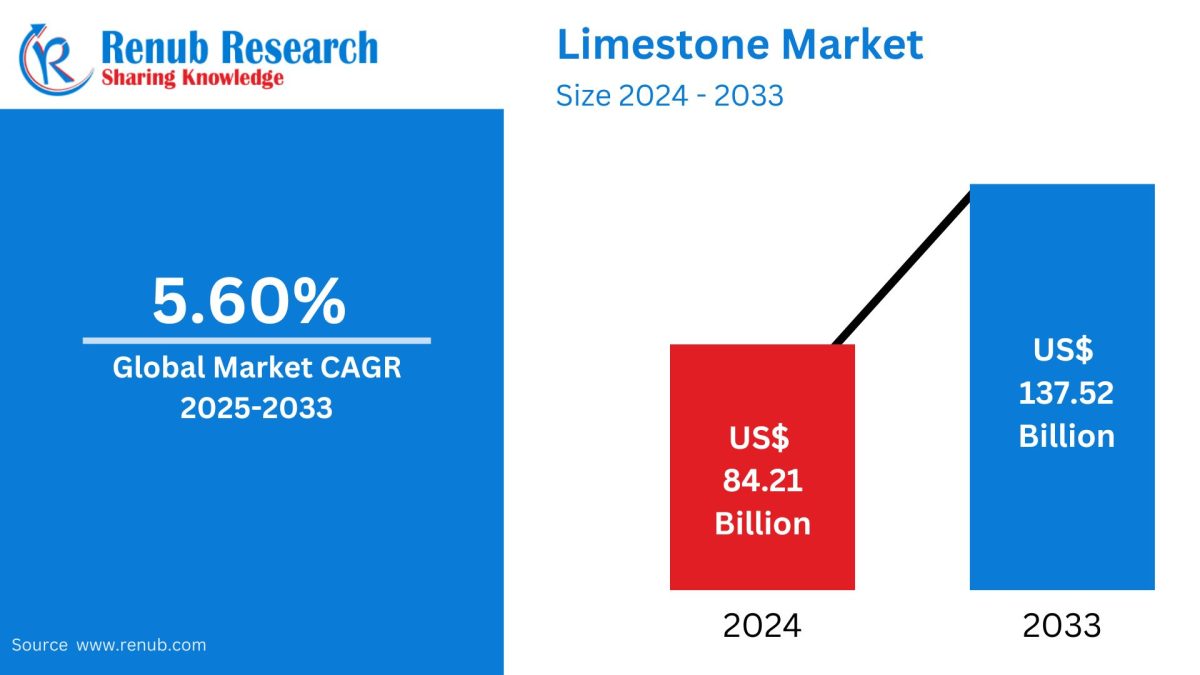
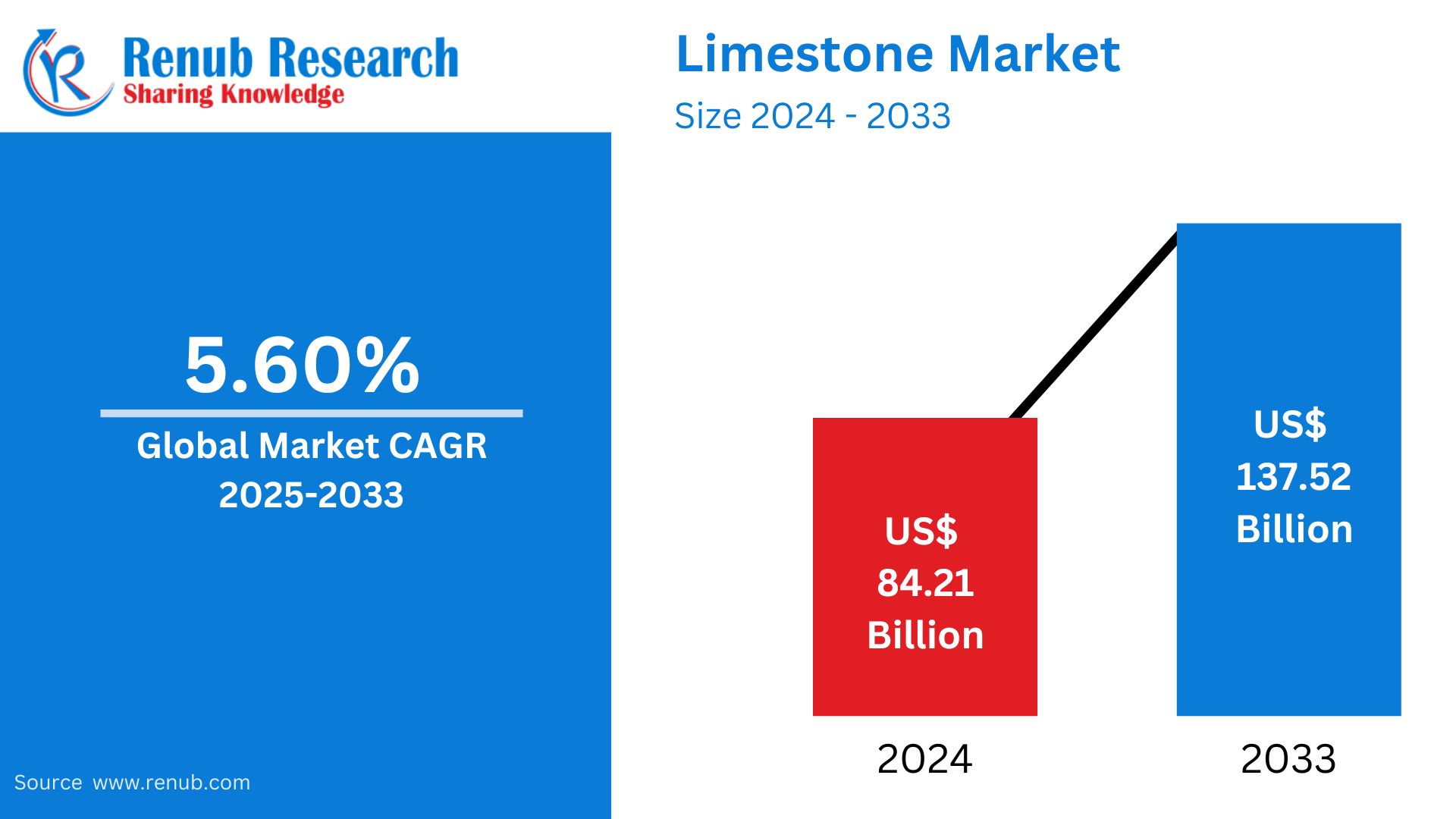
According to Renub Research global limestone market is positioned for robust expansion, projected to grow from US$ 84.21 billion in 2024 to US$ 137.52 billion by 2033, registering a CAGR of 5.60% between 2025 and 2033. Limestone’s indispensable role in construction, cement production, agriculture, steel manufacturing, water treatment, and environmental management ensures steady and sustainable demand. With governments worldwide investing heavily in infrastructure, industrial development, and sustainability-focused projects, the limestone industry is set to witness strong and stable growth in the coming years.
Global Limestone Market Overview
Limestone is a sedimentary rock primarily composed of calcium carbonate (CaCO₃), commonly formed from accumulated remains of marine organisms such as shells and corals. Its color varies from white and gray to yellow, depending on mineral composition. Known for its durability, chemical properties, and versatility, limestone is crucial in multiple industrial sectors. It is widely used in cement manufacturing, construction aggregates, soil neutralization, steel purification, glass production, and water treatment. When heated, limestone converts into lime (calcium oxide), which serves vital roles across chemical processing and industrial applications.
Growing construction output, infrastructure expansion, industrial development, agricultural enhancements, and sustainability-driven initiatives continue to propel the global limestone market. Innovations in mining efficiency, recycling, and eco-friendly extraction practices further strengthen market performance.
Download Free Sample Report:https://www.renub.com/request-sample-page.php?gturl=limestone-market-p.php
Key Market Drivers in the Global Limestone Market
Expanding Industrial and Agricultural Applications
Limestone remains indispensable in several industrial processes. In steel manufacturing, it acts as a fluxing agent, helping remove impurities. In power plants, it is widely used in flue gas desulfurization, reducing harmful emissions and supporting environmental compliance. Meanwhile, in agriculture, limestone functions as a soil conditioner, neutralizing acidic soils, improving fertility, and enhancing crop productivity. As global demand for steel, power generation solutions, and sustainable agricultural output increases, limestone consumption continues to rise correspondingly.
Strengthening Sustainability and Environmental Initiatives
Environmental sustainability initiatives significantly influence the limestone market. Limestone plays an essential role in air and water purification, wastewater treatment, and emission control technologies, aligning with global sustainability goals. At the same time, advances in green mining techniques, sustainable quarrying, energy-efficient processing, and recycling practices further enhance limestone’s environmental profile. With governments and corporations increasingly prioritizing eco-friendly materials and practices, limestone remains a crucial enabler of sustainability strategies.
Rising Infrastructure Development and Construction Demand
The global boom in infrastructure development is one of the strongest growth catalysts. Limestone is a primary raw material in cement and construction aggregates, essential for building residential complexes, commercial structures, transportation networks, bridges, tunnels, and public utility projects. Rapid urbanization, population growth, and megacity development—especially across emerging markets—continue to create sustained demand. Large-scale infrastructure initiatives, smart city programs, and national modernization projects further strengthen limestone’s long-term market prospects.
Regional Market Overview
United States Limestone Market
The U.S. limestone market benefits from strong demand across construction, manufacturing, agriculture, and environmental sectors. Limestone is extensively used in cement production, soil conditioning, water treatment, and flue gas desulfurization in power plants. Major production hubs include states such as Missouri, Texas, and Indiana. Growing infrastructure investments and environmental regulations supporting emission control continue to drive U.S. market expansion. Strategic developments, such as Omya AG’s acquisition of MK Minerals in July 2022, highlight ongoing consolidation and capability enhancement trends.
India Limestone Market
India represents one of the fastest-growing limestone markets globally due to its expanding construction, cement manufacturing, agriculture, and steel sectors. With vast limestone reserves in states like Rajasthan, Andhra Pradesh, and Madhya Pradesh, India is well-positioned to meet rising domestic demand. Government-led programs including housing development, industrial corridor creation, and mega infrastructure initiatives—such as projects under the Sagarmala Program—continue to accelerate market growth.
United Kingdom Limestone Market
The UK limestone market is driven by demand from cement production, construction, agriculture, and environmental applications. Limestone remains essential in road building, soil stabilization, water treatment, and emission control systems. Infrastructure investments in housing, transportation, and renewable energy facilities, combined with strong environmental policies, reinforce consistent demand. Regions like Yorkshire, Derbyshire, and the Peak District are key limestone production locations.
Saudi Arabia Limestone Market
Saudi Arabia’s limestone market is expanding rapidly, driven by cement demand for Vision 2030 infrastructure projects, urban development, industrial expansion, and agriculture needs. Limestone is used in building materials, road and urban infrastructure, and industrial processes. With vast natural reserves, particularly in Central and Eastern Provinces, the Kingdom is well-equipped to support rising consumption. Mega initiatives such as NEOM’s The Line, smart city developments, and nationwide modernization continue to stimulate limestone demand.
Market Segmentation
By Type
- Magnesian Limestone
- High Calcium Limestone
By Application
- Industry Lime
- Chemical Lime
- Construction Lime
- Refractory Lime
By End Use
- Construction
- Iron & Steel
- Agriculture
- Chemical
- Others
Regional Analysis
- North America: United States, Canada
- Europe: France, Germany, Italy, Spain, United Kingdom, Belgium, Netherlands, Turkey
- Asia Pacific: China, Japan, India, South Korea, Thailand, Malaysia, Indonesia, Australia, New Zealand
- Latin America: Brazil, Mexico, Argentina
- Middle East & Africa: Saudi Arabia, UAE, South Africa
Competitive Landscape and Key Companies
Key companies operating in the global limestone market include
Imerys SA, CEMEX S.A.B. de C.V., GCCP Resources Limited, Holcim Limited, Mineral Technologies Inc., RSMM Limited, United States Lime & Minerals Inc., and Gujarat Mineral Development Corporation Limited. These players focus on strategic expansions, technological upgrades, sustainability initiatives, mergers and acquisitions, and strengthening operational efficiencies to sustain competitive advantage.
Future Outlook of the Limestone Market 2025–2033
The global limestone market is expected to maintain strong growth momentum through 2033, supported by increasing infrastructure spending, industrial expansion, agricultural enhancements, and sustainability initiatives. Continued modernization of construction technologies, eco-friendly material adoption, and reinforcement of environmental solutions will strengthen limestone’s role as a critical global resource. With expanding usage across multiple industries and continued global development, limestone is poised to remain one of the most strategically important raw materials in the coming decades.
renubresearch