


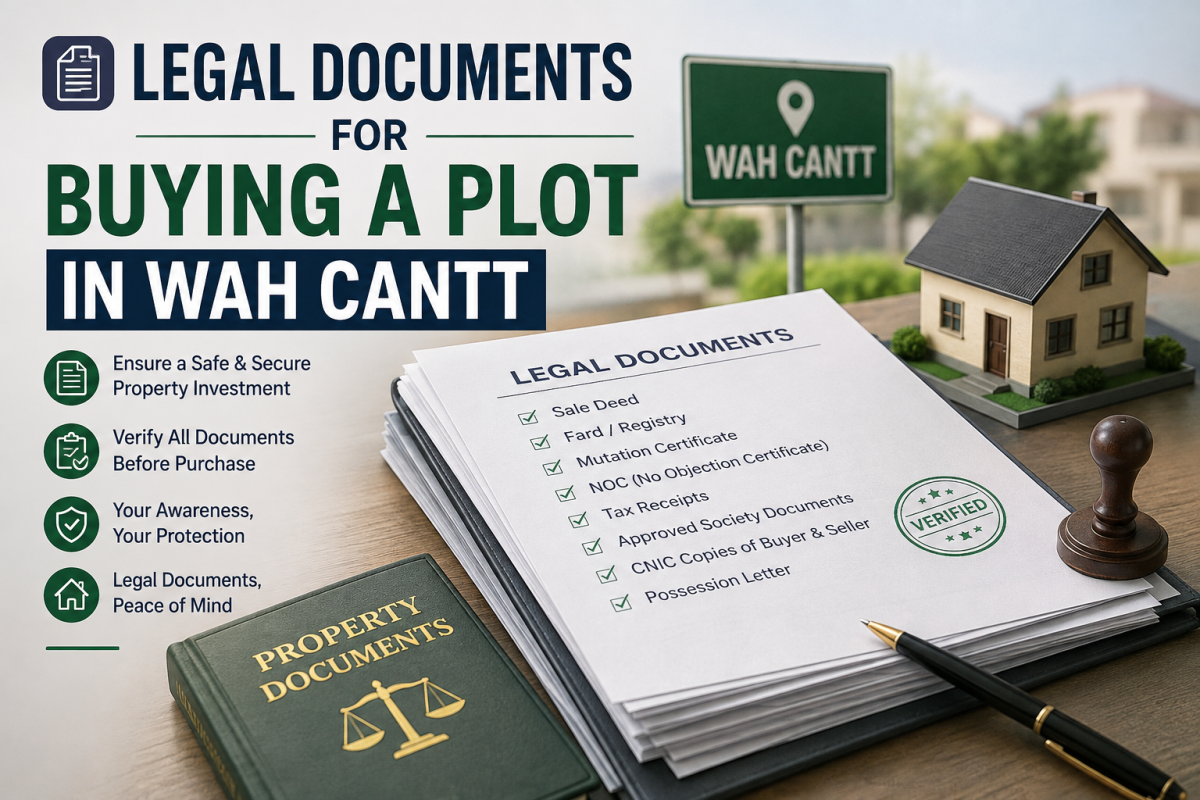
Legal Documents for Buying a Plot in Wah Cantt: Complete Checklist
Buying a plot in Wah Cantt is a major financial decision. Before paying an advance or signing a sale agreement, buyers should verify the property’s ownership, seller identity, plot details, transfer status, and relevant documentation.
Document verification is especially important because property transactions can involve different records depending on the property’s legal status and the authority responsible for it.
For properties in Punjab, the Punjab Land Records Authority (PLRA) provides official services for property registration, ownership records, mutation, and property transfers.
Why Document Verification Matters Before Buying a Plot in Wah Cantt
Ownership Proof vs. Transaction Documents
A registered deed records the transfer of property ownership, while mutation updates the official land record after a transfer. PLRA describes mutation as the official process of recording a change in land ownership following a sale, inheritance, gift, or court order.
Buyers should therefore review the documents together rather than relying on a single paper.
Why Verbal Claims Are Not Enough
Statements such as “the plot is clear” or “the transfer will be completed later” should never replace official verification.
Before making a significant payment, confirm the information through the relevant authority and, where appropriate, obtain independent legal advice.
Essential Documents to Verify Before Purchasing a Plot
Sale Deed and Transfer Documents
Review the registered sale deed and relevant previous transfer documents.
Check that the:
- Seller’s name is correct.
- Plot details match.
- Property size is consistent.
- Transaction history is clear.
PLRA states that a registry is the official legal document recording a property ownership transfer in Punjab.
Ownership Record and Property Title
Obtain the relevant ownership record or Fard and compare it with the seller’s documents.
PLRA provides official land-record services through its system and Arazi Record Centres.
Allotment or Allocation Letter
If the plot was originally allotted by a housing scheme or authority, check the allotment or allocation letter.
Confirm the allottee’s name, plot number, size, block, and any conditions attached to the property.
Possession Letter, Where Applicable
If possession has been formally issued, verify the possession documentation.
The plot number, location, size, and other details should match the official records.
Approved Site Plan and Plot Details
Confirm:
- Plot number
- Plot size
- Block
- Location
- Boundaries
- Road access
- Applicable land use
Do not rely only on an estate agent’s map or marketing material.
Seller’s Identity and Supporting Documents
Verify the seller’s CNIC and compare the details with the ownership records.
If the seller is acting through a power of attorney, inheritance arrangement, company, or other representative structure, additional documents may be required.
How to Verify That the Seller Can Legally Sell the Plot
Matching Seller Details With Ownership Records
The seller’s identity should correspond with the relevant ownership documentation.
Any difference in names, CNIC information, plot numbers, or ownership shares should be investigated before proceeding.
Checking Joint Ownership or Third-Party Claims
Determine whether the plot is jointly owned or subject to any claim, mortgage, dispute, or restriction.
Do not assume that one person can sell the entire property without confirming their legal authority.
Verifying Previous Transfers and Transaction History
Review previous deeds, mutation records, and other relevant transfer documentation where applicable.
PLRA’s mutation process involves reviewing ownership information and supporting documents before the official record is updated.
Documents Buyers Should Check With the Relevant Authority or Society
Plot Number, Size, Block, and Location
Ask the relevant authority or society to confirm the property’s exact details.
These should match the documents supplied by the seller.
Transfer Status and Outstanding Dues
Confirm whether the plot is eligible for transfer and whether there are outstanding:
- Transfer fees
- Development charges
- Property taxes
- Society dues
- Other applicable charges
Development and Approval Records
Verify the property’s applicable development and approval status.
Where cantonment-related records apply, buyers should confirm the requirements with the relevant cantonment authority because cantonment property is subject to specific legal and administrative rules. The Pakistan Cantonment Property Rules include provisions relating to cantonment property registers and site plans.
Any Restrictions Affecting Transfer or Sale
Check whether there are restrictions affecting the transfer, use, possession, or sale of the property.
Never assume that a plot can be transferred simply because the seller claims it is transferable.
What to Check Before Signing the Sale Agreement
Total Purchase Price and Payment Schedule
Clearly record the total price, advance payment, remaining balance, and payment dates.
Transfer and Registration Responsibilities
The agreement should clearly state who will handle applicable registration, transfer costs, taxes, and other charges.
Outstanding Taxes, Charges, or Society Dues
Confirm who is responsible for existing liabilities before completing the transaction.
Conditions for Cancellation or Refund
The agreement should explain what happens if ownership verification, documentation, or transfer approval fails.
For a significant transaction, having the agreement reviewed by a qualified property lawyer is strongly recommended.
Red Flags in Plot Documentation
Missing Original Documents
Be cautious if important documents are unavailable or the seller refuses to provide documents for verification.
Names or Plot Details That Do Not Match
Differences between the CNIC, ownership record, deed, allotment letter, or plot details require investigation.
Pressure to Pay Before Verification
Do not let urgency replace due diligence.
Unclear Ownership or Transfer History
An incomplete ownership trail can create legal and financial risk.
Promises That Are Not Supported by Documents
Claims about possession, approvals, development, transfer, or future benefits should be supported by appropriate records.
Final Document Checklist Before Buying a Plot in Wah Cantt
Ownership Verification
- Verify current ownership records.
- Check the relevant registry or deed.
- Review mutation or transfer records where applicable.
- Confirm the seller’s identity.
Seller Verification
- Check the seller’s original CNIC.
- Confirm authority to sell.
- Review power of attorney where applicable.
- Investigate joint ownership or third-party claims.
Plot and Site Verification
- Confirm plot number.
- Confirm size and location.
- Verify block and boundaries.
- Check the relevant site plan.
- Confirm applicable development status.
Transfer and Payment Verification
- Confirm transfer eligibility.
- Check outstanding dues.
- Clarify applicable taxes and fees.
- Document the payment schedule.
- Have the agreement reviewed professionally.
Conclusion
Buying a plot in Wah Cantt should never be based only on price, location, or the seller’s assurances. Proper document verification is essential for reducing the risk of ownership disputes, transfer problems, unexpected liabilities, and other complications.
For Punjab properties, official PLRA services can help with land records, registration, mutation, and property transfer. PLRA also provides access to Arazi Record Centres and other official land-record services.
Buyers comparing residential investment opportunities can also explore Kohistan Enclave while applying the same document-verification and due-diligence principles before making a purchase.
FAQs
1. Is a sale deed a valid proof of property ownership in Pakistan?
A registered deed is an important legal document recording a property transfer, but buyers should also verify the current ownership record and applicable mutation or transfer records. PLRA identifies registry as the official legal document recording a property ownership transfer in Punjab.
2. What documents are required to buy a plot in Pakistan?
Requirements vary by property and transaction. Common documents may include the registered deed, ownership record, CNICs, allotment or possession documents where applicable, and transfer-related records.
3. How can I verify the ownership of a plot before purchasing it?
Compare the seller’s identity with the relevant ownership records and verify the property details through the appropriate authority. PLRA provides official land-record and ownership-related services in Punjab.
4. What is the main document used to prove ownership of property in Pakistan?
There is not necessarily one document that applies to every property. Registered deeds, ownership records, mutation records, allotment documents, and other official records may be relevant depending on the property’s circumstances.
5. How do I verify a plot’s allotment and transfer documents?
Compare the documents with the seller’s identity and plot details, then confirm them with the relevant authority or society. Do not rely solely on photocopies or verbal confirmation.
6. What should I check before signing a plot sale agreement?
Check ownership, seller identity, plot details, purchase price, payment schedule, outstanding dues, transfer requirements, taxes, and cancellation conditions. Consider having a qualified property lawyer review the agreement.
7. What are the biggest document-related red flags when buying a plot in Wah Cantt?
Major warning signs include missing documents, mismatched names or plot details, unclear ownership history, unexplained transfer restrictions, pressure to pay before verification, and claims that cannot be supported by official records.
Kohistan Enclave