


Japan Solar Panel Market Size and Forecast 2025–2033
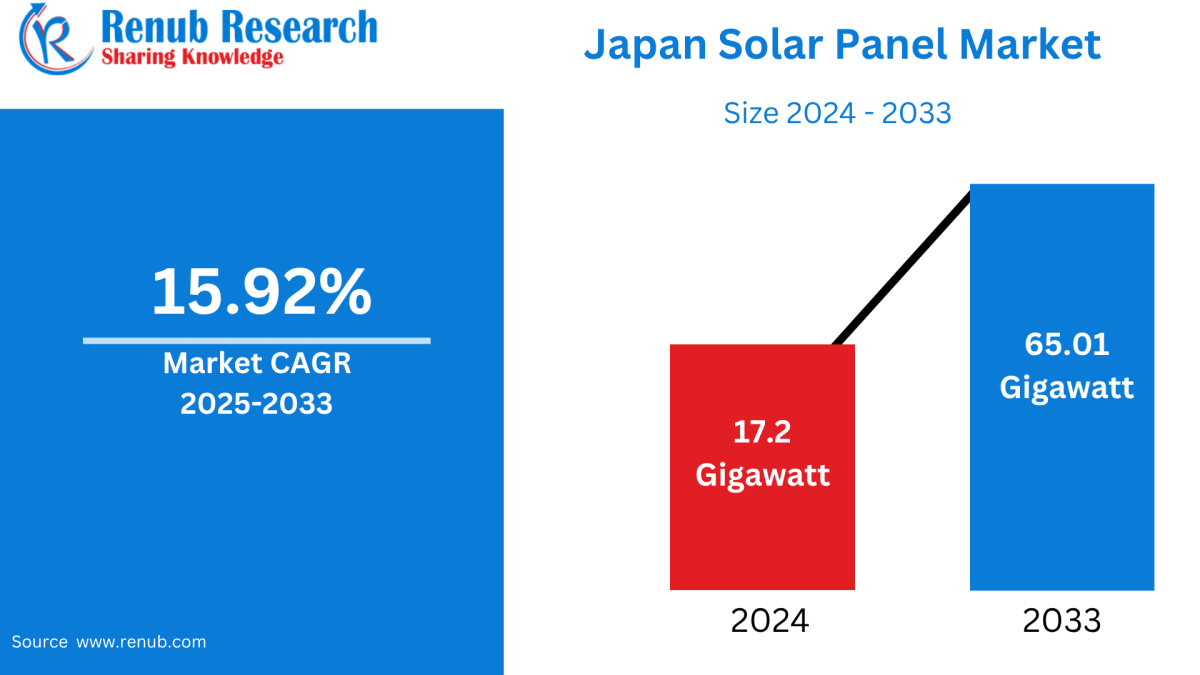
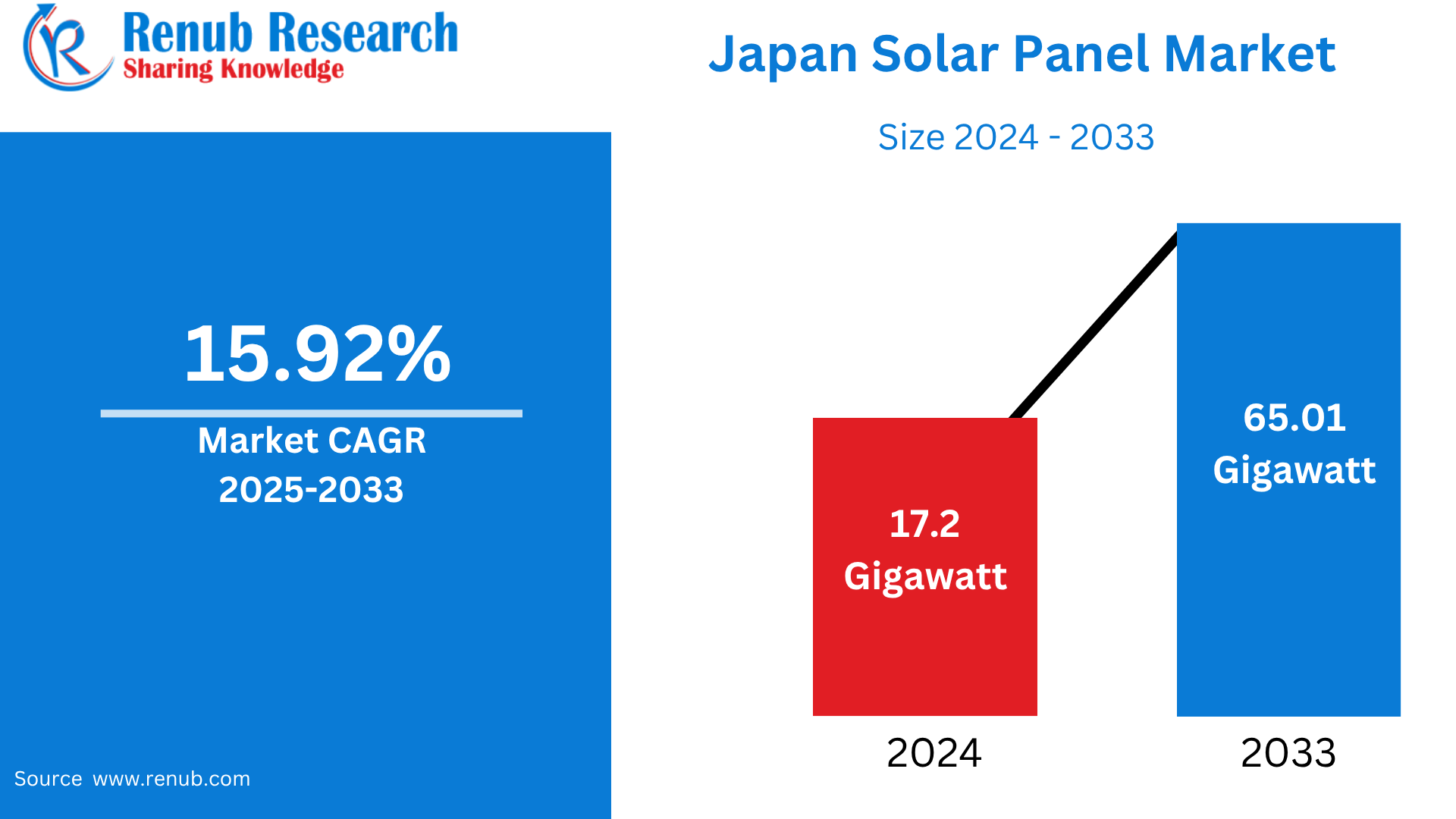
According to Renub Research Japan solar panel market is entering a phase of accelerated growth, driven by strong government backing, rising electricity prices, and the country’s long-term commitment to decarbonization. The market is projected to expand from 17.2 Gigawatts in 2024 to 65.01 Gigawatts by 2033, registering a robust CAGR of 15.92% during 2025–2033. Japan’s focus on energy security, combined with technological leadership in photovoltaic (PV) systems, positions the country as one of the most attractive and advanced solar markets in Asia.
Solar energy has become a cornerstone of Japan’s renewable energy strategy, especially after the Fukushima nuclear disaster reshaped national energy priorities. With limited domestic fossil fuel resources and high dependence on imports, Japan views solar power not only as an environmental solution but also as a strategic asset for long-term energy independence.
Japan Solar Panel Market Overview
A solar panel is a device that converts sunlight into electricity using photovoltaic cells. These panels can be installed on rooftops, open land, water surfaces, or integrated directly into buildings to generate clean and renewable electricity for residential, commercial, and industrial applications. Solar panels play a vital role in reducing greenhouse gas emissions and dependence on fossil fuels.
In Japan, solar energy adoption has increased significantly over the past decade. The country’s geographic constraints, high population density, and advanced urban infrastructure have driven strong demand for rooftop solar systems, particularly in residential and commercial buildings. Following 2011, the Japanese government introduced generous feed-in tariffs and subsidy programs, accelerating nationwide adoption.
Japan’s global reputation for engineering excellence has also contributed to high system efficiency, durability, and reliability. Continuous innovation in PV technology, energy storage integration, and smart grid systems has strengthened consumer confidence and sustained market momentum.
Request a free sample copy of the report:https://www.renub.com/request-sample-page.php?gturl=japan-solar-panel-market-p.php
Growth Drivers in the Japan Solar Panel Market
Government Policies and Incentives
Government support remains the single most important driver of the Japan solar panel market. In response to energy security concerns and climate commitments, authorities introduced feed-in tariffs, capital subsidies, tax incentives, and long-term renewable energy roadmaps. These policies significantly reduced installation costs and encouraged widespread participation from households, businesses, and industrial users.
Institutions such as the Ministry of Economy, Trade and Industry (METI) and NEDO have launched multi-year research and development programs focusing on high-efficiency solar cells, recycling of PV modules, and grid stability. Japan’s target of achieving carbon neutrality by 2050 further strengthens long-term investor confidence and ensures policy continuity across market segments.
High Energy Prices and Energy Security Concerns
Japan’s reliance on imported oil, gas, and coal exposes the country to global price volatility and geopolitical risks. Rising energy prices have made solar power an economically attractive alternative, offering predictable and long-term electricity costs. Solar panels allow households and businesses to hedge against utility price fluctuations while improving energy self-sufficiency.
Energy security has become a national priority, particularly after supply disruptions and global fuel price shocks. Solar energy, combined with battery storage, is increasingly viewed as a resilient and strategic solution for both urban and rural areas, driving sustained demand across the country.
Technological Innovation and Domestic Production
Japan is a global leader in solar technology innovation. Domestic manufacturers are known for producing high-efficiency, compact, and long-lasting solar panels suited for space-constrained environments. Advancements such as bifacial modules, perovskite solar cells, smart inverters, and integrated storage systems have significantly improved energy output and system reliability.
Strong domestic manufacturing capabilities reduce dependence on foreign supply chains and ensure high quality standards. Breakthroughs in next-generation solar technologies, including ultra-light and flexible panels, are further expanding application possibilities and strengthening Japan’s competitive position in the global solar industry.
Problems in the Japan Solar Panel Market
Land Availability and Installation Space Constraints
Limited land availability is a major structural challenge for large-scale solar deployment in Japan. Dense urban areas leave little room for ground-mounted solar farms, while many older buildings lack the structural strength required for rooftop installations. These limitations increase installation complexity and costs, particularly in metropolitan regions such as Tokyo and Osaka.
Although solutions such as floating solar farms, vertical installations, and building-integrated photovoltaics are emerging, they require higher capital investment and advanced engineering. Space constraints remain a key factor limiting rapid scalability in certain regions.
Declining Feed-in Tariff Rates
While feed-in tariffs played a crucial role in early market expansion, gradual reductions in tariff rates have extended payback periods for new solar installations. As Japan transitions toward a more market-driven renewable energy model, reduced subsidies may discourage price-sensitive consumers and small businesses.
Policy uncertainty regarding future incentives also affects investor confidence. To sustain growth, the market increasingly depends on cost reductions, efficiency improvements, energy storage integration, and self-consumption models rather than subsidy-driven returns.
Japan Crystalline Silicon Solar Panel Market
Crystalline silicon solar panels dominate the Japanese market due to their high efficiency, long lifespan, and proven reliability. Both monocrystalline and polycrystalline panels are widely used in residential and commercial rooftop installations, where space efficiency is critical.
Japanese consumers value performance, quality, and durability, making crystalline silicon the preferred choice. Continuous improvements in manufacturing processes and automation are reducing costs and improving output, ensuring this segment remains the market leader through the forecast period.
Japan Thin Film Solar Panel Market
Thin film solar panels are gaining traction in niche and specialized applications. Their lightweight, flexible design makes them suitable for building-integrated photovoltaics, curved surfaces, and portable solar systems. Although their efficiency is lower than crystalline silicon, advancements in materials such as CIGS are improving competitiveness.
Thin film panels align well with Japan’s architectural innovation and sustainability goals. Demand is expected to rise in customized and design-focused projects, particularly in urban and commercial developments.
Japan Commercial Solar Panel Market
The commercial segment is a major growth driver for Japan’s solar panel market. Office buildings, shopping centers, educational institutions, and warehouses are increasingly installing rooftop solar systems to reduce energy costs and meet ESG commitments.
Government incentives, tax benefits, and green financing options have made solar adoption more accessible for businesses. Commercial users typically have stronger financial capacity, making this segment less sensitive to subsidy reductions and more resilient over the long term.
Japan Industrial Solar Panel Market
Industrial users are rapidly adopting solar panels as part of broader decarbonization and energy efficiency strategies. Manufacturing plants, logistics centers, and industrial parks are utilizing large rooftop areas and unused land to generate solar power.
Integration with energy storage systems and smart energy management platforms enhances reliability and cost savings. Industrial solar adoption supports Japan’s industrial decarbonization goals and represents one of the fastest-growing application segments.
Kanto Solar Panel Market
The Kanto region, including Tokyo, is a focal point of solar adoption due to high population density and strong policy support. Rooftop solar dominates residential and commercial installations, supported by subsidies and high consumer awareness.
Kanto’s advanced digital infrastructure and innovation ecosystem encourage adoption of high-efficiency and smart solar solutions. Pilot projects involving microgrids and peer-to-peer energy trading further enhance regional market potential.
Tohoku Solar Panel Market
Tohoku offers significant opportunities for ground-mounted solar farms and community solar projects due to lower land costs and higher solar exposure. Post-disaster reconstruction efforts emphasized renewable energy development, positioning Tohoku as a renewable energy hub.
Agro-photovoltaics and rural solar initiatives are gaining popularity, supported by government and private investment. The region is emerging as a key contributor to Japan’s solar capacity expansion.
Chugoku Solar Panel Market
The Chugoku region shows steady growth driven by residential, commercial, and mid-scale solar installations. Urban centers such as Hiroshima and Okayama are seeing increased rooftop adoption, while grid modernization efforts support renewable integration.
Solar leasing programs and public awareness campaigns are improving affordability and accessibility. The region is expected to experience consistent and stable market expansion.
Market Segmentation
By Type
The market includes crystalline silicon panels (monocrystalline and polycrystalline), thin film panels, and other emerging technologies. Crystalline silicon remains dominant due to efficiency and reliability.
By End Use
Key end-use segments include residential, commercial, and industrial applications. Commercial and industrial segments are expected to drive the majority of new capacity additions.
By Region
Regional analysis covers Kanto, Kansai/Kinki, Chubu, Kyushu-Okinawa, Tohoku, Chugoku, Hokkaido, and Shikoku, each with distinct adoption patterns and growth drivers.
Key Players Analysis
The Japan solar panel market features strong competition among global and domestic manufacturers. Key players include Sharp Corporation, Mitsubishi Electric Corporation, Toshiba Corp., First Solar Inc., SunPower Corporation, Trina Solar Co. Ltd, Hanwha Corporation, LG Electronics Inc., and JinkoSolar Holding Co. Ltd.
These companies compete on efficiency, durability, innovation, pricing, and after-sales service. Strategic partnerships, R&D investment, and localization remain central to competitive advantage.
Conclusion
The Japan solar panel market is poised for rapid expansion through 2033, supported by policy commitment, rising energy costs, and technological leadership. Despite challenges related to space constraints and declining subsidies, continued innovation and strong demand across residential, commercial, and industrial segments ensure long-term growth. As Japan advances toward carbon neutrality and energy independence, solar power will remain a foundational pillar of its clean energy future.
renubresearch