

One of the most critical decisions you’ll make before traveling to Japan is how you’ll stay connected. Mobile phone connectivity in a foreign country affects everything: navigation, emergency communication, translation, booking accommodations, staying in touch with loved ones, and accessing information. Unfortunately, deciding between airport SIM cards, pre-ordered eSIMs, rental WiFi hotspots, or international roaming plans overwhelms many travelers. Each option has distinct advantages and disadvantages that should be evaluated based on your specific needs. This comprehensive guide compares airport SIM cards versus pre-ordered eSIM solutions, helping you make an informed decision that ensures smooth connectivity throughout your Japan journey.
Understanding Japan’s Mobile Connectivity Options
Japan’s mobile network coverage is excellent among the world’s best. The three major carriers (NTT DoCoMo, Softbank, and au/KDDI) provide extensive 4G/LTE coverage throughout the country, even in remote regions. For tourists, the choice isn’t about coverage quality all options offer good coverage. Instead, the decision centers on cost, convenience, setup time, flexibility, and customer support. Airport SIM cards are physical SIM cards purchased at airport terminals after landing. You purchase a card, activate it, and use it immediately. Pre-ordered eSIMs are digital SIM profiles delivered via email before arrival. You activate them through your phone settings before or immediately after landing. Rental WiFi hotspots are small devices providing portable internet without changing your SIM. International roaming through your home carrier is the simplest but typically most expensive option.
Airport SIM Cards: Convenience and Hidden Costs
Airport SIM cards are convenient: you land, visit a booth, purchase a SIM, and activate immediately. This appeals to travelers who didn’t plan ahead or prefer maximum simplicity. However, airport SIM cards have significant disadvantages. First, cost is premium. Airport retailers charge elevated prices compared to pre-ordered options often 30-50% more. You’ll pay $30-50 for relatively limited data (500MB-1GB), whereas pre-purchased options offer similar data for $15-25. Second, setup is complex for some. You’ll need to remove your existing SIM, insert the new SIM, configure network settings, and potentially install configuration profiles. For travelers unfamiliar with phone settings, this is stressful after a long flight. Third, data limits are restrictive. Many airport SIM packages include limited data buckets once exhausted, you face expensive overage charges or speed throttling. This creates stress about data consumption and constant worry about running out. Fourth, most airport SIMs require monthly contracts or advance payments. You can’t simply pay for what you use; you’re locked into packages..
Pre-Ordered eSIMs: Planning Ahead for Better Value
Pre-ordered eSIMs represent the modern connectivity solution. You purchase and activate an eSIM before arriving in Japan delivery is instant via email with a QR code. Upon landing, you scan the QR code, select your eSIM as the active plan, and your phone connects to Japanese networks immediately. This approach offers numerous advantages. Cost is significantly lower than airport SIMs typical pricing is $15-25 for comparable or superior data plans. eSIMs often include unlimited data or very generous allowances (5GB, 10GB, or truly unlimited). Setup is simpler than physical SIM cards no card insertion, no configuration profiles, just scan and activate. Flexibility is superior you maintain your home phone number on your primary SIM while using the eSIM for data, allowing family and friends to reach your home number. If issues arise, you can contact customer support before traveling, receiving guidance in English from representatives accustomed to tourists. Many eSIM providers offer 24/7 English support, critical for peace of mind. Activation is immediate within minutes of scanning the QR code, you have internet connectivity. No waiting for setup, no searching for network settings, no confusion. Data limits are typically generous or unlimited, eliminating stress about consumption. You’re not watching data usage constantly. Multi-country travel is simplified, you can have multiple japan travel eSIMs for different countries active simultaneously (if your phone supports dual eSIMs), switching between them as you travel. Additionally, eSIM plans are becoming increasingly popular; more providers are offering them, driving competitive pricing downward and service quality upward.
Direct Comparison: Cost, Speed, Coverage, and Support
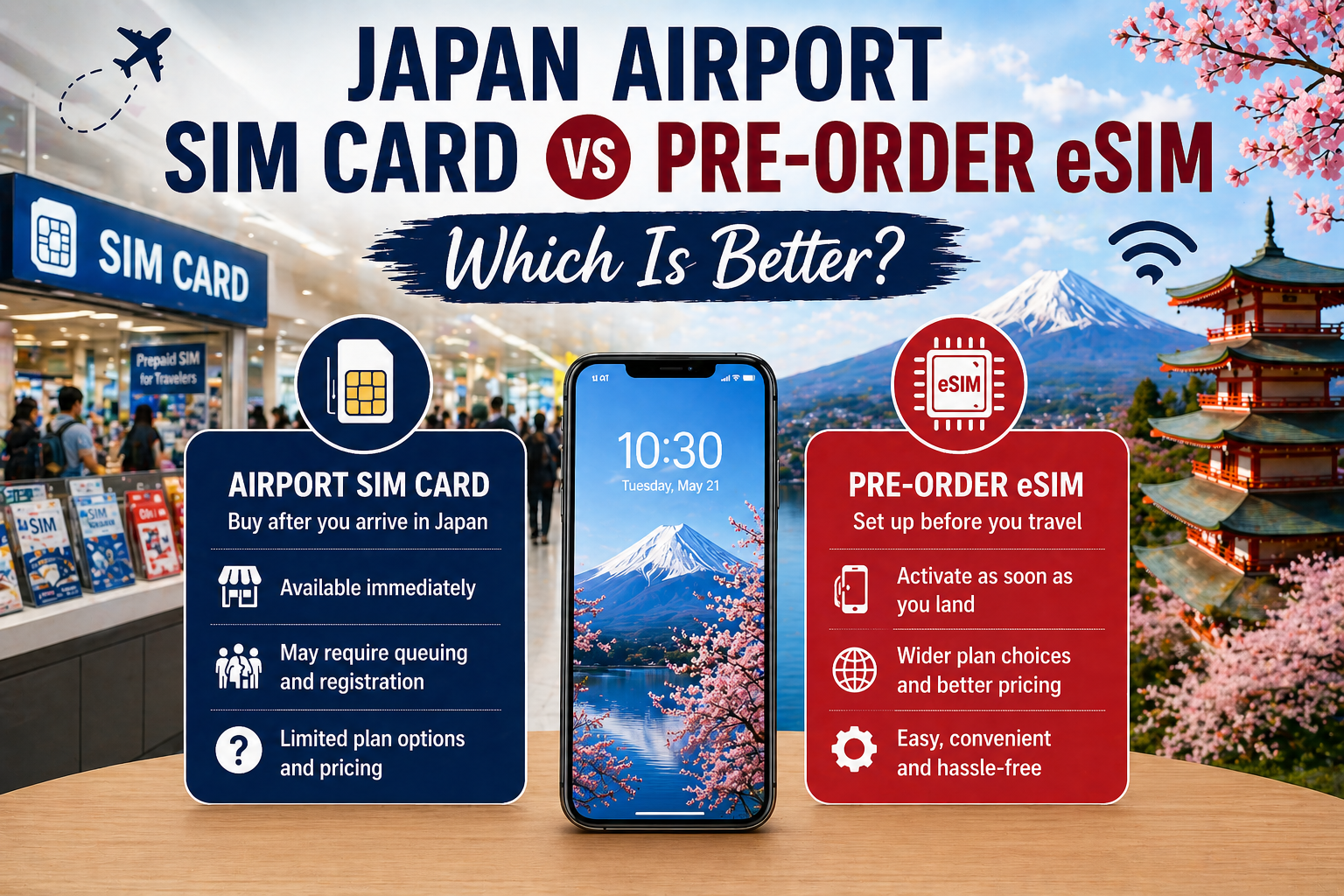
Cost: Airport SIM cards cost $30-50 for limited data (500MB-1GB). Pre-ordered eSIMs cost $15-25 for generous data (5GB-unlimited). Clear advantage: eSIM. Speed and Coverage: Both provide excellent 4G/LTE coverage using major Japanese carriers. There’s negligible difference; both connect to the same networks. Advantage: Tie. Activation Speed: Airport SIM cards require finding a booth, waiting in line, completing paperwork, installing the SIM, and configuring settings typically 30-45 minutes. eSIMs require scanning a QR code and waiting 2-5 minutes. Advantage: eSIM. Flexibility: Airport SIM cards lock you into their package; changing plans mid-trip requires visiting another retailer. eSIMs allow seamless plan changes through their app. Advantage: eSIM. Customer Support: Airport booths offer minimal post-purchase support. eSIM providers typically offer 24/7 English support. Advantage: eSIM. Multi-Country Travel: Using separate airport SIM cards for each country is expensive and complicated. eSIMs allow multiple plans simultaneously. Advantage: eSIM. Device Compatibility: Airport SIM cards work with all phones. eSIMs require modern phone supporting eSIM technology.
Making the Decision: Factors Specific to Your Travel Style
Choose an airport SIM card if: you’re traveling on a tight schedule with last-minute plans and can’t arrange anything in advance; your phone doesn’t support eSIM; you prefer having a physical SIM card rather than digital profiles; you’re only traveling 3-4 days and don’t need excessive data; you want the reassurance of purchasing in person. Choose a pre-ordered eSIM if: you have at least one week before departure (allowing time to order and receive it digitally); your phone supports eSIM (most phones manufactured in the last 5 years do); you’re traveling 5+ days and want good value; you want unlimited or generous data allowances; you want reliable English-language customer support; you’re traveling to multiple countries and want to avoid carrying multiple SIM cards; you want seamless setup without dealing with physical SIM cards; you want flexibility to change plans mid-trip if needed. Most travelers fall into the second category and should choose eSIM.
Hidden Costs and Gotchas to Avoid
Airport SIM hidden costs include overage charges (exceeding data limits results in expensive charges), activation fees (some cards charge $5-10 to activate), and network configuration charges (some require purchasing configuration profiles for $3-5). You end up spending more than advertised. Confirm pricing includes all charges before purchasing. eSIM hidden costs are fewer but include ensuring your phone’s eSIM capability (verify your phone supports eSIM before purchasing), understanding dual SIM functionality (if activating both your home SIM and eSIM, both need to be active simultaneously), and confirming the eSIM works with your home SIM before traveling (some old phones don’t handle dual SIM well). Most modern phones handle this flawlessly. Research your specific phone model’s eSIM compatibility before purchase. Both options have potential roaming charges if you travel outside Japan verify whether your plan includes roaming to adjacent countries if relevant. Alternative Options: When SIM Cards or eSIMs Aren’t Best
Rental WiFi hotspots are small devices providing internet without changing your SIM. This appeals to travelers who want to keep their primary SIM unchanged. However, you carry another device, keep it charged, and pay a daily fee ($5-10/day) that exceeds eSIM daily cost. Hotspots are suitable for travelers unwilling to change SIM settings or traveling briefly. For longer stays, eSIM is superior. International roaming through your home carrier is the most expensive option. Most carriers charge $5-10 daily for full roaming, or $8-10 for limited high-speed data with automatic throttling. For a 10-day trip, this totals $50-100, significantly more than SIM or eSIM options. International roaming is suitable only for travelers needing their primary home number to work throughout their trip and not concerned about cost. For most travelers, it’s unnecessarily expensive. Other options include purchasing a local phone for your trip (impractical for most), relying entirely on WiFi at accommodations (insufficient for true convenience), or traveling without data (stressful and limiting). For modern travel, having personal mobile data is essential for safety, navigation, translation, and enjoyment.
Final Recommendation and Action Steps
For most travelers: Purchase a pre-ordered eSIM 1-2 weeks before departure. Verify your phone supports eSIM. Choose a provider offering unlimited data, English support, and competitive pricing. Ensure you understand the activation process most eSIMs require scanning a QR code and selecting them in phone settings, a process taking 2-5 minutes. Test your eSIM activation immediately upon landing, before leaving the airport. If issues arise, contact support from the airport while you have time to troubleshoot. This approach ensures you have reliable connectivity throughout your trip at excellent value with minimal stress. If your phone doesn’t support eSIM or you’re traveling in the next 3-4 days without time to order: Plan to purchase an airport SIM card, understanding you’re paying premium prices for convenience. Budget $40-50 and allocate 45 minutes at the airport for purchase and setup.
Connected and Ready: Your Japan Journey Awaits
Mobile connectivity in Japan is no longer a luxury it’s essential infrastructure for modern travel. Whether choosing an airport SIM card or pre-ordered eSIM, ensuring connectivity before your trip eliminates one major stress point and enables you to focus on experiencing Japan. With the information provided, you can confidently make the choice matching your specific travel style and needs. Arrive in Japan connected, prepared, and ready to explore this remarkable country. Your seamless connectivity journey starts with making this decision thoughtfully before you board your flight.
Warren Landsman