


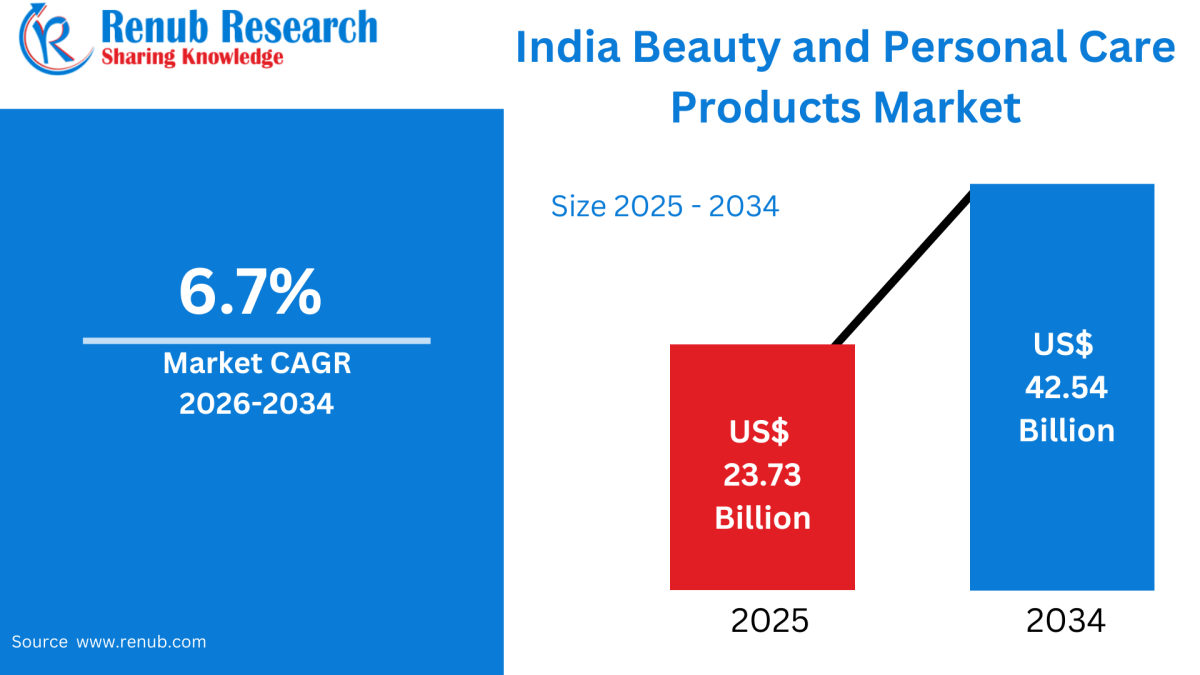
India Beauty and Personal Care Products Market Size and Forecast 2026–2034
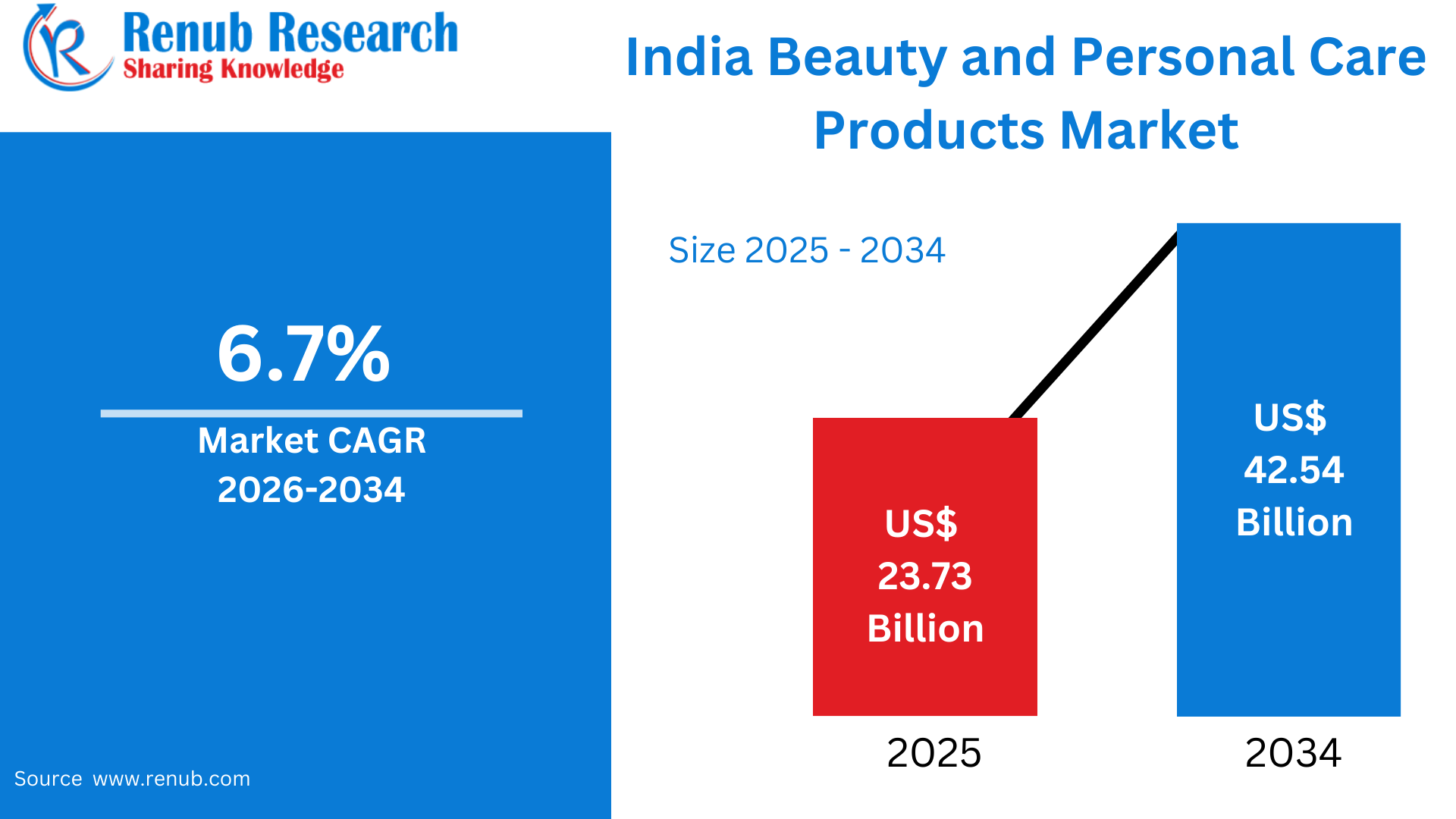
According to Renub Research India beauty and personal care products market is poised for sustained expansion over the forecast period, driven by rising disposable incomes, rapid urbanization, lifestyle transformation, and heightened awareness of grooming and wellness. The market, valued at US$ 23.73 billion in 2025, is projected to reach US$ 42.54 billion by 2034, registering a CAGR of 6.7% during 2026–2034. This consistent growth reflects India’s transition into a consumption-led economy where personal appearance, hygiene, and self-care are becoming integral to everyday life across age groups, genders, and income segments.
The growing influence of digital media, e-commerce expansion, and increasing demand for herbal, natural, and Ayurvedic products are reshaping purchasing behavior. Both mass-market and premium brands are benefiting from deeper market penetration in urban, semi-urban, and increasingly rural regions, making beauty and personal care one of the most resilient and opportunity-rich segments of India’s consumer goods landscape.
Download Free Sample Report:https://www.renub.com/request-sample-page.php?gturl=india-beauty-personal-care-products-market-p.php
Indian Beauty and Personal Care Market Outlook
Beauty and personal care products encompass a wide range of items used for cleansing, protecting, grooming, and enhancing the human body. This includes skin care, hair care, oral care, color cosmetics, fragrances, grooming aids, and hygiene products. These products serve both functional and emotional needs, supporting health, confidence, and self-expression.
In India, the demand for beauty and personal care products has accelerated due to changing lifestyles, higher standards of hygiene, and increasing emphasis on self-care. Consumers across genders and age groups are now more aware of skincare routines, hair health, oral hygiene, and grooming practices. The influence of social media, beauty influencers, celebrity endorsements, and digital marketing has further fueled product adoption. Additionally, the strong cultural alignment with Ayurveda and herbal wellness has positioned India as a unique market where tradition and modern beauty trends coexist and reinforce each other.
Rising Disposable Income and Urbanization
Increasing disposable income and rapid urbanization are among the most important drivers of the Indian beauty and personal care products market. With urban areas expected to house over half of India’s population by 2050 and contribute nearly two-thirds of GDP, consumer exposure to modern lifestyles and global beauty standards is increasing steadily.
Urban and semi-urban consumers demonstrate higher spending on skincare, haircare, cosmetics, and premium personal care products. Working professionals place greater importance on appearance, grooming, and wellness, which directly supports demand growth. This trend is no longer confined to metropolitan cities; tier-2 and tier-3 cities are showing rising aspirations and willingness to spend on quality and branded products. The expansion of malls, modern retail formats, and exclusive beauty stores further accelerates market growth by improving product accessibility and brand visibility.
Growing Demand for Natural, Herbal, and Ayurvedic Products
A strong shift toward natural, herbal, and Ayurvedic beauty and personal care products is reshaping the Indian market. Concerns over chemical ingredients, long-term side effects, and skin sensitivity are encouraging consumers to choose plant-based, organic, and traditionally inspired formulations. India’s long-standing association with Ayurveda provides authenticity and trust to herbal personal care products.
Consumers increasingly perceive Ayurvedic and natural products as safer, gentler, and more effective for long-term use. This preference spans skincare, haircare, oral care, and personal hygiene categories. Brands that combine traditional Ayurvedic knowledge with modern scientific research are gaining strong acceptance. This trend cuts across age groups and income segments, making herbal and natural products one of the fastest-growing segments in the Indian beauty and personal care market.
Digital Influence and E-commerce Expansion
Digital transformation and the rapid growth of e-commerce are significantly influencing the Indian beauty and personal care products market. Social media platforms, online beauty tutorials, influencer content, and targeted digital advertising play a critical role in shaping consumer preferences.
E-commerce platforms provide consumers with access to a wide range of domestic and international brands, detailed product information, user reviews, and competitive pricing. Smartphone penetration, especially in tier-3 and tier-4 cities, is expanding the digital consumer base. Direct-to-consumer (D2C) models allow brands to engage directly with customers, launch new products quickly, and personalize offerings. As online trust improves and logistics become more efficient, e-commerce is emerging as a key growth channel for beauty and personal care products in India.
Intense Competition and Price Sensitivity
Despite strong growth prospects, the Indian beauty and personal care market faces intense competition. The presence of numerous domestic brands, global players, startups, and unorganized local manufacturers creates a highly crowded marketplace. Price sensitivity remains high, particularly in mass-market categories such as soaps, shampoos, toothpaste, and hair oils.
Frequent discounts, promotional offers, and competitive pricing pressure profit margins. New entrants face high marketing costs to establish brand recognition and trust. Differentiation based on quality, performance, branding, and ingredient transparency is becoming increasingly challenging. Sustaining long-term growth requires continuous innovation, efficient supply chains, and strong brand positioning.
Regulatory Compliance and Product Safety Challenges
Regulatory compliance and product safety are critical challenges in the Indian beauty and personal care market. Products must adhere to strict regulations related to formulation, labeling, ingredient usage, and quality standards. Frequent regulatory updates increase compliance complexity and operational costs, particularly for smaller manufacturers.
The presence of counterfeit products, mislabeling, and inconsistent quality can negatively affect consumer trust. Ensuring consistent quality across extensive distribution networks is another challenge. Companies must invest in quality assurance, transparent sourcing, and regulatory expertise to maintain credibility and long-term competitiveness in the market.
Indian Organic Beauty and Personal Care Products Market
The organic beauty and personal care products segment in India is witnessing rapid growth as consumers increasingly seek chemical-free and eco-friendly alternatives. Awareness about the potential adverse effects of synthetic ingredients is encouraging the adoption of organic skincare, haircare, oral care, and hygiene products.
Indian consumers’ belief in traditional wellness practices strengthens the appeal of organic and Ayurvedic formulations. Products made from plant-based, ethically sourced ingredients are gaining traction among environmentally conscious and health-focused consumers. This segment is expected to remain a major growth driver within the broader beauty and personal care market.
Indian Skin Care Products Market
The skin care products market is one of the fastest-growing categories in India’s beauty and personal care sector. Rising concerns about pollution, sun exposure, and premature aging have increased demand for moisturizers, cleansers, sunscreens, serums, and anti-aging products.
Dermatologist-recommended products, personalized skincare solutions, and derma-cosmetic formulations are gaining popularity. Both men and women are increasingly adopting multi-step skincare routines influenced by digital content and professional advice. Changing climatic conditions and lifestyle patterns further reinforce the importance of skin care in daily routines.
India Beauty and Personal Care Mass Products Market
Mass products dominate the Indian beauty and personal care market in terms of volume due to their affordability and widespread reach. Daily-use items such as soaps, shampoos, hair oils, and toothpaste drive consistent demand.
Strong brand recognition, affordable pricing, and extensive distribution through traditional and modern retail channels support high sales volumes. Despite the rise of premium products, mass-market offerings will continue to remain essential due to India’s price-conscious consumer base and large population.
India Beauty and Personal Care Specialty Stores Market
Specialty beauty and personal care stores are gaining prominence due to their curated product selection and enhanced shopping experience. These stores focus on skincare, cosmetics, fragrances, and premium personal care products, offering professional guidance and product trials.
Urban consumers prefer specialty stores for authentic products, expert advice, and personalized service. The organized retail experience and trust associated with specialty stores support higher-value purchases and brand loyalty, particularly in premium and niche categories.
India Female Beauty and Personal Care Products Market
The female beauty and personal care products market in India continues to grow steadily, driven by increasing workforce participation, higher disposable income, and evolving perceptions of beauty and self-care. Women across age groups are investing more in skincare, cosmetics, grooming, and wellness products.
Brands are increasingly offering specialized products tailored to different life stages, skin types, and personal preferences. Digital platforms, beauty influencers, and online tutorials strongly influence purchase decisions. A growing focus on individuality, confidence, and self-expression positions female-focused beauty products as a major growth engine.
Maharashtra Beauty and Personal Care Products Market
Maharashtra represents one of the largest and most developed beauty and personal care markets in India. Cities such as Mumbai, Pune, and Nagpur drive strong demand for skincare, haircare, cosmetics, fragrances, and grooming products.
High urbanization, strong purchasing power, and exposure to global beauty trends support the adoption of premium, dermatologically tested, and natural products. The presence of modern retail formats, specialty stores, and robust e-commerce infrastructure further accelerates market growth in the state.
Uttar Pradesh Beauty and Personal Care Products Market
Uttar Pradesh offers significant growth opportunities due to its large population and improving retail infrastructure. Urban centers such as Noida, Ghaziabad, Lucknow, and Kanpur are witnessing increasing demand for skincare, haircare, oral care, and grooming products.
Mass-market products dominate due to price sensitivity, while branded and herbal products are gaining traction in urban and semi-urban areas. Rising income levels, better digital access, and lifestyle aspirations are positioning Uttar Pradesh as a high-volume, high-growth market.
Telangana Beauty and Personal Care Products Market
Telangana’s beauty and personal care products market is expanding due to growing awareness of grooming, hygiene, and wellness. Urban centers such as Hyderabad drive demand for skincare, haircare, and cosmetic products.
The state shows strong affinity for herbal and Ayurvedic personal care items, reflecting cultural preferences for natural remedies. Improved distribution, digital penetration, and social media influence are shaping purchase decisions and supporting steady growth across categories.
Gujarat Beauty and Personal Care Products Market
Gujarat’s beauty and personal care market is driven by economic activity, value-conscious consumers, and a preference for durable and cost-effective products. Cities like Ahmedabad, Surat, and Vadodara show increasing demand for skincare, haircare, grooming, and hygiene products.
While mass and mid-range products dominate, awareness of herbal and natural offerings is increasing. Well-developed distribution networks and rising health consciousness support Gujarat’s continued contribution to national market growth.
Market Segmentation Overview
The India beauty and personal care products market is segmented by type into conventional and organic products. By product category, it includes skincare, haircare, color cosmetics, fragrances, and others. Pricing segments include mass and premium products. Distribution channels comprise supermarkets and hypermarkets, specialty stores, e-commerce, and others. End users include male and female consumers. Key states driving growth include Maharashtra, Tamil Nadu, Karnataka, Gujarat, Uttar Pradesh, West Bengal, Rajasthan, Telangana, Andhra Pradesh, and Madhya Pradesh.
Competitive Landscape and Company Analysis
The competitive landscape includes global chemical and ingredient suppliers as well as integrated players supporting the beauty and personal care industry. Major companies covered in the market analysis include BASF SE, China Petrochemical Corporation, Daelim Co. Ltd, Exxon Mobil Corporation, Formosa Plastics Corporation, HPCL-Mittal Energy Limited, INEOS, LG Chem Ltd., LyondellBasell Industries N.V., and Sumitomo Chemical Co. Ltd..
renubresearch