
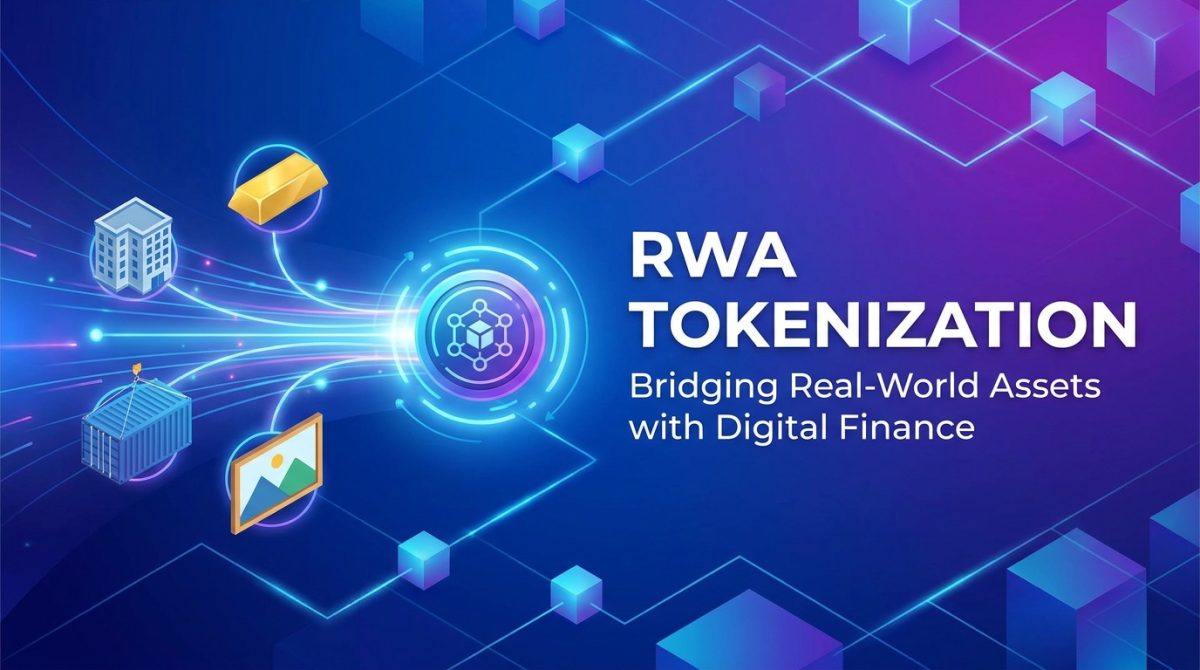
Real-world asset tokenization has moved from a blockchain experiment to one of the most closely watched developments in digital finance. The idea is straightforward but powerful: assets that exist outside the blockchain, such as real estate, bonds, private credit, commodities, invoices, carbon credits, or investment funds, can be represented as digital tokens on a blockchain. These tokens can carry ownership rights, income rights, redemption rights, or other legally defined economic claims. For businesses, this opens a new model for asset issuance and investment access. For investors, it can make traditionally difficult-to-access assets more transparent, divisible, and digitally manageable.
The market is already showing meaningful momentum. RWA.xyz reported more than $27 billion in distributed asset value and more than 700,000 total asset holders across tracked tokenized real-world asset categories in July 2026. McKinsey has estimated that tokenized market capitalization across asset classes could reach about $2 trillion by 2030, excluding cryptocurrencies and stablecoins, with a more optimistic scenario reaching around $4 trillion. These numbers suggest that tokenization is no longer only a niche Web3 concept; it is becoming part of a wider conversation about the modernization of financial infrastructure.
Developing an RWA tokenization platform, however, is not as simple as creating a token and listing it for sale. A successful platform must connect blockchain technology with legal agreements, compliance systems, asset custody, investor verification, payment flows, reporting tools, and secondary transfer rules. This educational overview explains how RWA tokenization platforms are developed, what features matter most, what challenges businesses must consider, and why the strongest platforms are built at the intersection of finance, law, and technology.
Understanding RWA Tokenization Platform Development
An RWA tokenization platform is a digital system that allows real-world assets to be converted into blockchain-based tokens and managed throughout their lifecycle. In practical terms, the platform helps asset owners issue tokens, onboard investors, automate compliance checks, distribute income, maintain ownership records, and support transfers or redemptions according to legal and business rules.
A professional RWA Tokenization Company usually supports this process by combining blockchain engineering with asset structuring, user experience design, smart contract development, wallet integration, KYC/AML workflows, and platform deployment. Businesses also use RWA Tokenization Services when they need help with token creation, regulatory-ready architecture, investor dashboards, admin modules, and marketplace features. In the broader field of Real World Asset Tokenization, the goal is not just to digitize an asset but to create a reliable bridge between off-chain value and on-chain ownership representation.
This is where beginners often misunderstand the concept. The token itself is only one layer of the system. The real value comes from the full infrastructure behind it: the legal wrapper that defines investor rights, the custodian that safeguards the underlying asset, the smart contracts that control token behavior, and the compliance engine that ensures only eligible participants can buy or transfer tokens.
How an RWA Tokenization Platform Works
An RWA tokenization platform begins with asset identification. The issuer must decide which asset will be tokenized and whether it is suitable for digital representation. Good candidates usually have clear ownership, reliable valuation, stable documentation, and a practical investment use case. Real estate, Treasury-backed products, private credit portfolios, gold reserves, and fund units are common examples because they have measurable value and can be connected to enforceable rights.
The next step is legal structuring. This is one of the most important parts of the entire development process. A token cannot simply claim to represent an asset unless there is a legal framework behind that claim. Depending on the asset type and jurisdiction, the token may represent equity in a special purpose vehicle, a debt instrument, fund units, revenue-sharing rights, or a redeemable claim against an underlying asset. Without this structure, investors may hold a token without clear protection.
Once the legal model is defined, developers create the token architecture. The token may be fungible, where every token has the same value and rights, or non-fungible, where each token represents a distinct asset or claim. Smart contracts define how tokens are minted, transferred, restricted, redeemed, or burned. If the asset is regulated, the smart contract may include permissioned transfer rules so that only verified investors can hold or trade the token.
The platform then connects these smart contracts with user-facing applications. Investors need dashboards where they can browse assets, complete verification, review documents, purchase tokens, view holdings, and track distributions. Administrators need tools to approve users, manage assets, monitor transactions, update compliance rules, and generate reports. A complete platform also integrates wallets, payment gateways, custody systems, and data feeds.
Core Steps to Develop an RWA Tokenization Platform
The first development step is business model planning. The platform owner must define what kind of assets will be tokenized, who the target investors are, which jurisdictions will be served, and how the platform will generate revenue. For example, a platform focused on tokenized real estate may need property valuation tools and rental income distribution, while a platform focused on private credit may need loan monitoring, borrower reporting, and yield calculation modules.
The second step is regulatory and legal planning. Because many tokenized assets may be treated as securities or investment products, compliance cannot be added as an afterthought. The platform should be designed around investor eligibility, disclosure obligations, transfer restrictions, tax considerations, and reporting requirements. This is especially important for platforms serving multiple regions because investor protection rules differ across jurisdictions.
The third step is technical architecture design. Developers must choose the blockchain network, token standard, smart contract framework, backend infrastructure, database model, wallet system, and integration layers. Public blockchains may provide transparency and broader ecosystem access, while private or permissioned networks may offer greater control and privacy for institutional use cases.
The fourth step is smart contract development. Smart contracts should handle token issuance, ownership updates, compliance checks, income distribution, redemption, and administrative controls. They must be tested carefully because errors in smart contract logic can create financial loss or compliance failures.
The fifth step is platform development. This includes the investor portal, issuer dashboard, admin panel, document repository, payment interface, wallet connection, notification system, reporting engine, and security controls. Once development is complete, the platform should undergo smart contract audits, penetration testing, compliance review, and user acceptance testing before launch.
Important Features of an RWA Tokenization Platform
A well-developed RWA tokenization platform needs more than basic token issuance. Its features should support the full asset lifecycle from onboarding to exit. Investor onboarding is one of the most important modules. It typically includes account creation, identity verification, KYC/AML checks, investor accreditation where required, wallet connection, and risk disclosure acceptance.
The asset management module allows issuers to upload asset details, valuation reports, legal documents, images, financial statements, and performance updates. This improves transparency and helps investors evaluate opportunities before committing funds.
Smart contract automation is another essential feature. The platform should support automated token issuance, transfer restrictions, dividend or yield distribution, redemption workflows, and supply management. For income-generating assets, automated distribution can reduce manual work and create a clearer record of payments.
Compliance controls are critical. The system should maintain whitelists, restrict unauthorized transfers, monitor investor limits, and generate audit logs. For regulated tokenized assets, compliance automation helps reduce operational risk and supports long-term platform credibility.
Secondary transfer or marketplace functionality may also be useful, but it must be designed carefully. Tokenization can improve the conditions for liquidity, but research on RWA markets shows that on-chain representation and actual liquidity are different outcomes. One 2026 study found that tokenized RWA liquidity varies widely across asset categories and that asset value alone does not reliably predict trading activity.
Real-World Examples and Market Direction
Institutional adoption is one reason RWA tokenization has gained credibility. BlackRock launched its first tokenized fund, BUIDL, on Ethereum through Securitize, showing how traditional asset managers are exploring blockchain-based fund infrastructure. Tokenized Treasury products, private credit, commodities, and fund units have become especially visible because they connect blockchain efficiency with familiar financial assets.
Real estate is also one of the most promising use cases. Deloitte predicts that tokenized real estate could grow from less than $0.3 trillion in 2024 to $4 trillion by 2035, driven by fractional ownership, broader investor participation, and new digital investment models. This does not mean every property will be tokenized, but it does suggest that real estate finance may gradually adopt more digital, programmable ownership structures.
Private credit is another strong use case. A platform can tokenize exposure to loan portfolios, automate investor reporting, and distribute yield based on repayment schedules. Commodity tokenization can represent assets such as gold or other reserves, provided custody and audit systems are strong. Invoice tokenization can help businesses convert receivables into tradable or investable digital assets.
These examples show that RWA tokenization works best when it solves a real market problem. The purpose should not be to use blockchain for novelty. The purpose should be to improve access, settlement, transparency, asset administration, or capital formation.
Challenges in RWA Tokenization Platform Development
The biggest challenge is legal enforceability. A blockchain token must be backed by real contracts, real assets, and real rights. If the legal structure is weak, token holders may face uncertainty during disputes, insolvency, asset sale, or redemption. A 2026 taxonomy of RWA systems found that many deployed models use hybrid architectures, where blockchain supports token representation and transfer control while core legal guarantees remain anchored in off-chain legal wrappers, custody arrangements, compliance processes, and verification systems.
Custody is another major issue. If a token represents gold, the gold must be stored and audited. If it represents real estate, property ownership and management must be handled properly. If it represents credit, repayment data and borrower performance must be verified. Blockchain can record token transactions, but it cannot independently guarantee that the off-chain asset is safe, profitable, or accurately valued.
Liquidity risk also matters. Many businesses promote tokenization as a liquidity solution, but liquidity depends on demand, market access, investor trust, regulatory permission, and trading infrastructure. A tokenized asset can still be illiquid if there are few buyers or if transfers are heavily restricted.
Security is equally important. Smart contracts must be audited, admin keys must be protected, user data must be secured, and platform access must be monitored. Since RWA platforms connect financial assets with digital systems, they must be built with strong cybersecurity standards from the beginning.
Conclusion
Developing an RWA tokenization platform requires more than blockchain development; it requires a complete framework that combines asset selection, legal structuring, token design, compliance automation, investor onboarding, custody integration, smart contract security, and lifecycle management. As real-world asset tokenization continues to grow, businesses that build reliable and regulation-ready platforms will be better positioned to unlock new investment models and improve asset accessibility. For startups, enterprises, and asset owners looking to enter this space, Blockchain App Factory provides the best services for building secure, scalable, and feature-rich RWA tokenization platforms tailored to real business needs.
FAQs
1. What is an RWA tokenization platform?
An RWA tokenization platform is a blockchain-based system that allows real-world assets such as real estate, commodities, private credit, funds, or invoices to be represented as digital tokens and managed through smart contracts and compliance workflows.
2. How do you develop an RWA tokenization platform?
Development usually involves asset selection, legal structuring, token design, smart contract development, KYC/AML integration, wallet setup, investor dashboard creation, admin panel development, security testing, and platform deployment.
3. What assets can be tokenized on an RWA platform?
Common assets include real estate, Treasury-backed products, private credit, gold, commodities, invoices, carbon credits, intellectual property, and investment fund units.
4. Is RWA tokenization legally compliant?
RWA tokenization can be compliant when it follows applicable securities laws, property laws, tax rules, investor verification requirements, and jurisdiction-specific regulations. Legal structuring is essential before launching any asset-backed token.
5. Why should businesses use professional RWA tokenization services?
Professional services help businesses manage the technical, legal, compliance, and security challenges of tokenization. They support smart contract development, platform architecture, investor onboarding, asset management, and post-launch scalability.
Charles Franklin