


Real-time communication has become a foundational expectation in today’s digital-first logistics environment, especially as consumers increasingly rely on mobile platforms for quick, dependable services. Pickup and delivery apps must provide accurate updates, seamless messaging, and instant alerts to keep users informed at every stage of their order journey. As businesses explore options such as on demand delivery app development, they must prioritize communication systems that enhance transparency, strengthen trust, and support operational efficiency across all stakeholders.
Evolving communication expectations in pickup and delivery apps
Consumer expectations for instant information have never been higher. As delivery services scale, real-time communication is essential to reduce uncertainty and keep customers continuously informed. Users expect immediate confirmations, time-stamped updates, location information, and quick access to support teams. Meeting these expectations requires platforms that combine precise tracking technology with reliable communication channels that can operate across multiple devices and network conditions.
Businesses also recognize the operational advantages of seamless communication. Delivery agents, dispatchers, and support teams benefit from synchronized data and automated notifications that prevent misalignment. The overall ecosystem functions efficiently when messaging tools, tracking systems, and status updates work together without interruption.
Role of real time connectivity in modern logistics app workflows
Modern delivery workflows depend heavily on uninterrupted connectivity, as each stage of the order cycle involves time-sensitive exchanges of information. Real-time connectivity ensures that both customers and service providers remain aware of any changes occurring during packaging, pickup, transit, or drop-off. This framework helps minimize basic but costly misunderstandings.
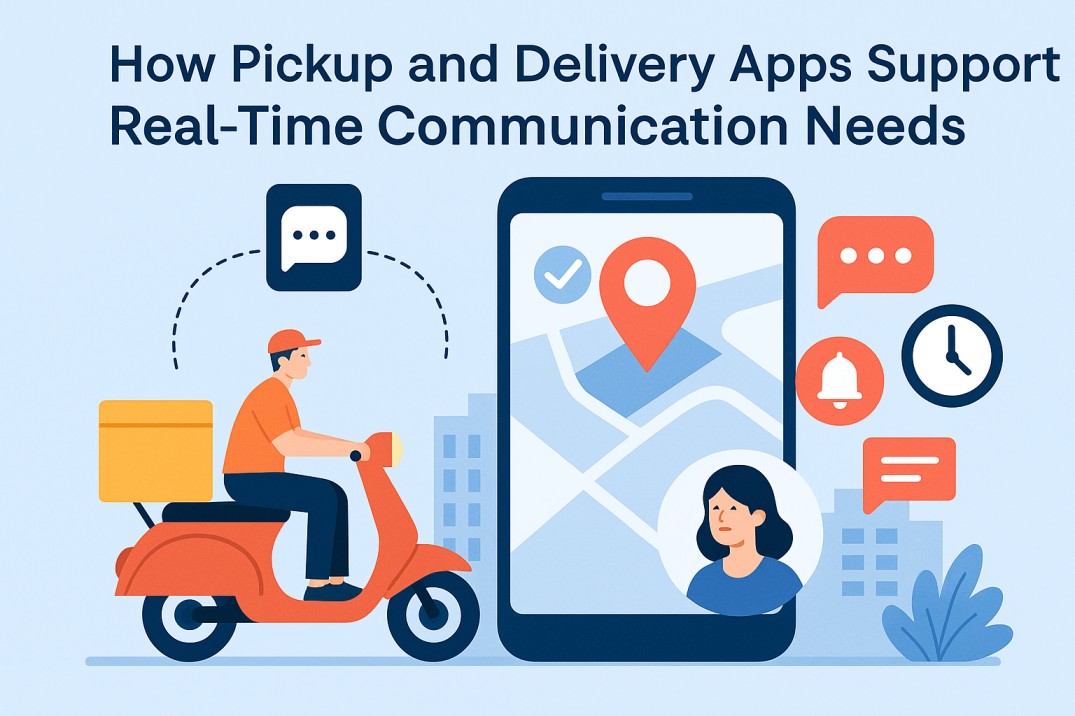
Effective real-time communication in logistics apps typically involves:
- Live location sharing between drivers and customers
- Automated push notifications at each status change
- Instant messaging for clarifications or special instructions
- Real-time alerts for route changes or delays
- Backend synchronization for dispatch teams
These elements support fast decision-making and allow companies to maintain high service reliability, especially during peak demand periods.
Core communication features shaping digital delivery interactions
Communication features define how users interact with a delivery platform, and their performance can significantly impact user satisfaction. Customers rely on intuitive features that simplify interactions and reduce the need for manual follow-ups. Businesses exploring on demand delivery app development must consider the value of integrating communication capabilities that enhance overall user experience.
Some essential communication features include:
- Order confirmation messages that reassure customers their requests have been received and processed.
- Driver communication tools that allow both parties to coordinate drop-off details.
- In-app chat systems that offer quick resolutions to simple issues without requiring phone calls.
- Delivery time estimations that adjust dynamically based on movement data.
- Automated alerts that instantly inform customers about delays or new expected arrival times.
These features help build trust and reduce the anxiety that often surrounds time-sensitive deliveries.
How real time updates reduce operational delays and confusion
Operational delays in logistics usually stem from miscommunication, lack of visibility, or outdated information. Real-time updates eliminate these issues by keeping every participant informed from the moment an order is placed until final delivery. Delivery agents benefit from optimized routes and timely instructions that prevent unnecessary detours or repeated attempts.
Critical advantages of real-time updates include:
- Improved route accuracy: Drivers receive immediate guidance when traffic patterns change.
- Reduced customer inquiries: Transparent tracking minimizes the need for status-related questions.
- Lower risk of missed deliveries: Customers stay prepared for arrival windows.
- Consistent coordination: Dispatch teams maintain oversight through live dashboards.
Businesses that deploy robust update systems also reduce losses caused by delivery failures, fuel mismanagement, and repeated customer support interactions.
Communication driven efficiency benefits for drivers and users
Communication tools directly influence the working efficiency of delivery personnel. Drivers rely heavily on app-based instructions, confirmations, and customer interactions to manage daily tasks effectively. When communication flows smoothly, drivers can complete more tasks within shorter time frames.
Key benefits include:
- Clear task assignment: Drivers receive accurate pickup and drop-off details without confusion.
- Fewer manual calls: In-app communication reduces interruptions during driving.
- Higher task completion rates: Efficient instructions lead to more successful deliveries.
- Improved customer satisfaction: Users appreciate timely communication and courteous coordination.
For customers, efficiency translates into punctual deliveries, better visibility, and a more predictable service experience. The entire delivery cycle becomes simpler, more transparent, and more dependable.
Integrating automation to strengthen reliability of app communication
Automation has become a vital element in real-time communication systems. Automated notifications and workflows reduce the need for human intervention and ensure that users receive updates at precisely the right moments. Automation also decreases the chances of errors that can occur when information is manually entered or delayed.
Examples of automation within delivery communication systems include:
- Auto-dispatching frameworks that allocate orders to the most suitable drivers.
- Predictive delivery times generated from real-time data and historical trends.
- Instant alerts triggered as soon as drivers reach predefined routing points.
- Smart responses that help customers navigate common issues quickly.
Automation not only boosts accuracy but also contributes to scalability, enabling platforms to operate consistently even during periods of heavy demand.
Key development considerations for scalable real time platforms
Building a communication-rich delivery app requires more than integrating simple messaging tools. Development teams must consider scalability, data synchronization, and responsiveness across varying network environments. Organizations exploring on demand delivery app development also evaluate factors such as performance optimization, latency reduction, and system redundancy.
Some important development considerations include:
- Cloud-native architecture for reliable scalability
- WebSocket or MQTT protocols for low-latency communication
- Efficient database structuring for real-time data access
- Load balancing systems to maintain performance during peak usage
- Cross-platform compatibility to ensure seamless functionality on all devices
- User-friendly interface designs that simplify interactions
In addition, financial planning requires understanding delivery app development cost, as communication features significantly influence overall budgeting.
Future communication trends shaping next generation delivery apps
The evolution of digital logistics continues to introduce new communication-driven possibilities. As technology advances, delivery apps are expected to incorporate more intelligent, adaptive, and personalized communication tools. These enhancements aim to improve operational excellence and customer satisfaction while reducing friction throughout the delivery lifecycle.
Emerging trends include:
- AI-powered chat assistants that solve customer queries instantly
- Context-aware notifications that adapt based on user behavior
- Enhanced driver-assist tools powered by machine learning
- Voice-based instructions for hands-free driver communication
- Predictive delivery insights that warn users of potential delays earlier than ever
Businesses adopting these innovations may rely on platforms like a white label delivery app or build custom systems supported by MVP app development services to accelerate their deployment timelines.
Security and privacy factors guiding communication design choices
Communication systems in delivery apps must prioritize data security and user privacy. Since messaging tools and tracking features collect sensitive information, platforms must adhere to secure protocols and transparent policies. Protecting communication channels ensures that personal data, location information, and operational records remain safe from unauthorized access.
Important security considerations include:
- End-to-end encryption for messaging
- Secure authentication layers for users and drivers
- Regular audits and vulnerability checks
- Transparent data handling policies
- Compliance with regional and international privacy regulations
A secure communication environment strengthens user confidence and supports long-term platform credibility.
Conclusion
Real-time communication plays a crucial role in ensuring that pickup and delivery services operate smoothly, efficiently, and reliably. By integrating intelligent features, automation, and robust connectivity frameworks, delivery platforms can enhance user experience while optimizing operational workflows. As technology continues to evolve, communication systems will remain central to innovation, shaping the future of how goods move across digital and physical landscapes.
Jhon