
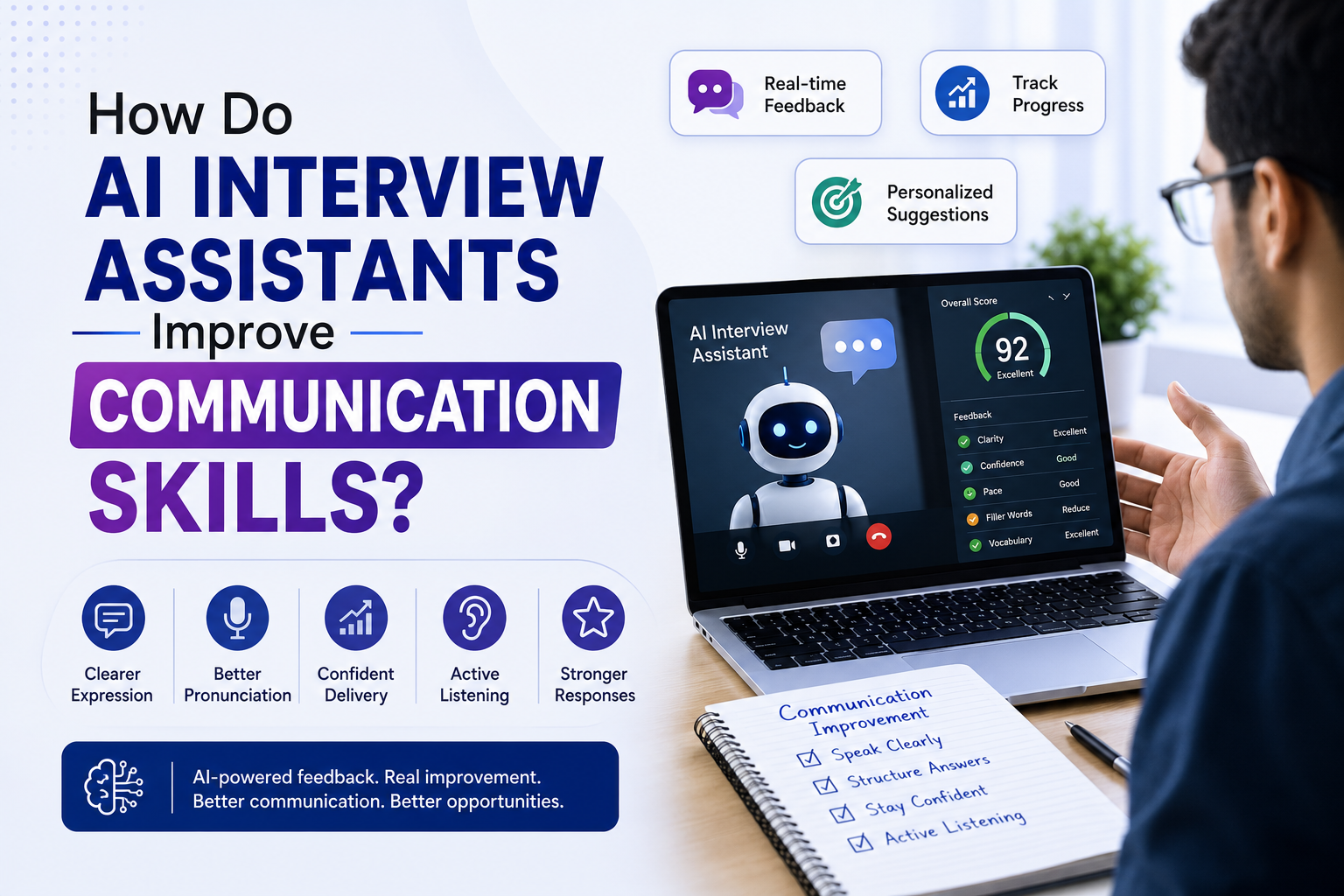
Communication shapes every stage of a job interview. Strong answers alone rarely create a lasting impression if they lack clarity, confidence, or structure. Many candidates struggle to organize thoughts under pressure, maintain steady speech, and respond with precision. AI interview assistants address these challenges through realistic practice sessions, instant feedback, and targeted improvement suggestions. As a result, users build stronger speaking habits, improve interview readiness, and communicate ideas more effectively across different professional situations.

Why does communication matter during job interviews?
Clear communication helps employers evaluate more than technical knowledge. Every response reflects a candidate’s ability to organize information, solve problems, and interact with colleagues. Even highly qualified applicants can lose opportunities when messages become confusing or inconsistent.
Moreover, communication extends beyond spoken words. Tone, pacing, confidence, vocabulary, and logical flow all influence how interviewers interpret responses. Candidates who communicate effectively often appear more prepared, reliable, and capable of handling workplace responsibilities.
Strong communication also creates meaningful conversations rather than scripted exchanges. Instead of memorizing answers, candidates who communicate naturally adapt to unexpected questions while maintaining professionalism.
Consequently, improving communication becomes one of the most valuable investments for anyone preparing for interviews across different industries.
How Do AI Interview Assistants Support Communication Development?
Modern AI interview assistants simulate realistic interview conversations while analyzing multiple aspects of verbal performance. Rather than simply checking whether an answer is correct, these systems evaluate how information is presented.
Personalized Speaking Analysis
Each practice session generates detailed feedback based on individual performance.
Common evaluation areas include:
- Speaking clarity
- Response organization
- Grammar consistency
- Vocabulary selection
- Sentence length
- Confidence indicators
- Filler word frequency
- Speech pacing
Furthermore, repeated sessions allow users to compare progress over time, making communication improvement measurable instead of subjective.
Realistic Interview Practice
Simulated interviews recreate professional interview environments that encourage natural responses.
Practice commonly includes:
- Behavioral questions
- Technical scenarios
- Leadership discussions
- Situational challenges
- Problem-solving exercises
- Role-specific conversations
As candidates repeat these sessions, communication gradually becomes more fluent under pressure.
Building a Clearer Response Structure
Many candidates possess valuable knowledge but struggle to communicate ideas logically. AI interview assistants encourage structured thinking before speaking.
Organizing Thoughts More Effectively
Well-organized answers typically include:
- A direct response
- Supporting explanation
- Relevant example
- Clear conclusion
This sequence allows interviewers to follow each response without confusion.
Additionally, structured communication reduces unnecessary repetition while improving confidence.
Reducing Rambling
Lengthy answers often weaken interview performance. AI systems identify responses that drift away from the original question.
Instead of speaking continuously without direction, candidates receive suggestions that encourage concise communication while preserving important details.
Consequently, each answer becomes easier to follow and more persuasive.
Improving Verbal Confidence
Confidence influences how messages are received. Even accurate answers may appear uncertain when delivered with hesitation.
AI interview assistants help candidates build confidence through repeated exposure to interview scenarios.
Consistent Practice Builds Comfort
Frequent interview simulations reduce anxiety because users become familiar with different questioning styles.
Over time, candidates become more comfortable:
- Starting responses quickly
- Maintaining eye-level conversation
- Completing thoughts clearly
- Speaking naturally
- Handling follow-up questions
Therefore, confidence develops through repetition rather than memorization.
Managing Speaking Pace
Speaking too quickly often creates confusion. Conversely, speaking too slowly may reduce engagement.
AI evaluation tools identify pacing problems by analyzing speech patterns throughout each response.
Recommended improvements often encourage users to:
- Pause naturally
- Emphasize important ideas
- Avoid rushing
- Maintain conversational rhythm
As a result, communication becomes easier to follow while sounding more professional.
Reducing Filler Words
Filler words interrupt communication and weaken professional credibility.
Common examples include:
- Um
- Uh
- Like
- You know
- Basically
- Actually
AI interview assistants automatically detect excessive filler usage throughout practice sessions.
Replacing Fillers With Purposeful Pauses
Instead of inserting unnecessary words, candidates gradually replace them with brief pauses.
Moreover, thoughtful pauses provide extra time to organize ideas before continuing.
This adjustment produces several benefits:
- Stronger confidence
- Improved clarity
- Better listening experience
- More polished delivery
- Greater interviewer engagement
Consequently, responses sound deliberate rather than rushed.
Strengthening Vocabulary Without Sounding Artificial
Professional communication depends on choosing appropriate words rather than overly complicated language.
AI interview assistants often recommend vocabulary improvements that increase clarity without making responses sound rehearsed.
Selecting Stronger Professional Language
Candidates gradually replace vague expressions with more precise alternatives.
Examples include:
- Explained instead of talked
- Improved instead of fixed
- Coordinated instead of helped
- Delivered instead of did
- Resolved instead of handled
These adjustments make responses more specific while remaining natural.
Furthermore, improved vocabulary allows candidates to communicate accomplishments more effectively.
Enhancing Active Listening Skills
Communication involves listening as much as speaking. Interview success depends on answering the actual question rather than assuming its meaning.
AI interview assistants strengthen listening habits by presenting varied question formats that require thoughtful interpretation.
Responding More Accurately
Instead of relying on prepared scripts, users practice identifying the interviewer’s primary objective before responding.
Effective listening encourages candidates to:
- Identify key topics
- Focus on required details
- Avoid unrelated information
- Clarify uncertain questions
- Provide complete responses
Consequently, conversations become more meaningful and relevant.
Improving Storytelling During Interviews
Professional storytelling helps interviewers evaluate decision-making, leadership, teamwork, and problem-solving abilities.
However, many candidates either provide too little information or overwhelm interviewers with unnecessary details.
AI interview assistants encourage balanced storytelling that remains focused throughout each response.
Creating Memorable Examples
Strong interview stories usually include:
- The situation
- The challenge
- The actions taken
- The outcome
- The measurable impact
Moreover, structured storytelling keeps responses engaging while highlighting professional strengths naturally.
Supporting Different Interview Styles
Not every interview follows the same format. Communication expectations vary depending on the position, industry, and hiring process.
AI interview assistants prepare users for multiple interview environments.
Common practice categories include:
- Entry-level interviews
- Management interviews
- Technical interviews
- Sales interviews
- Customer service interviews
- Executive interviews
- Remote interviews
- Panel interviews
Preparing across different formats strengthens adaptability while improving communication flexibility.
Improving Communication for Virtual Interviews
Remote interviews introduce additional communication challenges that extend beyond spoken responses.
Candidates must maintain eye contact with the camera, minimize distractions, and communicate clearly despite digital limitations.
Many users searching for the best AI interview assistant online value platforms that simulate virtual interview environments because consistent practice strengthens communication habits before real conversations begin.
Virtual Communication Skills That Matter
AI interview simulations commonly reinforce:
- Camera awareness
- Voice projection
- Professional pacing
- Clear articulation
- Focused attention
- Smooth conversation flow
As virtual hiring continues across many industries, these skills remain valuable throughout the hiring process.
How Personalized Feedback Accelerates Progress
Every candidate has unique communication strengths and weaknesses. Generic interview advice rarely addresses individual speaking habits. AI interview assistants provide targeted evaluations after each session, allowing users to focus on areas requiring immediate attention.
Measuring Improvement Over Time
Consistent evaluation creates a clear improvement path. Instead of guessing whether communication has improved, candidates review measurable progress after every practice session.
Performance tracking often includes:
- Response clarity scores
- Speaking consistency
- Vocabulary growth
- Reduced filler words
- Confidence improvement
- Response completion rates
- Communication accuracy
- Speaking fluency
Moreover, visible progress motivates users to continue practicing with greater purpose.
Identifying Repeated Communication Patterns
Many speaking habits develop unconsciously. AI systems recognize recurring behaviors that candidates may overlook.
Common patterns include:
- Repeating identical phrases
- Providing incomplete answers
- Speaking too softly
- Overexplaining simple points
- Interrupting logical flow
- Losing focus during lengthy responses
Consequently, targeted recommendations help replace ineffective habits with stronger communication techniques.
Preparing for Unexpected Questions
Interview conversations rarely follow a predictable script. Hiring managers frequently ask follow-up questions that require quick thinking.
AI interview assistants generate varied scenarios that encourage flexible communication rather than memorized responses.
Developing Faster Thinking
Regular exposure to different question styles improves spontaneous speaking.
Candidates gradually become better at:
- Organizing ideas quickly
- Remaining calm under pressure
- Answering unfamiliar questions
- Connecting previous examples
- Adjusting communication style
- Maintaining professional language
Therefore, interviews feel more like productive conversations than stressful examinations.
Improving Nonverbal Communication Awareness
Words communicate only part of a message. Facial expressions, posture, eye contact, and vocal delivery influence interviewer perception.
Many AI interview assistants evaluate visible presentation alongside spoken responses.
Important Nonverbal Elements
Effective communication includes:
- Consistent eye contact
- Natural facial expressions
- Professional posture
- Controlled hand movements
- Appropriate vocal energy
- Confident body positioning
Furthermore, strengthening these behaviors improves overall credibility while making conversations appear more genuine.
Communication Skills Beyond Job Interviews
Interview preparation creates benefits that extend into everyday professional situations.
Strong communicators perform more effectively during:
- Team meetings
- Client discussions
- Performance reviews
- Project presentations
- Leadership conversations
- Networking events
- Workplace collaboration
- Internal training sessions
Consequently, communication improvement supports long-term career development instead of serving only one hiring process.
Common Mistakes AI Interview Assistants Help Correct
Many candidates repeat similar communication mistakes regardless of experience level.
Frequent issues include:
- Answering before thinking
- Speaking without structure
- Using excessive filler words
- Ignoring the main question
- Giving overly short responses
- Speaking for too long
- Sounding overly rehearsed
- Using vague language
Fortunately, repeated simulations make these weaknesses easier to identify and correct before actual interviews.
Tips for Maximizing Communication Improvement
Technology delivers the greatest value when paired with consistent practice and intentional effort.
For stronger results:
- Practice several short sessions each week.
- Review feedback before starting another interview.
- Focus on improving one communication skill at a time.
- Record progress across multiple practice sessions.
- Practice different interview formats regularly.
- Read questions carefully before answering.
- Speak naturally instead of memorizing scripts.
- Repeat challenging scenarios until responses become comfortable.
Moreover, steady practice produces gradual, lasting communication improvement without creating unnecessary pressure.
The Future of AI-Assisted Interview Communication
Artificial intelligence continues to improve language analysis and conversational coaching. Future interview assistants will likely provide even more detailed evaluations of speech quality, emotional delivery, conversational balance, and professional communication.
Additionally, smarter personalization may adapt practice sessions according to industry expectations, career level, and communication goals. Such advancements will help candidates prepare with greater precision while maintaining authentic speaking styles.
Although technology continues to evolve, clear communication will remain one of the most valuable professional skills. Candidates who regularly refine their speaking abilities will remain better prepared for changing hiring expectations.
Conclusion
Effective communication influences every stage of the hiring process. AI interview assistants strengthen speaking clarity, confidence, organization, and adaptability through realistic practice and personalized feedback. Moreover, consistent preparation helps candidates replace ineffective habits with stronger communication techniques that extend beyond interviews into everyday professional interactions. As communication continues to shape career opportunities, structured practice supported by intelligent technology offers a practical path toward clearer, more confident conversations.
FAQs
1. How do AI interview assistants improve speaking confidence?
Repeated interview simulations reduce uncertainty by familiarizing candidates with different questioning styles. Immediate feedback highlights communication strengths while identifying areas requiring improvement. Consequently, regular practice creates greater comfort, smoother delivery, and stronger confidence during real interviews without relying on memorized responses.
2. Can AI interview assistants improve communication for beginners?
Yes. Beginners benefit from structured practice sessions that focus on speaking clearly, organizing ideas, and responding logically. Personalized feedback helps correct mistakes early, allowing communication skills to improve steadily through repeated conversations and realistic interview simulations.
3. Do AI interview assistants help reduce nervous speaking habits?
Yes. Many systems identify habits such as rushing, excessive pauses, filler words, and inconsistent pacing. Regular practice encourages calmer delivery and better speech control. As confidence grows, nervous behaviors gradually decrease while communication becomes more polished.
4. Why is structured communication important during interviews?
Structured responses make ideas easier for interviewers to follow. Clear organization highlights problem-solving ability, professionalism, and logical thinking. Furthermore, organized communication reduces confusion while allowing candidates to present qualifications more effectively.
5. Can AI interview assistants improve vocabulary?
Yes. These systems often recommend stronger word choices and clearer sentence construction. Rather than encouraging complicated language, they promote precise professional vocabulary that improves clarity while keeping responses natural and engaging.
6. How often should someone practice with an AI interview assistant?
Short, consistent practice sessions usually produce better results than occasional lengthy sessions. Regular repetition reinforces stronger communication habits while allowing users to monitor progress and gradually improve confidence, clarity, and response quality.
7. Are AI interview assistants useful for virtual interviews?
Yes. Many platforms simulate online interview settings and evaluate communication factors such as camera awareness, speech clarity, pacing, and eye contact. Consequently, candidates become more comfortable participating in remote hiring conversations.
8. Can these tools prepare candidates for behavioral interviews?
Behavioral interviews require organized storytelling and thoughtful communication. AI interview assistants help candidates structure examples logically while maintaining concise, engaging responses that directly address interviewer questions without unnecessary detail.
9. Do communication improvements transfer into the workplace?
Absolutely. Better communication benefits presentations, meetings, client interactions, leadership discussions, and daily collaboration. Strong speaking habits developed through interview practice often support broader professional growth across many workplace situations.
10. Should candidates rely only on AI interview assistants?
AI interview assistants provide valuable practice and objective feedback, but balanced preparation remains important. Combining communication practice with role-specific knowledge, thoughtful preparation, and consistent review creates stronger interview performance and greater professional confidence.
NostrobeAI