
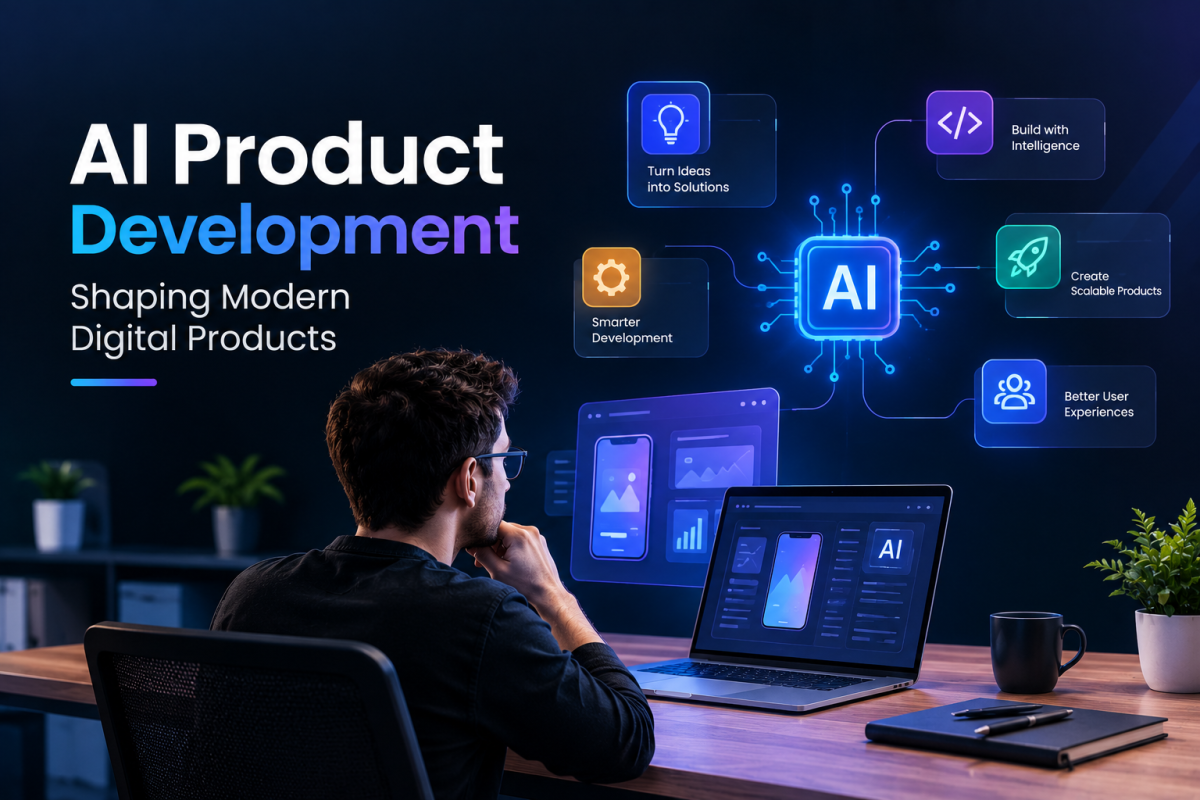
Digital products are becoming more intelligent, responsive, and personalized as artificial intelligence continues to evolve. From smart search and recommendation systems to AI assistants and predictive analytics, businesses are finding new ways to incorporate intelligence into software experiences.
This shift is making AI Product Development an important part of modern product strategy. Rather than simply adding an AI feature to an existing application, businesses are increasingly designing products around intelligent capabilities from the beginning.
What Makes an AI-Powered Digital Product Different?
Traditional software generally follows predefined rules and instructions. AI-powered products can analyze data, identify patterns, understand natural language, generate content, and make predictions based on available information.
For example, an e-commerce platform can use AI to personalize product recommendations, while a business application can analyze large datasets and highlight trends that might otherwise take employees hours to identify.
The goal is not to use AI simply because it is available. The technology should solve a specific user or business problem and make the product more useful.
Key Ways AI Is Transforming Digital Products
1. More Personalized User Experiences
AI can analyze user behavior, preferences, and interactions to create more personalized experiences. Recommendation engines can suggest relevant products, content platforms can customize feeds, and software applications can adapt experiences according to individual needs.
Personalization can help users find relevant information faster while making digital products more responsive to their expectations.
2. Intelligent Automation
Many digital products include repetitive workflows that require manual intervention. AI can support these processes by classifying information, generating responses, summarizing content, extracting data, or recommending actions.
This does not necessarily mean removing humans from the workflow. Instead, AI can handle suitable repetitive tasks while people focus on decisions that require judgment and context.
3. Better Decision Support
Modern applications can process large amounts of information much faster than manual analysis. AI can help identify patterns, generate insights, and highlight potential issues.
For example, an operations platform could analyze historical information and identify trends that may require attention. Employees can then use these insights as an additional input when making decisions.
Understanding the AI Product Development Process
A successful product requires more than selecting an AI model. The AI Product Development Process typically involves several interconnected stages.
Define the Problem
The first step is to identify a clear problem and determine whether AI can provide a meaningful solution. Teams should define the target users, expected outcomes, and measurable success criteria.
Assess Data Requirements
AI capabilities depend heavily on data. Teams should determine what information is available, whether it is reliable, and how it can be securely accessed and processed.
Data quality, privacy, structure, and availability can all influence the technology architecture.
Select the Right AI Technology
Different use cases require different approaches. Some products may benefit from generative AI, while others may need machine learning, natural language processing, computer vision, recommendation systems, or a combination of technologies.
The decision should consider accuracy, cost, latency, scalability, security, and integration requirements.
Build and Integrate
Once the technology strategy is established, developers can integrate AI capabilities into the broader product. This may involve APIs, databases, cloud infrastructure, user interfaces, authentication systems, and third-party services.
The AI component should work as part of the product rather than operating as an isolated feature.
The Role of an AI Product Development Team
Building intelligent products often requires expertise across multiple technical areas. An AI Product Development Team may include software engineers, AI or machine learning specialists, data engineers, cloud professionals, UX designers, and product managers.
Collaboration between these roles is important because AI performance is only one part of the overall product experience.
A technically advanced model will not necessarily create a successful product if the interface is confusing, the data is unreliable, or the solution does not address a genuine user need.
Scaling AI Products Responsibly
Launching an AI-powered product is only the beginning. As usage increases, businesses need to monitor performance, infrastructure costs, model behavior, security, and user feedback.
Organizations should establish processes for evaluating AI outputs and identifying errors. Human oversight may also be necessary for workflows involving sensitive information or high-impact decisions.
Scalability should be considered during architecture planning. A product that works with a small number of users may require different infrastructure when usage increases significantly.
Choosing AI Product Development Services
Businesses that lack specialized internal expertise may consider external AI Product Development Services for specific parts of the product lifecycle.
When evaluating a development partner, organizations should consider technical capabilities alongside experience with software architecture, data engineering, cloud infrastructure, security, and product design.
For example, CodeCones works across AI, software engineering, data, cloud, and DevOps, which can be relevant when an AI capability needs to be integrated into a larger digital product ecosystem.
Practical Steps for Businesses
Businesses exploring AI-powered products can start with a simple approach:
- Identify one specific problem worth solving.
- Define the users and desired outcomes.
- Evaluate available data and security requirements.
- Select an appropriate AI technology.
- Build a small proof of concept.
- Test the product with realistic use cases.
- Collect user feedback and measure performance.
- Improve the system before expanding its capabilities.
This approach helps reduce unnecessary complexity and provides evidence before significant resources are committed.
Conclusion
AI is changing the way modern digital products are designed, developed, and improved. Its capabilities can support personalization, automation, decision-making, and more intelligent user experiences across many industries.
However, successful AI Product Development depends on more than implementing advanced technology. Businesses need clear objectives, reliable data, appropriate architecture, strong engineering, and continuous evaluation.
For organizations exploring an AI-powered product, starting with a focused use case and gradually expanding based on measurable results can provide a practical path forward. A well-planned approach can help turn AI capabilities into useful digital experiences that evolve alongside users and business needs.
Elis Perry