

Titanium Market Analysis
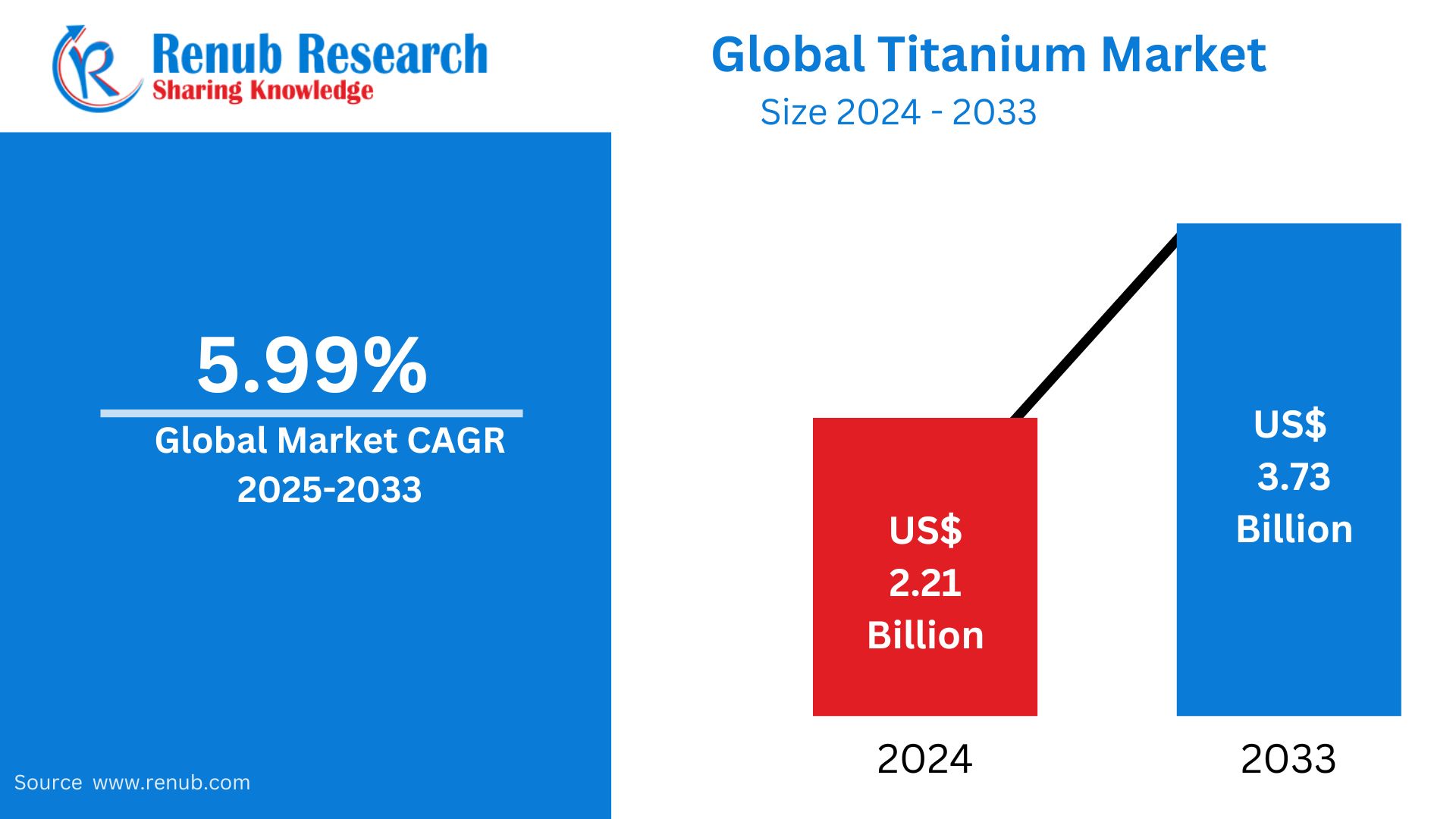
According to Renub Research global Titanium Market is poised for robust expansion over the coming decade, projected to grow from US$ 2.21 billion in 2024 to US$ 3.73 billion by 2033, advancing at a CAGR of 5.99% from 2025 to 2033. Titanium’s exceptional properties—remarkable strength-to-weight ratio, excellent corrosion resistance, and superior biocompatibility—make it indispensable across industries such as aerospace, defense, healthcare, industrial processing, marine engineering, and energy. As demand for high-performance, lightweight, and durable materials intensifies worldwide, titanium continues to gain prominence as a strategic material shaping next-generation engineering and technological advancements.
Global Titanium Market Overview
The global titanium industry plays a critical role across multiple high-value sectors including aerospace, medical devices, automotive, industrial processing, marine applications, and power generation. Titanium’s structural efficiency enables manufacturers to design lighter yet stronger components, improving performance, fuel efficiency, and long-term durability. The aerospace sector remains the single largest consumer of titanium as it is essential for aircraft frames, structural supports, jet engines, and landing gear systems. Its thermal stability and ability to withstand extreme operational environments reinforce its importance in modern aviation and defense applications.
Beyond aerospace, titanium has rapidly expanded its footprint in healthcare. Its biocompatibility, non-toxicity, and resistance to bodily fluids make it ideal for orthopedic implants, spinal devices, dental implants, prosthetics, and surgical instruments. The material’s compatibility with additive manufacturing also enables customized, patient-specific implants, resulting in better recovery outcomes and enhanced medical precision.
Industrially, titanium is widely deployed in chemical processing plants, oil and gas facilities, desalination systems, and power generation units. Its resilience against corrosive chemicals, seawater exposure, and extreme heat significantly reduces maintenance costs and improves operational reliability. Its increasing integration into sporting goods, consumer electronics, and high-performance automotive parts further broadens its market scope.
However, the titanium industry faces challenges such as high production costs, energy-intensive extraction processes, and supply chain vulnerabilities. The widely used Kroll Process is expensive and complex, limiting cost-sensitive applications. Despite these constraints, technological advancements, growing defense spending, healthcare expansion, renewable energy initiatives, and increasing industrial investments are expected to sustain strong titanium demand globally.
Download Free Sample Report:https://www.renub.com/request-sample-page.php?gturl=titanium-market-p.php
Key Growth Drivers of the Global Titanium Market
Expanding Demand from Aerospace and Defense Applications
Titanium remains a cornerstone of aerospace engineering due to its lightweight strength, high heat tolerance, and resistance to corrosion. Aircraft manufacturers widely utilize titanium for structural frames, turbine blades, landing systems, and engine components to enhance fuel efficiency and aerodynamic performance. As global commercial aviation rebounds and fleet modernization programs accelerate, titanium consumption continues to rise.
Defense modernization programs across major economies further strengthen titanium demand. It is critical in missile systems, submarines, naval vessels, armored vehicles, and satellite components due to its durability in hostile environments. Additionally, the rapid growth of private aerospace ventures, space exploration missions, and satellite deployment initiatives reinforce titanium’s strategic importance. With commercial air travel expansion, military investments, and space innovation advancing, titanium demand in aerospace and defense will remain resilient throughout the forecast period.
Rising Adoption in Healthcare and Medical Technology
The healthcare sector has emerged as one of the fastest-growing titanium consumers. Titanium’s biocompatibility, lightweight composition, and corrosion resistance make it ideal for orthopedic implants, dental implants, bone plates, artificial joints, pacemaker casings, and prosthetics. Its ability to integrate naturally with human bone tissue supports long-lasting, low-rejection medical solutions.
The increasing prevalence of orthopedic conditions, aging global population, and expanding surgical procedures fuel continuous demand growth. Technological advancements in medical manufacturing, especially 3D printing using titanium powder, enable personalized implants tailored to patient anatomy, improving recovery efficiency and reducing complications. With precision medicine, minimally invasive surgeries, and advanced healthcare infrastructure development gaining momentum, titanium’s influence in the medical domain will continue to strengthen significantly.
Growing Industrial and Chemical Processing Applications
Titanium has secured a vital position in global industrial processing due to its exceptional corrosion resistance, especially in harsh environments involving chemicals, seawater, and high-pressure systems. It is extensively used in heat exchangers, pressure vessels, condensers, pipelines, and reactors in industries such as chemical processing, petrochemicals, oil and gas, desalination, and marine engineering.
As countries expand industrial infrastructure, increase energy production, and accelerate desalination initiatives to combat water scarcity, titanium demand is expected to rise sharply. Its longevity reduces maintenance costs, enhances system reliability, and supports sustainability initiatives—making it an economically viable solution over the long term despite higher upfront costs.
Major Challenges in the Global Titanium Market
High Production and Processing Costs
Titanium remains one of the most expensive structural metals due to its complex extraction and production processes. The Kroll Process, the dominant method of titanium extraction, is energy-intensive, time-consuming, and costly. Additionally, processing titanium into functional components requires specialized technology, skilled expertise, and high-precision manufacturing environments, further increasing operational expenses.
These cost barriers restrict titanium adoption in mass-market applications such as mainstream automotive manufacturing or cost-sensitive consumer products. Although research is ongoing to develop more cost-effective industrial processes, high material costs remain a key restraint for broader titanium market penetration.
Supply Chain Vulnerability and Raw Material Dependency
Global titanium supply is highly concentrated, with only a few nations dominating titanium sponge and mineral production. This concentration creates supply chain fragility and exposure to geopolitical disruptions, export regulations, and mining policy shifts. Limited downstream processing facilities further intensify dependency on select global suppliers.
Such vulnerabilities can result in price instability, material shortages, and supply delays for industries reliant on titanium. Strengthening regional processing capabilities, diversifying sourcing, and supporting recycling initiatives are crucial strategies to ensure long-term titanium supply security and pricing stability.
Titanium Market Regional Outlook
North America Titanium Market Outlook
North America, particularly the United States, holds a dominant position in the titanium market, driven by strong aerospace, defense, and healthcare sectors. Major aircraft manufacturers, defense contractors, and medical device developers rely heavily on titanium for advanced engineering and technological innovation. The region also invests significantly in titanium alloy innovation, additive manufacturing, and metallurgical advancements. While domestic production remains strong, import reliance persists, positioning supply chain resilience as a strategic priority.
Europe Titanium Market Outlook
Europe represents another major titanium consumer, led by Germany, France, the United Kingdom, and Italy. Strong aerospace manufacturing, industrial engineering, automotive technology, and healthcare systems fuel titanium demand. European industries prioritize precision manufacturing and sustainability, encouraging titanium recycling initiatives and processing advancements. Germany’s engineering strength, aviation leadership, and medical innovation particularly reinforce titanium utilization across the region.
Asia-Pacific Titanium Market Outlook
Asia-Pacific is the fastest-growing regional market, driven by rapid industrialization, infrastructure development, aerospace expansion, and increasing healthcare investments. China, Japan, India, and South Korea are major contributors. India, in particular, is strengthening titanium usage in defense, aerospace manufacturing, medical implants, and desalination projects while pursuing domestic production capabilities. Ongoing government initiatives, urbanization, and technological investment will continue to propel titanium market growth across Asia-Pacific.
Middle East and Emerging Market Opportunities
The Middle East, especially the United Arab Emirates and Saudi Arabia, is increasingly investing in titanium for desalination plants, marine engineering, defense modernization, and industrial diversification. Titanium’s resistance to seawater corrosion makes it a preferred material in regional infrastructure development. Growing industrial partnerships and manufacturing localization initiatives are expected to accelerate titanium adoption in the region.
Recent Developments in the Titanium Industry
Recent strategic developments, including titanium capacity expansions, advanced research collaborations, and critical mineral partnerships, are enhancing titanium supply stability and manufacturing innovation worldwide. Increasing investment in titanium melting operations, recycling initiatives, and mineral recovery technologies highlights global efforts to strengthen production efficiency, sustainability, and technological advancement.
Titanium Market Segmentation Overview
The titanium market is segmented by product type into titanium metal, titanium alloys, titanium compounds, and catalysts. Key application sectors include aerospace, industrial processing, power generation, chemical processing, healthcare, and marine engineering. Regionally, major markets include North America, Europe, Asia-Pacific, Latin America, and the Middle East & Africa.
Competitive Landscape of the Global Titanium Market
The titanium market is characterized by strong participation from leading material science and manufacturing companies. Prominent global players include ATI Materials, Titanium Metals Corporation, The Chemours Company, Nippon Steel Corporation, Kobe Steel, Hermith GmbH, Castle Metals, AK Scientific, 3M Company, and other specialized titanium producers. These companies focus on technological innovation, capacity expansion, strategic partnerships, sustainability initiatives, and advanced alloy development to strengthen market positions.
Future Outlook of the Global Titanium Market
The global Titanium Market is expected to witness sustained growth as industries increasingly prioritize lightweight materials, superior durability, sustainability, advanced medical solutions, and aerospace innovation. Technological progress in titanium extraction, enhanced manufacturing efficiencies, additive manufacturing adoption, and diversification of supply chains will further support long-term market expansion. With rising investments, evolving applications, and continuous innovation, titanium will remain a key material shaping modern engineering, healthcare advancements, industrial development, and future technological evolution through 2033.
renubresearch