


Drop Point Hunting Knife Set: How to Choose the Right Fixed Blade
Choosing a hunting knife is not simply a matter of picking the sharpest-looking blade. For hunters and outdoor users, blade profile, construction, size, handle design, maintenance requirements, and carry system all influence whether a knife makes sense for the intended field conditions.
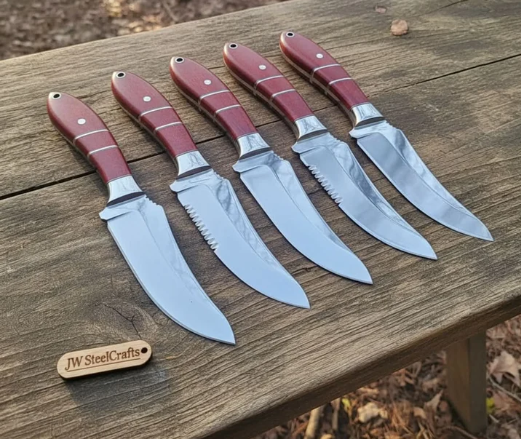
A drop point hunting knife set can be particularly useful when the goal is to have more than one fixed blade available for hunting, camping, field preparation, and general outdoor tasks. But the value of a set depends on how well its individual knives match the jobs they are expected to perform.
What Is a Drop Point Hunting Knife?
A drop point knife has a spine that gradually curves downward toward the tip. This creates a relatively broad belly and a controlled point, making the profile common in hunting and outdoor fixed-blade designs.
The main attraction is versatility. Instead of optimizing the blade for only one specialized task, the drop point balances slicing area, point control, and general utility. That makes it a practical profile for hunters who want one primary knife or a complementary set of field blades.
The profile should still be evaluated alongside the rest of the knife. A drop point does not automatically make a knife suitable for every hunting application. Blade length, edge geometry, steel, handle, tang construction, and sheath all matter.
Why Is the Drop Point Popular for Hunting?
The shape provides a useful combination of a curved cutting belly and a controlled tip.
For hunting applications, that geometry can be helpful when a knife needs to transition between broader slicing work and more controlled cutting. The relatively substantial area behind the point can also make the tip less delicate than some narrower blade profiles.
However, blade shape should be viewed as one part of the overall design rather than a guarantee of performance. Knife geometry is a balance between cutting ability, edge stability, toughness, and the intended application.
What Should You Look for in a Drop Point Hunting Knife Set?
Before choosing a set, evaluate the knives as a system rather than judging the appearance of the collection alone.
1. Blade Profile
Start with the profile because it determines much of the knife’s cutting character.
A drop point generally provides:
- A broad cutting belly
- A controlled tip
- A practical balance between slicing and detail work
- A versatile shape for hunting and outdoor use
- A familiar configuration for fixed-blade hunting knives
If every knife in the set has essentially the same profile and dimensions, ask whether the additional knives actually provide useful versatility.
A good set should give you meaningful choices rather than simply duplicate the same knife several times.
2. Fixed-Blade Construction
A fixed blade has a blade that extends continuously into the handle rather than folding into a handle mechanism.
For hunters, fixed-blade construction can be attractive because there is no folding mechanism to maintain. Cleaning is also relatively straightforward when the knife is used in demanding outdoor environments.
The important question is not simply whether a knife is fixed blade, but how the blade, tang, handle, and sheath work together.
3. Tang Construction
Tang design deserves close attention when comparing hunting knives.
A full tang generally extends the blade material through the handle area, creating a continuous structural foundation. Other tang configurations can also be appropriate depending on the intended knife design, but buyers should understand what construction they are actually receiving.
Do not assume that the words “full tang” alone determine quality. Blade geometry, steel properties, heat treatment, handle construction, and workmanship remain relevant.
Is a Drop Point Better Than a Clip Point for Hunting?
The answer depends on the intended task.
A drop point generally emphasizes controlled tip geometry and a broad cutting belly, while a clip point typically creates a narrower, more acute point. Neither profile is universally appropriate for every outdoor application.
| Feature | Drop Point | Clip Point |
|---|---|---|
| Tip geometry | Broad and controlled | Narrower and finer |
| Cutting belly | Generally broad | Varies by design |
| General hunting use | Highly versatile | Useful for specific preferences |
| Detail-tip work | Good | Often advantageous |
| Traditional appearance | Modern hunting association | Common in Bowie-style designs |
| Main consideration | Balance and versatility | Finer point and precision |
For someone seeking a general-purpose hunting fixed blade, the drop point’s combination of belly and controlled point can make it a logical starting point. A clip point may be preferable when a finer tip or traditional Bowie-style profile is more important.
Drop Point vs. Dedicated Skinning Knife
A common mistake is assuming that every hunting knife should perform exactly like a dedicated skinner.
A dedicated skinning knife typically emphasizes a broad cutting area and geometry optimized around skinning. A drop point is more general-purpose.
That distinction matters when selecting a knife set.
A hunter who processes different game or performs several field tasks may appreciate having complementary blade shapes. Someone who primarily needs one knife for general field use may prefer a versatile drop point rather than carrying several highly specialized blades.
The right choice therefore depends on task diversity, not simply the number of knives included.
Does Blade Length Matter?
Yes. Blade length should correspond to the work you expect the knife to perform.
A shorter blade can provide greater control for detailed work, while a longer blade may provide additional cutting area for broader tasks. There is no single blade length that is ideal for every hunter.
Consider:
- The type and size of game normally encountered
- Whether the knife is primarily for field dressing or general camp use
- How much detailed cutting is expected
- Available carry space
- The user’s hand size and handling preferences
- Whether another knife in the set fills a different role
Instead of choosing based solely on a measurement, consider whether the blade’s length and geometry match the actual job.
Does Steel Matter More Than Blade Shape?
Neither should be considered in isolation.
Steel influences properties such as toughness, wear resistance, corrosion resistance, and sharpening characteristics. Blade geometry influences how those material properties are translated into cutting behavior.
Knife performance is therefore a combination of steel + heat treatment + geometry + edge condition + intended use.
A technically impressive steel cannot compensate for unsuitable geometry, and an attractive blade profile does not automatically indicate excellent performance. Knife design involves trade-offs rather than one universally perfect specification.
For hunters, maintenance conditions should also influence steel selection. Someone regularly exposed to moisture may place greater importance on corrosion resistance, while another user may prioritize edge retention or ease of sharpening.
What Handle Features Matter on a Hunting Knife?
The handle is where the knife interfaces with the user’s hand, so comfort and control deserve as much attention as blade appearance.
Look at:
- Handle shape
- Grip texture
- Material
- Overall thickness
- Finger clearance
- Construction around the tang
- Resistance to moisture
- Ease of cleaning
Natural wood, synthetic materials, micarta, G10, resin-based materials, and other handle options each have different characteristics.
A visually impressive handle is not necessarily the most appropriate one for wet, cold, dirty, or extended outdoor conditions. Think about the environment first and appearance second.
What Makes a Hunting Knife Set More Useful Than a Single Knife?
The primary advantage of a set is role separation.
For example, a hunter might want:
- A primary drop point for general field work
- A smaller blade for controlled detail tasks
- A dedicated skinning-oriented blade
- A secondary knife for camp or utility work
The exact combination should reflect the user’s needs.
A four-piece set where every knife performs almost the same role may provide less practical value than a smaller set containing genuinely complementary designs.
The Three-Question Set Test
Before buying, ask:
Question 1: What does each knife do?
If you cannot identify a distinct purpose for every knife, the set may contain unnecessary duplication.
Question 2: Where will each knife be used?
Field processing, camping, food preparation, and general outdoor work can create different requirements.
Question 3: What happens if one knife becomes unavailable?
A useful set should provide some redundancy without making every blade identical.
This approach shifts the decision from “How many knives do I get?” to “How much useful coverage does the set provide?”
How Does a Drop Point Folding Knife Compare With a Fixed Blade?
A drop point folding knife uses the same general blade profile but places it into a folding mechanism.
The biggest difference is construction rather than blade shape.
| Consideration | Fixed Blade | Folding Knife |
|---|---|---|
| Construction | Non-folding | Folding mechanism |
| Cleaning | Generally straightforward | Mechanism can require additional attention |
| Carry size | Usually larger | Usually more compact |
| Deployment | Requires sheath/carry system | Folds into handle |
| Field role | Strong fit for dedicated outdoor use | Convenient for compact carry |
| Maintenance | Blade and handle focused | Blade plus moving mechanism |
For dedicated hunting use, a fixed blade may make more sense when the priority is a straightforward field knife. A folder can be attractive when compact carry is more important.
Neither format eliminates the need to evaluate the individual knife’s construction and intended purpose.
How to Choose the Best Drop Point Hunting Knife for Your Needs
Rather than searching for one universally “best” drop point hunting knife, use a decision framework.
Choose based on your primary task
If field dressing is the main job, prioritize controlled geometry, appropriate blade size, comfortable handling, and easy maintenance.
If camping is equally important, consider how well the knife handles general outdoor cutting tasks.
If collecting is part of the purchase, craftsmanship, materials, finishing, and visual character may carry greater importance.
Choose based on environment
A knife used in consistently wet conditions should be evaluated differently from one that spends most of its time in a dry pack or display case.
Think about:
- Rain
- Snow
- Humidity
- Mud
- Blood and organic residue
- Cleaning opportunities
- Long-term storage
Choose based on maintenance habits
Be realistic about how you maintain equipment.
A knife that requires frequent attention may not suit someone who wants simple field maintenance. Conversely, a collector or experienced knife owner may enjoy maintaining a more demanding blade material.
Common Mistakes When Buying a Hunting Knife Set
Mistake 1: Choosing by appearance alone
A striking Damascus pattern, polished handle, or decorative sheath can attract attention, but appearance does not tell you everything about geometry or construction.
Mistake 2: Assuming more knives means more value
The useful question is whether each knife adds a different capability.
Mistake 3: Ignoring the sheath
A hunting knife is part of a carry system. The sheath should securely accommodate the knife and suit the intended method of transport.
Mistake 4: Overlooking maintenance
Steel and handle materials require appropriate care. Moisture should not be left on the blade for extended periods, and knives should be stored clean and dry.
Mistake 5: Treating marketing terms as technical specifications
Words such as “premium,” “professional,” or “best” do not replace measurable information about construction, dimensions, materials, and intended use.
A careful buyer should separate documented specifications from marketing descriptions.
How Should a Hunting Knife Be Maintained?
Basic maintenance is straightforward.
After outdoor use:
- Remove dirt and residue.
- Clean the blade according to the manufacturer’s care recommendations.
- Dry the knife thoroughly.
- Inspect the edge and handle for damage.
- Apply appropriate protective oil when the blade material requires it.
- Store the knife in a dry environment.
- Check the sheath periodically for moisture or debris.
Avoid unnecessary impacts, prying, or other tasks outside the knife’s intended design. Good maintenance is not just about preserving appearance; it helps the knife remain predictable and usable over time.
What Should You Check Before Buying a Handmade Hunting Knife Set?
Use this checklist before purchasing:
| Buying Factor | What to Examine |
|---|---|
| Blade profile | Does the shape match the intended work? |
| Blade length | Is the size appropriate for the user’s tasks? |
| Steel | Are the material and maintenance requirements clear? |
| Heat treatment | Is relevant information available from the maker? |
| Tang | What type of construction is used? |
| Handle | Is it comfortable and appropriate for the environment? |
| Sheath | Does it provide practical storage and carry? |
| Set composition | Does every knife serve a distinct role? |
| Maintenance | Are care requirements realistic for the buyer? |
| Documentation | Are specifications clearly stated? |
This checklist is especially useful when comparing handmade knives because two visually similar products can have very different construction details.
When Does a Drop Point Hunting Knife Set Make Sense?
A set makes the most sense when the buyer regularly moves between several outdoor tasks or wants complementary blades for different stages of field work.
It can also appeal to collectors who appreciate coordinated handmade designs or buyers looking for a practical gift for a hunter.
For someone who performs one narrowly defined task, however, a single specialized knife may be more appropriate than a larger set.
The goal should always be useful specialization without unnecessary duplication.
Final Considerations
A drop point hunting knife set should be evaluated as a complete system rather than as a collection of attractive blades.
The drop point profile offers a useful balance of controlled tip geometry and cutting belly, while fixed-blade construction provides a straightforward format for dedicated outdoor use. But the profile is only the beginning. Steel, heat treatment, edge geometry, tang construction, handle design, sheath quality, maintenance, and intended use all contribute to the overall suitability of a hunting knife.
For hunters and outdoorsmen, the most useful buying question is not simply, “Which knife is the best?” It is:
“Which combination of blade geometry, construction, materials, and size matches the work I actually do?”
Answering that question makes it much easier to identify whether a drop point hunting knife set—or a single specialized fixed blade—is the right choice.
jwsteelcrafts