


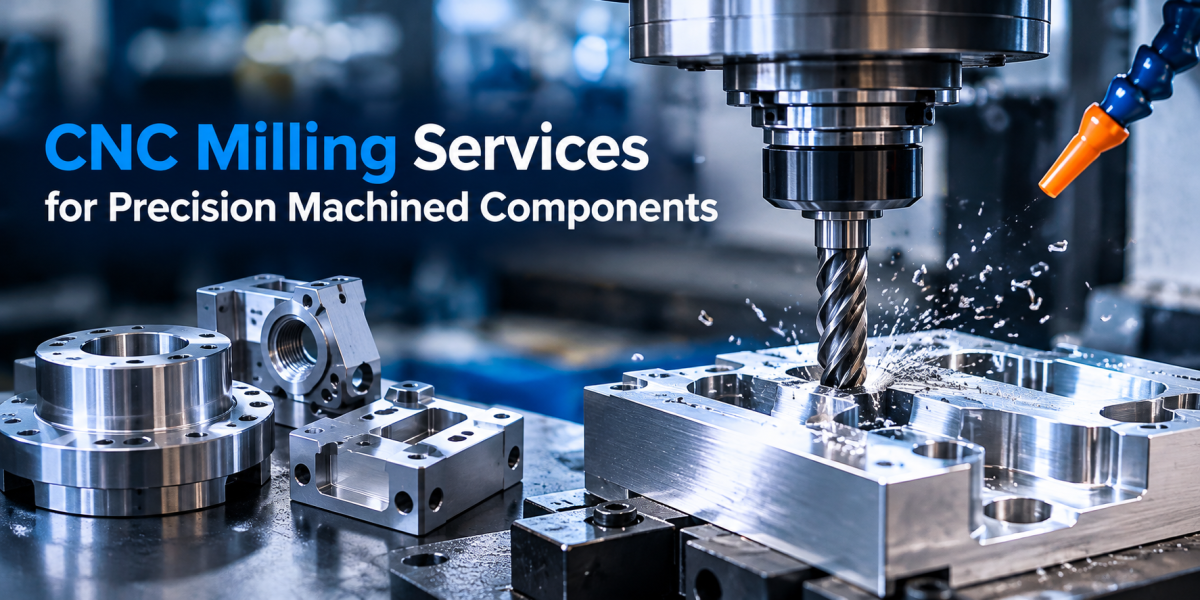
In today’s competitive manufacturing industry, precision, quality, and efficiency are essential for producing reliable components. Businesses across industries require accurately manufactured parts that meet strict specifications and perform consistently in demanding environments. CNC milling services play an important role in meeting these requirements by delivering high-quality components with excellent accuracy and repeatability.
Condor Precision understands the importance of precision manufacturing and the need for dependable machining solutions. CNC milling is an advanced manufacturing process that uses computer-controlled cutting tools to remove material from a workpiece and create components with specific dimensions, shapes, and surface finishes. This technology supports the production of both simple and complex parts for a wide range of industrial applications.
Whether a business requires custom-machined components, prototypes, or production parts, professional CNC milling services can help improve product quality, manufacturing efficiency, and consistency.
What Are CNC Milling Services?
CNC milling, or Computer Numerical Control milling, is a machining process in which automated equipment controls the movement of cutting tools to shape raw materials into finished components. The machine follows programmed instructions based on a digital design, allowing manufacturers to produce parts according to precise engineering specifications.
CNC milling machines can work with various materials, including aluminum, stainless steel, carbon steel, brass, copper, and certain engineering plastics. The appropriate material and machining method depend on the component’s intended use, strength requirements, operating environment, and design.
At Condor Precision, CNC milling is an important manufacturing solution for businesses seeking precision-machined components. With suitable machining processes and quality-control practices, manufacturers can produce parts that meet demanding dimensional and functional requirements.
Benefits of CNC Milling for Precision Machined Components
1. High Accuracy and Repeatability
One of the main advantages of CNC milling services is the ability to manufacture components with consistent dimensions. Computer-controlled operations help reduce variations between parts and support repeatable production.
This is particularly important for components that must fit into assemblies or operate alongside other precision-engineered parts. Consistent machining can also reduce rework and help manufacturers maintain production standards.
2. Complex Component Manufacturing
Modern CNC milling equipment can produce components with intricate geometries, detailed features, pockets, slots, holes, and contoured surfaces. Multi-axis machining capabilities can provide additional flexibility for manufacturing complex designs.
These capabilities make CNC milling suitable for industries where components must follow detailed engineering drawings and specific design requirements.
3. Improved Production Efficiency
CNC milling machines can automate many machining operations, reducing the need for continuous manual intervention. Once a program has been prepared and verified, the machine can repeat the required operations efficiently.
Automation can help reduce production time, improve workflow consistency, and support both small-batch and larger-volume manufacturing. Actual production efficiency depends on the part design, material, machining strategy, and required tolerances.
4. Material Flexibility
Different applications require different material properties. Aluminum is often selected for its lightweight characteristics, while stainless steel may be used where corrosion resistance is important. Carbon steel, brass, copper, and engineering plastics can also be suitable for particular applications.
Professional CNC milling services help manufacturers select appropriate machining processes for the chosen material and the component’s functional requirements.
5. Consistent Quality
Precision components often need to meet defined dimensional tolerances and surface-finish requirements. Appropriate inspection methods, calibrated measuring equipment, and controlled machining processes help verify that finished parts meet the agreed specifications.
A structured quality-control approach is especially valuable for parts used in demanding industrial applications.
CNC Milling Applications Across Industries
CNC milling services support a wide range of manufacturing sectors. The technology is suitable for producing custom components, replacement parts, prototypes, and production-ready products.
Aerospace Manufacturing
The aerospace industry requires components designed to meet strict engineering and quality requirements. CNC milling can manufacture brackets, housings, structural parts, and other precision components from suitable aerospace-grade materials.
Material traceability, documentation, inspection, and compliance with applicable industry requirements may be essential for aerospace projects.
Automotive Industry
Automotive manufacturers use precision-machined components in assemblies, equipment, tooling, and specialized mechanical systems. CNC milling can produce engine-related parts, fixtures, housings, mounting brackets, and custom components according to engineering specifications.
Repeatable machining is particularly useful when manufacturers need multiple components with consistent dimensions.
Industrial Equipment
Industrial machinery frequently depends on accurately manufactured parts to maintain proper alignment and reliable operation. CNC milling can produce machine housings, mounting plates, support blocks, fixtures, and other mechanical components.
Custom machining also helps businesses obtain parts designed for specific equipment configurations.
Medical Equipment Manufacturing
Certain medical equipment and devices require accurately machined components made from appropriate materials. CNC milling can support the production of housings, instrument components, fixtures, and specialized equipment parts.
Projects in regulated medical applications may require additional validation, traceability, and compliance measures depending on the intended use.
Electronics and Technology
Electronic equipment often incorporates precision housings, mounting plates, heat sinks, and structural components. CNC milling can create features that support accurate assembly, effective heat management, and dependable component integration.
The CNC Milling Manufacturing Process
Understanding the manufacturing process helps businesses prepare better project specifications and communicate their requirements clearly.
Step 1: Design and Engineering
The process begins with a technical drawing or a computer-aided design (CAD) model. This information defines the component’s geometry, dimensions, material, tolerances, and other important requirements.
Step 2: Material Selection
The material is selected according to the component’s application, mechanical properties, environmental conditions, and budget. Correct material selection supports the intended performance of the finished part.
Step 3: CNC Programming
Computer-aided manufacturing (CAM) software or other programming methods are used to generate machining instructions. These instructions define tool paths, cutting operations, and machine movements.
Step 4: Machining and Material Removal
The workpiece is secured in the machine, and the cutting tools remove material according to the programmed instructions. Depending on the design, the process may include facing, slotting, drilling, pocketing, and contour milling.
Step 5: Inspection and Finishing
After machining, the component is inspected against the required specifications. Deburring, cleaning, surface treatment, or additional finishing operations may be performed when necessary.
Step 6: Final Verification
Before delivery, the completed components should be checked against the agreed quality criteria. Inspection documentation and material certifications can be provided when required and available under the project agreement.
Why Choose Condor Precision for CNC Milling Services?
Choosing a suitable machining partner is an important decision for manufacturers seeking reliable components and consistent production results. Condor Precision can be considered for CNC milling requirements where accurate machining, clear communication, and attention to engineering specifications are important.
When evaluating Condor Precision or any CNC machining supplier, businesses should consider several factors:
- Technical capabilities: Confirm that the available machinery can accommodate the component’s dimensions, complexity, and tolerances.
- Material experience: Check whether the supplier has experience machining the material required for the project.
- Quality control: Ask about inspection procedures, measuring equipment, and documentation.
- Production flexibility: Determine whether the supplier can support prototype development, small batches, or recurring production orders.
- Communication: Clear discussions about drawings, lead times, specifications, and revisions help reduce misunderstandings.
- Project requirements: Confirm pricing, delivery schedules, finishing options, and any required certifications before placing an order.
By reviewing these factors, businesses can make an informed decision and identify a manufacturing partner suited to their technical and commercial needs.
How to Get Started with a CNC Milling Project
Businesses looking for CNC milling services can make the quotation process more efficient by preparing the necessary project information in advance.
Start by sharing a CAD file or engineering drawing that includes dimensions and tolerances. Specify the required material, surface finish, quantity, and any special inspection or documentation requirements. If the component is part of an assembly, relevant functional details can also help clarify its purpose.
It is useful to identify whether the project involves a one-time prototype, a small production batch, or ongoing manufacturing. These details allow the machining supplier to evaluate tooling, setup requirements, production methods, and estimated lead times.
Before approving production, review the quotation and confirm that the specifications, costs, delivery expectations, and quality requirements are clearly documented.
Conclusion
CNC milling services are an essential part of modern precision manufacturing. They enable businesses to produce accurate, repeatable, and complex components for industries such as aerospace, automotive, industrial equipment, medical equipment, and electronics.
By combining computer-controlled machining with suitable materials, effective programming, and appropriate quality inspections, manufacturers can meet demanding component requirements and improve production consistency.
Condor Precision is a company to consider when evaluating CNC milling solutions for precision-machined components. Businesses should review its specific capabilities, material options, quality processes, and production capacity to determine whether they match their project requirements.
For companies seeking custom-machined parts, preparing clear engineering drawings and detailed specifications is a practical first step toward obtaining a suitable CNC milling solution.
You can also find the company’s location and business details on Google Maps.
condorprecision