
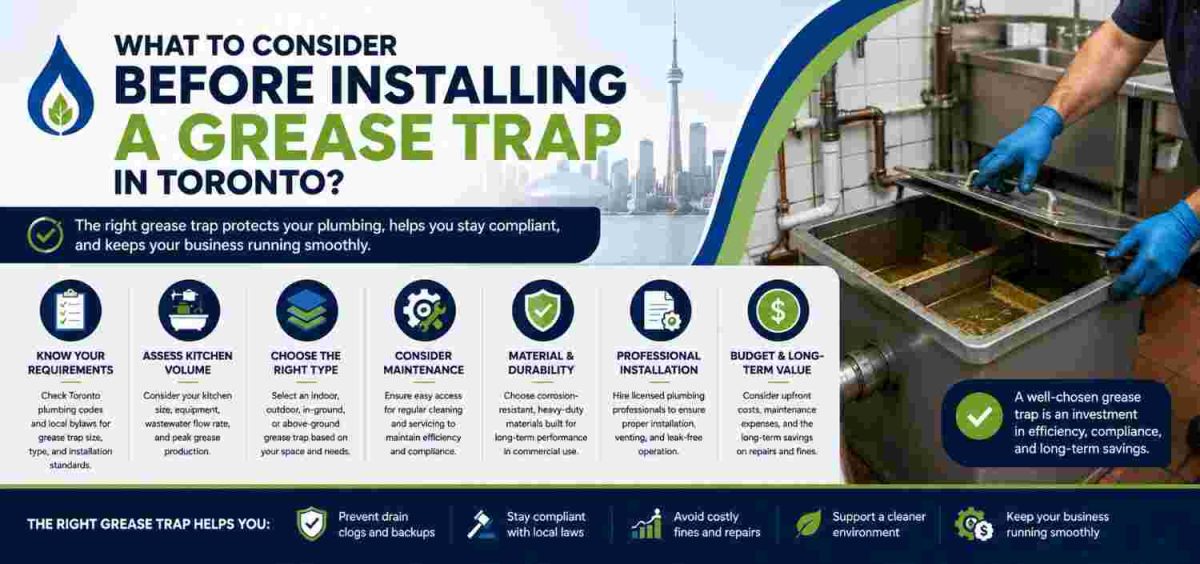
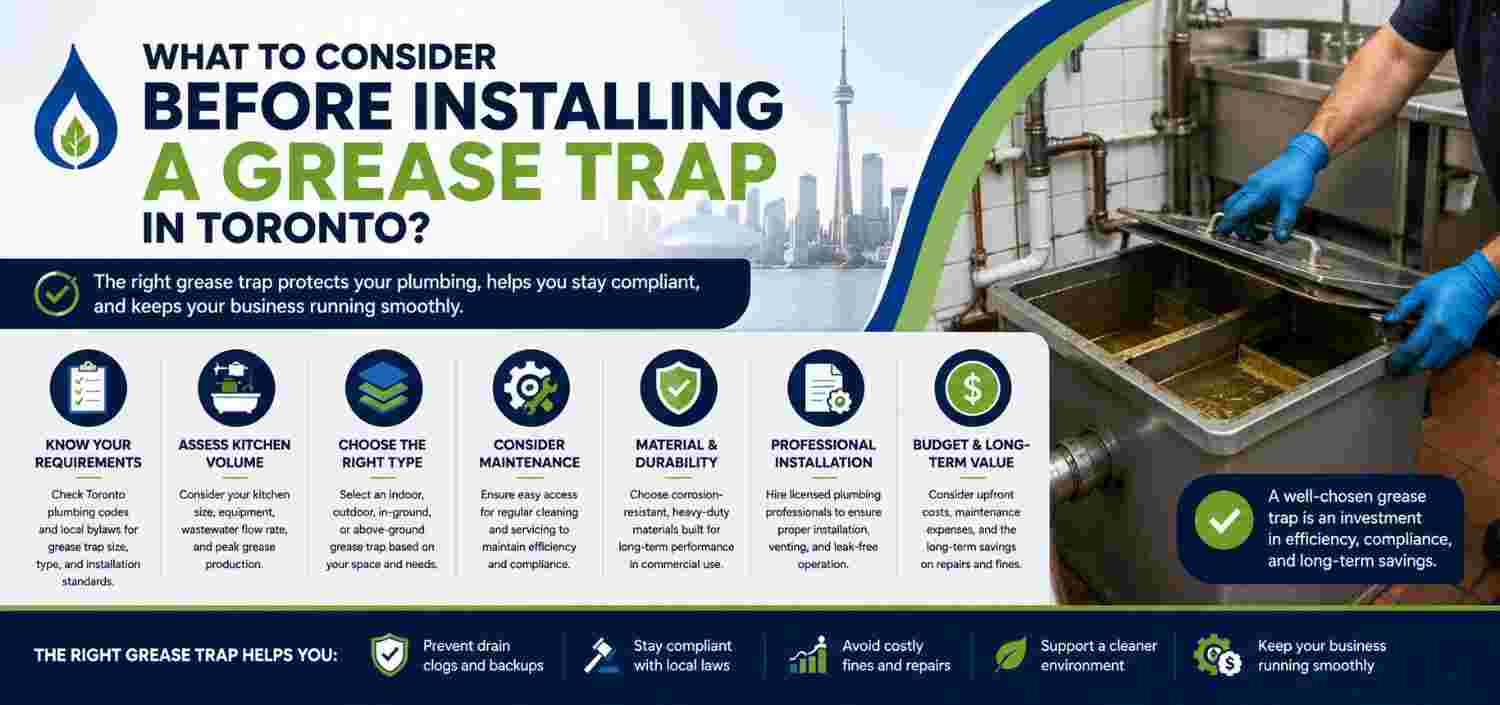
Installing a grease trap or grease interceptor requires more than selecting equipment that fits an available space. Businesses should consider grease load, connected fixtures, wastewater characteristics, equipment suitability, sizing, installation location, drainage layout, maintenance access, and applicable requirements. Restaurants, cafés, commercial kitchens, bakeries, catering facilities, hotels, and other food-related premises can have substantially different needs. Therefore, a plumbing assessment should reflect the actual operation and existing drainage system before equipment is selected.
What Does Grease-Management Equipment Do?
Food-service wastewater can contain fats, oils, grease, and food-related solids. Grease-management equipment is designed to separate or intercept some of these materials before wastewater continues through the downstream drainage system.
This process supports FOG management and can reduce the amount of grease entering connected commercial drains. However, installing equipment does not guarantee that blockages, odours, backups, or other drainage problems will never occur.
Moreover, equipment must suit the premises and receive appropriate ongoing maintenance to perform its intended function.
Which Properties May Need Grease Management?
Grease-producing operations vary considerably. Consequently, equipment selection should begin with the type of property and the activities generating wastewater.
Potentially relevant premises can include:
- Restaurants and cafés
- Commercial kitchens
- Bakeries
- Catering facilities
- Hotels with food-service operations
- Institutional kitchens
- Food-production facilities
- Other premises producing grease-containing wastewater
However, these properties do not necessarily require identical equipment. A small café with limited food preparation may produce different wastewater from a high-volume commercial kitchen.
Businesses planning grease trap installation Toronto should therefore assess their actual fixtures, operations, grease production, drainage system, and applicable requirements before selecting a unit.
How Should Equipment Type and Size Be Selected?
Grease trap sizing and equipment selection can influence how effectively a system handles its intended wastewater conditions. Physical dimensions alone do not determine whether equipment is suitable.
Consider Wastewater and Grease Load
The nature and volume of wastewater can affect equipment requirements. For example, a busy kitchen that frequently prepares grease-producing foods may place different demands on a system from a premises handling mainly beverages and light food preparation.
Relevant factors can include:
- Type of food preparation or processing
- Expected wastewater flow characteristics
- Amount of fats, oils, grease, and solids generated
- Number and type of connected fixtures
- Kitchen operating patterns
- Existing drainage arrangements
- Available installation space
Consequently, choosing solely by purchase price or selecting the smallest unit that physically fits may not address the actual operating conditions.
Grease Trap Versus Grease Interceptor
Terminology can vary according to equipment design and regulatory context. Generally, smaller grease-separation devices are commonly associated with particular fixtures or lower-demand applications, while larger grease-interception systems may serve higher-flow or higher-demand operations.
However, these descriptions should not be treated as universal regulatory definitions. Equipment configurations and terminology can differ.
Therefore, businesses should avoid relying solely on a generic online capacity chart. Selection may depend on connected fixtures, flow characteristics, grease production, plumbing design, equipment specifications, and applicable requirements.
Where Should the Equipment Be Installed?
Installation location affects plumbing connections, accessibility, maintenance, and day-to-day operations. The best location consequently depends on both the selected equipment and the property’s layout.
Space and Plumbing Configuration
The proposed location should provide enough physical space for the equipment and necessary plumbing arrangements. Plumbers may also need to consider the relationship between the unit and connected fixtures, existing drainage pipes, and other building systems.
Moreover, venting or other plumbing considerations may apply depending on the equipment and installation. These requirements should be assessed for the specific project rather than assumed from another property’s configuration.
Access for Inspection and Cleaning
Grease and food-related solids accumulate inside grease-management equipment during normal operation. Therefore, installation planning should provide practical access for inspection, cleaning, and servicing.
A location that makes routine access unnecessarily difficult can complicate long-term maintenance. Meanwhile, service activities should be considered in relation to staff areas, customer spaces, food preparation, and normal business operations.
Protection and Operational Practicality
Equipment should be located where it is suitable for the intended installation and protected from avoidable physical damage. Odour-management considerations may also influence planning.
However, there is no single location that works for every property. Indoor and other permitted installation arrangements depend on equipment type, available space, drainage configuration, property conditions, and applicable requirements.
How Does Existing Drainage Affect Installation?
An existing commercial drainage system can significantly influence an installation project. Plumbers may need to assess pipe locations, available connection points, drainage configuration, fixture connections, and the condition of accessible infrastructure.
For example, installing equipment during construction may allow greater flexibility than adding it to an operating kitchen with established walls, floors, equipment, and drains.
Consequently, retrofit work may involve more planning and potential disruption. Existing plumbing should also be assessed before assuming that a proposed unit can simply be inserted into the drainage system.
Why Should Maintenance Be Planned Before Installation?
Grease-management equipment requires ongoing attention because separated grease and solids remain within the unit until removed.
Maintenance planning should therefore consider:
- Ease of opening and inspecting the equipment
- Practical cleaning access
- Grease and solids accumulation
- Appropriate servicing arrangements
- Waste handling and disposal considerations
- Maintenance records where applicable
- Signs of reduced performance
- Long-term operating expenses
Service frequency should not be based on a universal schedule. It can vary according to equipment, usage, grease load, food-service activities, operating conditions, manufacturer information, and applicable requirements.
Moreover, recurring drainage problems, excessive accumulation, leakage, or other performance changes may justify professional assessment.
What Costs Should Businesses Consider?
Purchase price represents only one part of the financial decision. Installation complexity, plumbing modifications, accessibility, equipment size, site conditions, and required work can all affect initial costs.
In addition, businesses should consider ongoing inspection, cleaning, servicing, and disposal-related expenses where applicable.
Installation may also disrupt kitchen or business operations, particularly when existing drainage must be modified. Therefore, scheduling and operational impact should form part of project planning.
How Do Compliance Requirements Affect the Project?
Commercial kitchen plumbing and grease-management installations may be subject to requirements associated with plumbing, building work, wastewater discharge, sewer use, equipment installation, or other relevant rules.
However, applicable requirements depend on the premises and scope of work. Businesses should not assume that equipment accepted for one property will automatically be suitable for another.
Professional assessment can help identify project-specific plumbing considerations and determine when further approvals, inspections, or coordination with relevant authorities may apply.
Making an Informed Installation Decision
Before installing a grease trap or interceptor, assess the property’s operations, grease load, wastewater characteristics, connected fixtures, drainage infrastructure, equipment size, location, maintenance access, servicing needs, and long-term costs. Moreover, consider applicable requirements before finalizing equipment or plumbing changes. The most suitable system depends on actual site conditions rather than price, physical size, or a generic sizing chart alone. Careful planning can help ensure the selected equipment fits both the plumbing system and the practical needs of the premises.
Canadian Rooter