
GLP-1 medications have become a popular choice for the management of type 2 diabetes and, in some instances, have also been used to support long-term weight management. Because demand has increased, so too has interest in compounded forms of these medicines, often being promoted as a more affordable option compared to the branded medications.
The price difference can be attractive, especially for those expecting treatment for months or years. Yet a lower price doesn’t necessarily mean the product is equally safe, high-quality, or effective.
Key Takeaways
|
What Are Branded and Compounded GLP-1 Medicines?
GLP-1 stands for glucagon-like peptide-1, a hormone that helps regulate blood glucose levels and appetite. GLP-1 receptor agonists are designed to mimic some of this hormone’s actions; depending on the drug, they may prompt the body to secrete insulin when blood glucose is high, reduce appetite, and slow food passage through the stomach.
Semaglutide and tirzepatide are two well-known examples. Semaglutide is the active ingredient in Ozempic and Wegovy, and tirzepatide is used in Mounjaro and Zepbound in the United States; tirzepatide differs from semaglutide because it acts on both GIP and GLP-1 receptors.
Branded GLP-1 medicines are manufactured and marketed as specific products that have undergone regulatory review for their approved uses. Their formulation, strength, manufacturing standards, packaging and instructions for use are established for the product.
Compounded GLP-1 medicines are made by a pharmacy or other approved compounding facility to meet a specific patient’s medical requirements. The compounding process may include mixing ingredients or preparing the medicine in a different strength or dosage form, provided local regulations require it, and no approved product meets the patient’s needs.
Compounding has legitimate medical uses. However, a compounded preparation is not automatically equivalent to an approved branded product.
Safety and Quality: Where the Difference Matters Most
Both branded and compounded formulations containing the same active ingredient may cause similar side effects. The key distinction is that a compounded product’s safety and quality can depend on additional factors that an approved branded medicine already has standardised and assessed.
Manufacturing and quality control
Branded medicines that have been approved are produced under quality systems which have been established, and the regulatory requirements covering matters as identity, strength, purity and consistency; the approved labelling also includes information on the correct dosage, storage and administration.
Compounded products do not receive the same product-specific premarket assessment. Their quality depends on the ingredients used, the preparation process, the facility’s standards, and how the finished medicine is handled.
This does not mean all compounded preparations are unsafe; on the contrary, patients have less reason to be confident because each product must undergo its own regulatory review, and quality can vary from one preparation to another.
Dosing errors and injection risks
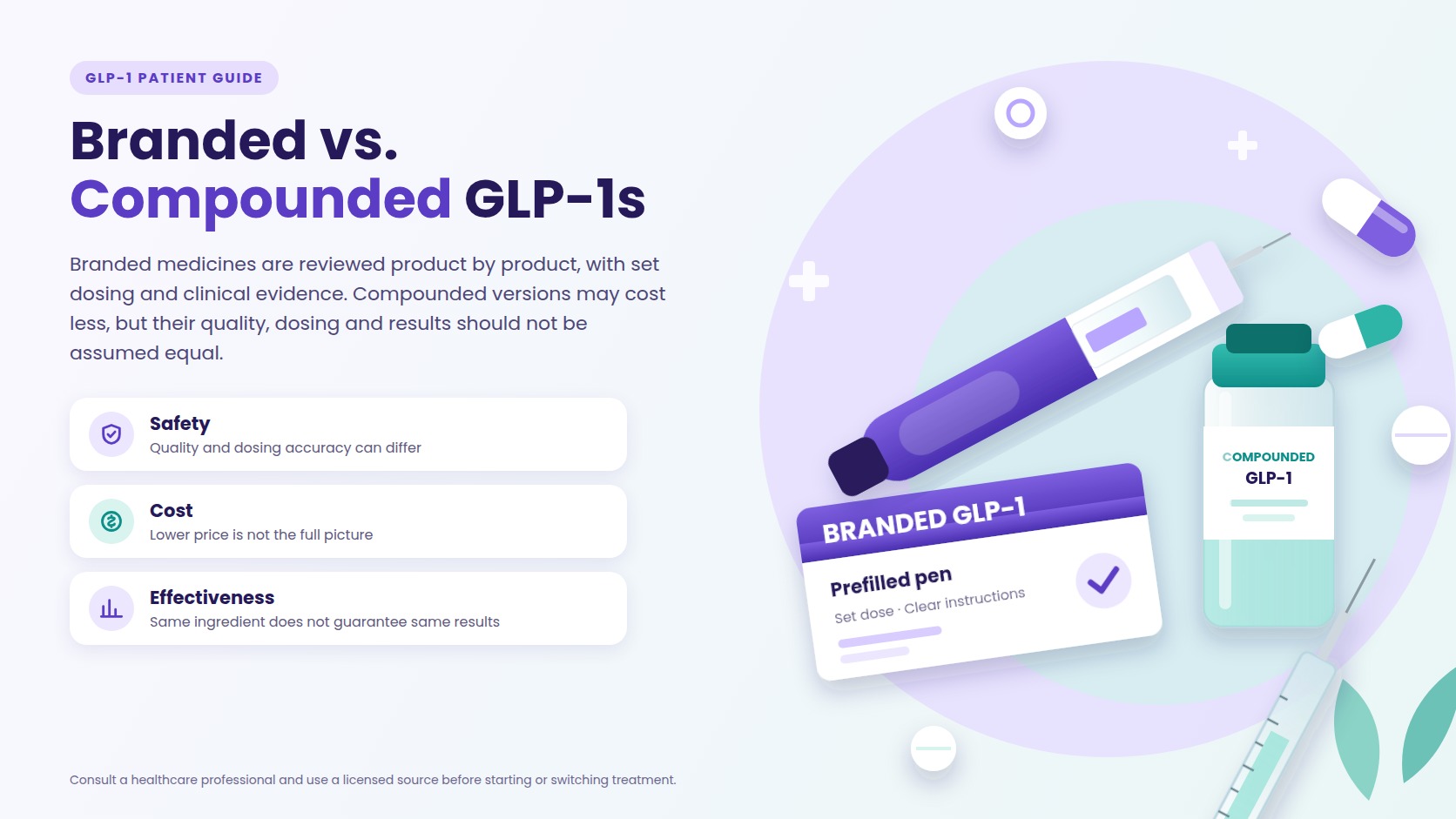
Many of the branded GLP-1 injections come in prefilled pens, which are used to deliver certain doses, while compounded products may be provided in multidose vials according to the preparation.
With a vial, the patient may need to draw the prescribed amount into a syringe. This introduces another step where mistakes can occur, particularly when instructions use syringe units instead of clearly explaining the prescribed dose in milligrams and the corresponding volume.
Ingredients and formulation concerns
Another concern is the ingredient itself, since the active ingredient in an approved semaglutide product is not the same as every substance that is referred to as a semaglutide derivative.
The FDA has specifically raised concerns about semaglutide salt forms, including semaglutide sodium and semaglutide acetate. These are different active ingredients from the semaglutide base used in approved medicines, and their equivalence has not been established.
Some combination products also include semaglutide together with other ingredients, for example, vitamin B12. Adding another ingredient does not mean weight loss will improve or the treatment will be safer. The safety and effectiveness of these combinations must be established, not assumed.
Cost Differences and the Real Price of Treatment
Compound GLP-1 products are often advertised at lower prices than branded medicines, which may seem like a significant advantage for those paying out of pocket.
The real cost will vary by product, prescribed dose, location, dispensing fees, and treatment duration. Since prices are subject to change, comparisons should be made using up-to-date and verified quotations rather than the advertised initial rates.
Brand-name products can be more expensive because their prices reflect the manufacturer’s costs for product development, regulatory requirements, production and distribution, and more. In some cases, insurance coverage can also affect what a patient pays.
Although compounded products may have lower initial prices, patients should consider the full cost of treatment. This cost should include the consultation, the process of dispensing the product, the use of appropriate syringes if they are needed, the arrangements for storage and any follow-up care. If the product is prepared incorrectly or a dosing error occurs, additional medical care may result in extra expenses.
In India and other markets, the applicable regulatory framework may differ. Advertising a product online at a lower price is not, by itself, proof that it has been lawfully manufactured, appropriately prescribed, or dispensed through a legitimate supply chain.
For patients, the more useful comparison is not simply the price per injection. It is the cost of obtaining a legitimate, appropriately prescribed medicine with reliable instructions and continuing clinical support.
Effectiveness: Do Compounded GLP-1s Work as Well?
The effectiveness of a GLP-1 medicine extends beyond its active ingredient, since factors such as dose, formulation, product quality, method of administration, and patient response matter.
Approved semaglutide and tirzepatide products have clinical trial data supporting their approved uses. The evidence varies by product, dose and indication. For instance, semaglutide products are approved for different uses, and results from a weight-management trial should not automatically be applied to every semaglutide formulation.
A compounded version of a drug may still perform worse than the branded product, and patients should not expect the same results unless supporting evidence exists for that specific compounded preparation.
This is particularly relevant when comparing compounded semaglutide vs Ozempic or considering Wegovy vs compounded semaglutide. Ozempic and Wegovy contain semaglutide, but they have different approved indications and product-specific dosing instructions. A compounded preparation is not automatically interchangeable with either one.
The same thing can be said about compounded tirzepatide compared to Mounjaro; even though the ingredient is referred to as tirzepatide, variations in the way it is prepared, its concentration, its quality and the method of administration may influence how reliably the patient receives the prescribed dose.
There is at the moment no good reason to suppose that compounded formulations always produce the same results as their branded counterparts merely because they contain the same named ingredient.
Branded vs. Compounded Semaglutide: A Practical Comparison
The following comparison summarises the main differences patients should consider.
| Factor | Branded GLP-1 medicines | Compounded GLP-1 medicines |
| Regulatory review | Approved products undergo product-specific regulatory review for their authorised uses. | Do not undergo the same premarket review as approved medicines in the US. |
| Formulation | Established formulation and product-specific instructions. | Formulation and presentation may vary by preparation. |
| Dose delivery | Often available in pens with established dose settings, depending on the product. | May require drawing a dose from a vial, depending on the preparation. |
| Clinical evidence | Supported by studies for the product’s approved indications. | Evidence supporting the specific compounded preparation may be limited. |
| Cost | Can be expensive without coverage or assistance. | May have a lower advertised price, depending on the provider. |
| Availability | Depends on local supply and distribution. | Depends on legal eligibility for compounding and the availability of a suitable pharmacy. |
| Interchangeability | Product-specific prescribing instructions apply. | Should not be assumed equivalent to a branded product. |
The fact that the two are being compared does not imply that all compound preparations are of low quality; on the contrary, it highlights the difference between a standardised and approved medicine and one which may not have undergone the same product-specific review.
How to Choose a GLP-1 Treatment More Safely
When deciding between a branded medicine and a compounded preparation, the choice should be based on the medical need rather than just the price.
- Check the indications: make sure that the medicine is approved for use in treating type 2 diabetes, for chronic weight management, or for another authorised purpose. The indications are not interchangeable among all products.
- Verify the source: Obtain prescription medicines through a legitimate, appropriately licensed pharmacy or dispensing provider. Be cautious of sellers offering injectable medicines without a prescription or making unrealistic weight-loss claims.
- Check the product details: Confirm the active ingredient, concentration, expiry date, storage instructions and dispensing information. If the product comes in a vial, ask for a clear explanation of how to measure the prescribed dose.
- Regarding affordability, if a branded product is too expensive, then ask the clinician about approved alternatives, the different strengths available, legitimate patient assistance schemes, or other treatments which are based on solid evidence.
- Plan follow-up care: Treatment requires monitoring of tolerability, response and any complications. The clinician may adjust the treatment plan based on progress rather than following a fixed schedule regardless of how the patient feels.
When patients in India are taking medications, they should check local requirements for authorisation and dispensing. The regulatory approval and availability in India may be different from that in the United States, and therefore it cannot be assumed that because a product has an American brand name or is approved by the FDA it is valid in India.
Conclusion
The choice between branded and compounded semaglutide is not simply a matter of cost. Branded products have well-defined formulations, have specific dosing instructions for each one, and are supported by clinical evidence for the uses approved for them. Compounded preparations can, however, be considered when a patient’s medical needs cannot be met with an appropriate approved product, provided local law permits it, and the professional decides so.
For the majority of patients, the sensible first move is to get a medicine that has been approved for the right indication prescribed. If cost or access is an issue, discuss valid alternatives with a healthcare professional instead of buying an unverified injection online.
Medical Disclaimer: This article is intended for informational purposes only and should not be considered a substitute for professional medical advice, diagnosis or treatment. Always consult a qualified healthcare professional before starting, stopping or switching GLP-1 medicines.
Pritimayee Swain