
Two quotes land in your inbox. Both for a 1.4 ATA soft-shell chamber. Both roughly the same diameter.
One is $11,800. The other is $18,400.
The photos look almost identical. The descriptions use the same language. So you do what most people do — you assume the cheaper one is the better deal, or that the pricier one is padding margin on brand name.
Then you read the line items carefully and find the difference sitting in one row: how oxygen actually gets from the concentrator into your lungs.
That single component — the breathing interface — can account for a multi-thousand dollar gap between two otherwise comparable quotes. And it’s the item most frequently omitted, downgraded, or quietly listed as “optional” without explanation.
Here’s what to look for.
What Gets Counted as “Included”
Start with a basic problem in how these quotes are built.
There is no standard bundle definition in this industry. One supplier’s “complete system” includes the chamber, compressor, concentrator, mask, chiller, and delivery. Another supplier’s “complete system” is the chamber and compressor, with everything else priced separately.
Both are technically accurate descriptions. Neither is comparable to the other without line-item detail.
The breathing system is where this gets most confusing, because the terminology is loose and the price range is wide.
BIBS, Explained Without the Marketing Layer
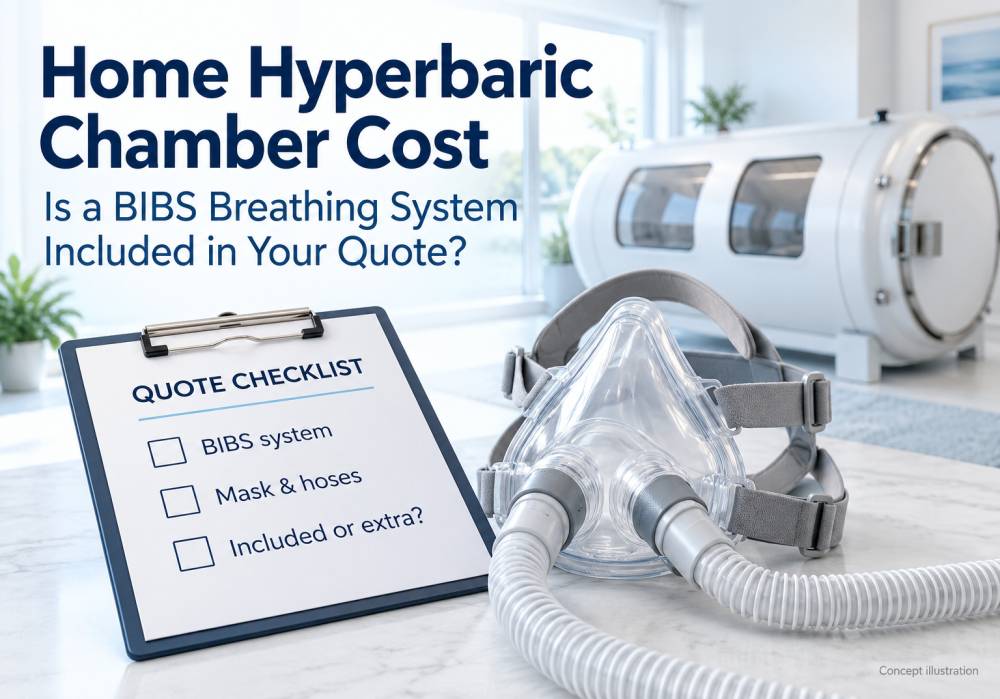
BIBS stands for Built-In Breathing System. In proper usage, it describes a delivery setup with two hose connections rather than one.
The first hose supplies oxygen to the mask. The second carries your exhaled breath out of the chamber through an overboard dump line. Your exhaled oxygen never enters the chamber atmosphere.
That design exists for a specific engineering reason. In a chamber pressurized with ambient air, if occupants exhale concentrated oxygen into the enclosed space, ambient oxygen concentration climbs. Past roughly 23.5 percent, you have an elevated fire risk inside a sealed environment you can’t quickly exit.
Overboard exhaust solves that by removing exhaled gas entirely.
What most home soft-shell chambers actually ship with is something different: an open mask or nasal cannula fed by a concentrator, with exhaled gas released directly into the chamber interior. Continuous chamber airflow flushes it out.
This is not inherently wrong. At 1.3 to 1.4 ATA with adequate airflow, it’s a widely used and generally accepted configuration. But it is not BIBS, and the cost difference between the two is significant.
The problem: some suppliers use “BIBS” as a marketing term for any mask-on-a-hose arrangement. When you’re comparing quotes, you need to know which system you’re actually being offered.
The Question That Clarifies Everything
Put this to any supplier in writing:
“Does the breathing system in this quote include an overboard exhaust line that vents exhaled gas outside the chamber, or does exhaled gas vent into the chamber interior? If the latter, what is the continuous chamber airflow rate in liters per minute?”
You’ll get one of three responses.
A clear, specific answer. Good sign. They know their system and have thought about it.
A vague answer that avoids the exhaust question. They’re likely selling an open mask setup and using BIBS language loosely.
No answer, or a redirect to a sales call. Draw your own conclusion.
Where the Money Actually Goes
Breaking the breathing system into its cost components makes the quote gaps easier to understand.
The oxygen concentrator
This is the largest single variable, and the one most commonly downgraded to hit a price point.
5 LPM units appear in most entry-level bundles. They cost the supplier considerably less. The problem is functional: under pressure, accounting for normal mask leakage and adult peak inspiratory flow, a 5 LPM continuous-flow setup cannot keep pace with what you’re actually drawing. You end up pulling makeup air through the mask edges, diluting the oxygen concentration reaching your lungs.
10 LPM units are the practical baseline for continuous-flow systems. The upgrade typically costs somewhere between $800 and $2,500 depending on the model.
Dual concentrator setups appear in premium configurations or where multiple people use the chamber. Add roughly the cost of a second unit plus a manifold.
What to verify: Make, model, rated output, purity percentage at maximum flow, and noise rating in decibels. Some concentrators advertise 95 percent purity but only sustain it at lower settings.
The mask or hood itself
Range here is wide — roughly $60 for a basic mask up to $600 or more for a properly engineered BIBS mask with demand valve and swivel connections.
What drives the difference: cushion material and design, whether multiple sizes are offered, presence of a demand valve versus continuous flow, seal quality, weight, and hose connection design.
What to verify: Is more than one size available? What does a replacement cushion cost? Where do replacement parts ship from?
Hoses, connectors, and routing hardware
Usually bundled, occasionally not. Worth confirming length, whether swivel connections are included at the mask, and whether there’s any in-chamber hose management.
This matters more in vertical chambers, where hoses hang downward and pull on the mask continuously.
Overboard exhaust system (true BIBS only)
If the quote genuinely includes BIBS, there’s a second hose run, a one-way backflow valve, an exhaust penetration in the chamber wall, and some termination arrangement outside the chamber.
This adds cost and installation complexity. It also means you need to think about where that exhaust vents — dumping concentrated oxygen into a small closed room relocates the fire hazard rather than eliminating it.
Reading Two Quotes Side by Side
Here’s how a $6,000 gap between comparable chambers typically breaks down.
Lower quote, $11,800:
Chamber, compressor, 5 LPM concentrator, basic open mask, standard hoses. No chiller. Curbside delivery.
Higher quote, $18,400:
Chamber, compressor, 10 LPM concentrator, engineered mask with two size options, swivel hose connections, inline air chiller, inside delivery and setup assistance, two-year warranty covering all components.
Neither supplier is lying. They’re selling different scopes.
But the lower quote requires roughly $4,000 to $5,000 in additional purchases before it’s operationally equivalent — concentrator upgrade, chiller, better mask. At which point the price gap mostly closes, except you’ve now made three purchases from potentially three sources with three warranty relationships.
The Line Items Most Often Missing
When you receive a quote, check specifically for each of these. Their absence is common.
Air chiller. Compressing air generates heat. Without cooling, interior temperature climbs noticeably by minute twenty and becomes genuinely uncomfortable by minute forty-five. Typically $1,200 to $3,000. This is not optional in practice, whatever the quote implies.
Concentrator upgrade to 10 LPM. Frequently shown as an add-on line rather than baseline.
Replacement mask cushions or additional mask sizes. Especially relevant if more than one person will use the chamber.
Freight and liftgate delivery. Often $300 to $900, sometimes excluded entirely from the headline number.
Inside delivery and placement. Curbside delivery means the pallet stops at the end of your driveway.
Setup and commissioning support. Phone, video, or on-site. Some suppliers include it; others charge.
Dedicated electrical circuit installation. Not the supplier’s cost, but a real one. The combined startup current of compressor, concentrator, and chiller will trip a standard 15-amp residential circuit. Budget $200 to $1,500 depending on your panel situation.
Prescription consultation. In the United States, hyperbaric chambers are regulated as Class II medical devices, and legitimate sellers require a prescription from a licensed provider before shipping. Telehealth consultation typically runs $75 to $150.
Vibration mats and basic room prep. Minor cost, but worth accounting for.
Ongoing Costs Tied to the Breathing System
Purchase price isn’t the whole picture.
Concentrator sieve beds degrade over time and typically need replacement every two to four years. Cost varies by model.
Mask cushions wear and lose seal quality. Annual replacement is common with regular use.
Filters — both compressor intake and concentrator — need periodic replacement. Budget $200 to $500 annually across the system.
Electricity. Running a compressor, concentrator, and chiller daily adds roughly $30 to $70 monthly depending on rates and session frequency.
Over five years, breathing-system consumables and maintenance can add $2,000 to $5,000 to total ownership cost. Worth factoring in when comparing a cheaper bundle against a better-engineered one.
A Quote Request Template
Rather than asking “what’s your price,” send this. You’ll get comparable responses from every supplier.
Please provide an itemized quote including:
- Chamber — model, internal diameter, internal length, rated working pressure
- Compressor — make, model, oil-free confirmation, filtration specification
- Oxygen concentrator — make, model, rated LPM output, purity at maximum flow, decibel rating
- Breathing interface — mask or hood type, sizes available, whether continuous flow or demand valve, whether overboard exhaust is included
- Hoses — length, swivel connections, in-chamber routing hardware
- Cooling — inline air chiller included, optional, or unavailable
- Delivery — curbside or inside, freight cost, liftgate requirement
- Setup support — included or additional, and in what form
- Warranty — coverage scope and duration by component
- Consumables — annual replacement items and current cost
- Parts — origin location and typical lead time
- Regulatory — FDA 510(k) clearance number for this specific model
- Prescription — whether you facilitate this and at what cost
Suppliers who return a complete itemized response are generally suppliers with organized operations. Those who resist itemization are usually bundling something they’d rather you didn’t examine closely.
Realistic Total Budget
For a properly configured home soft-shell setup — meaning one you’ll still be using in three years rather than one folded in a closet:
Chamber, compressor, 10 LPM concentrator, quality mask, air chiller, delivery, and setup: commonly $15,000 to $22,000 all-in.
Plus electrical work: $200 to $1,500 depending on your existing panel.
Plus prescription consultation where required: $75 to $150.
Annual operating budget thereafter: $600 to $1,500 covering electricity, filters, consumables, and periodic service.
Quotes substantially below this range are usually achieving it by downgrading the concentrator, omitting cooling, or excluding delivery and support. Which is fine if you understand the tradeoff and budget for the gap. It’s a problem if you don’t discover it until the equipment arrives.
Red Flags in a Quote
“BIBS” claimed without an overboard exhaust line. The terminology is being borrowed without the function.
Concentrator listed without LPM rating. This is the single most important spec in the breathing system. Omitting it is rarely accidental.
Air chiller marked optional with no explanation. It isn’t optional in practical use.
Single mask size with no alternatives. Face geometry varies. A universal-fit mask fits some faces well and others poorly.
No FDA clearance number provided on request. In the US, this applies to mild soft-shell units, not only clinical equipment. A supplier who can’t produce it in one email is a supplier worth passing on.
Seller states no prescription is needed. For a US-based seller, this indicates operating outside the regulatory framework or selling uncleared equipment.
Replacement parts shipping only from overseas. A torn mask cushion shouldn’t take your chamber out of service for six weeks.
Resistance to itemizing. Established suppliers do this routinely. Reluctance suggests something in the bundle doesn’t survive scrutiny.
Bottom Line
When two home hyperbaric chamber quotes differ by several thousand dollars, the breathing system is frequently where the difference lives — and it’s the component least likely to be described clearly.
Establish first whether the system is true BIBS with overboard exhaust or an open mask venting into the chamber. Then verify concentrator output in LPM, purity at maximum flow, mask sizing options, whether cooling is included, and what delivery and support actually cover.
Request itemization from every supplier using identical categories. Compare those, not headline prices.
The chamber is the thing you see in the photos. The breathing system is the thing determining whether the session does anything at all.
Oxygen Health Systems