
Who Can Receive ICU Care at Home?
ICU Care at Home may be suitable for selected patients who are medically stable but still require close monitoring, nursing support, medical equipment, or continuous assistance after leaving a hospital. It is not suitable for every critically ill patient. Doctors first assess the person’s medical condition, risk of sudden deterioration, treatment requirements, home environment, and availability of trained caregivers.
Patients who may be considered include those recovering from serious illness, people dependent on ventilators or oxygen in selected cases, patients with feeding tubes or tracheostomies, and individuals who need regular vital sign monitoring or complex nursing support. The decision should always come from the treating doctor and care team rather than the family alone.
The aim is to provide hospital level clinical support in a home setting when the patient no longer needs the full resources of an intensive care unit.
What Doctors Check Before Approving Home ICU Care
Moving a critically ill patient home is a clinical decision. Doctors usually consider several factors before recommending it.
1. Medical Stability
The first question is whether the patient is stable enough to leave the hospital.
A person who is experiencing uncontrolled bleeding, severe breathing difficulty, unstable blood pressure, repeated seizures, serious cardiac problems, or rapidly changing symptoms generally requires hospital based treatment.
Home care becomes more realistic when the patient’s condition has reached a stable stage and the required treatment can be safely provided outside a hospital.
2. Type of Medical Support Required
The care team looks at exactly what the patient needs each day.
This may include:
- Oxygen therapy
- Ventilator or respiratory support in selected situations
- Tracheostomy care
- Feeding tube management
- Catheter care
- Medication administration
- Wound and pressure sore care
- Blood pressure, pulse and oxygen monitoring
- Physiotherapy and rehabilitation
- Regular doctor reviews
Pranyaas lists home nursing support for respiratory care, tracheostomy and catheter care, feeding tube care, vital sign monitoring, and chronic disease management among its home based services.
The more complex the medical needs, the more important it becomes to have appropriately trained professionals available.
Patients Who May Benefit From ICU Care at Home
Patients Recovering After a Prolonged Hospital Stay
Some patients remain physically weak even after the immediate medical crisis has passed. They may still need frequent monitoring, medication administration, nutritional support, and help with mobility.
For these patients, returning home can be considered when the doctor believes their condition can be managed safely outside the hospital.
Patients Requiring Long Term Respiratory Support
Certain patients with serious respiratory conditions may continue to require oxygen therapy or other respiratory support after discharge.
Home care teams can assist with equipment, monitoring and routine nursing care, but the exact level of respiratory support must be prescribed and supervised by qualified medical professionals.
Patients With Tracheostomy or Feeding Tubes
Patients with a tracheostomy or feeding tube often require regular nursing attention. Care may involve cleaning, observation, feeding, medication administration and watching for signs of complications.
A trained nurse can also maintain records that can be shared with the treating doctor.
Bedridden Patients With Complex Medical Needs
A patient who cannot move independently may require frequent repositioning, skin care, hygiene support, nutritional assistance and monitoring.
This becomes particularly important when there is a risk of pressure injuries, infections, dehydration or complications related to immobility.
The Home Environment Matters More Than Families Often Expect
A medically suitable patient can still face problems if the home is not prepared for the level of care required.
The care team may assess:
- Availability of electricity for medical equipment
- Space for a hospital bed and equipment
- Cleanliness and ventilation
- Accessibility for medical staff
- Availability of a family member or responsible caregiver
- Emergency transport arrangements
- Distance from an appropriate hospital
- Ability to maintain medication and treatment schedules
For example, a patient dependent on respiratory equipment may require backup power arrangements. A family should also know exactly whom to contact if the patient’s condition suddenly changes.
The Care Team Is Just as Important as the Equipment
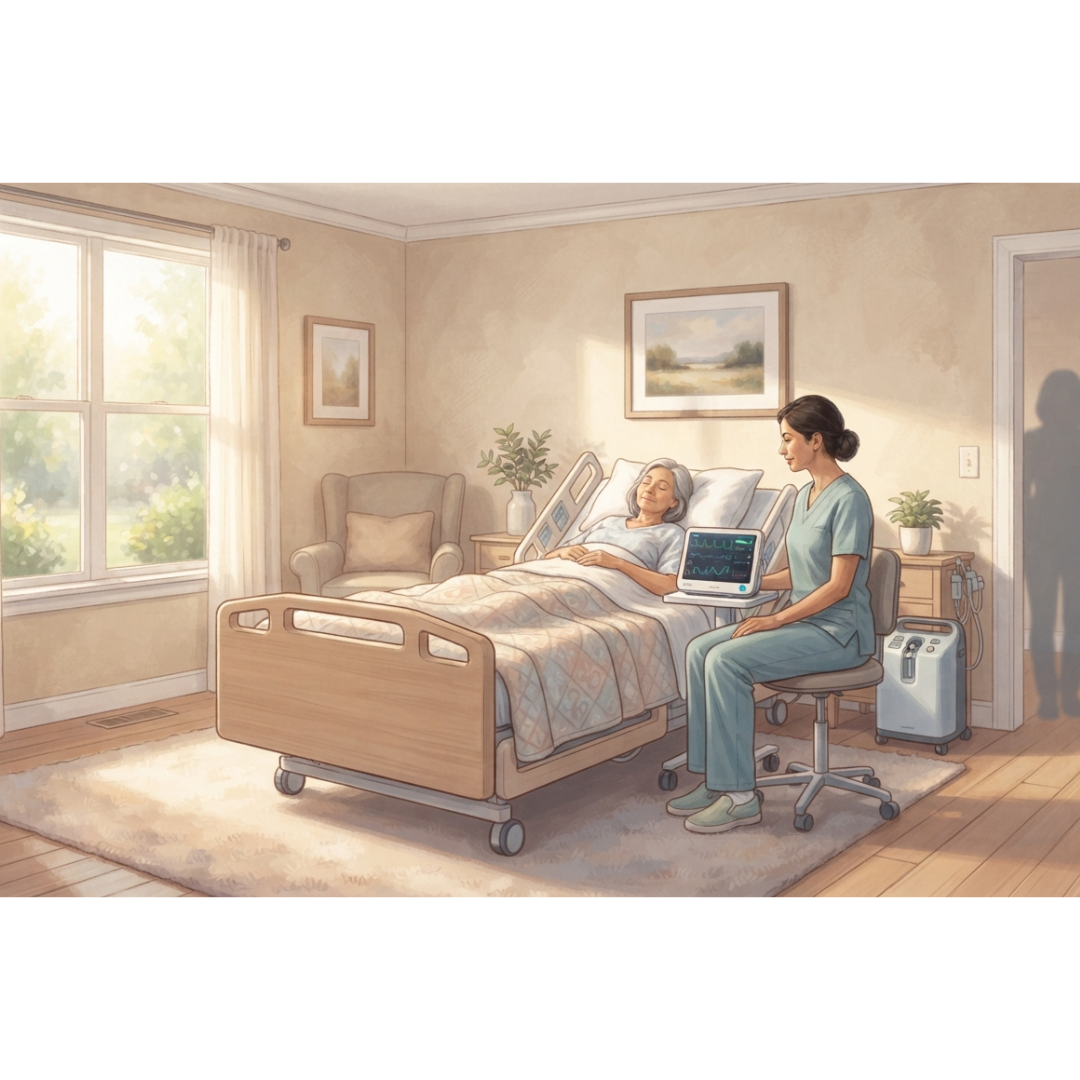
A home ICU setup is not simply a hospital bed, oxygen machine and monitoring devices. Skilled people are central to the care plan.
Depending on the patient’s condition, the team may include a doctor, registered nurse, physiotherapist, caregiver and care coordinator.
The nurse may monitor vital signs, administer prescribed medication, provide tube or catheter care, support hygiene, and report changes to the doctor. The caregiver can assist with daily activities, while the physiotherapist may work on mobility and respiratory rehabilitation.
Pranyaas provides trained nursing support for conditions requiring vital sign monitoring, respiratory care, post operative support and complex nursing procedures.
Family Readiness Is Another Important Factor
Family members do not need to perform clinical procedures themselves, but they should understand the patient’s care plan.
They should know:
- Which medicines are given and when
- What symptoms require immediate medical attention
- How medical equipment is used
- When the doctor needs to be contacted
- Who is responsible for maintaining care records
- What to do during an emergency
This matters because home based critical care involves coordination between the patient, family, nurses and doctors.
When ICU Care at Home May Not Be Appropriate
There are situations where a hospital remains the safer option.
Home care may not be appropriate when a patient has unstable vital signs, requires frequent emergency intervention, needs advanced diagnostic facilities, or has a condition that can deteriorate rapidly.
Families should never move a patient home simply because hospital care is expensive, inconvenient or emotionally difficult. The medical decision must come first.
Pranyaas itself notes that serious emergencies such as severe breathing difficulty, loss of consciousness, major bleeding and suspected heart attack or stroke generally require immediate medical attention and may need hospital emergency services.
How Families Can Prepare for Home ICU Support
Before discharge, families should ask the hospital team for a clear written care plan.
This should cover medication schedules, diet, equipment requirements, nursing frequency, warning signs, follow up appointments and emergency contacts.
The home should also be prepared before the patient arrives. Medical equipment should be installed and tested, the sleeping area should allow adequate access for nurses, and important medical documents should remain easily available.
A professional provider such as Pranyaas can also help families assess their home care requirements and arrange trained nursing support based on the patient’s needs. Its services include nursing care, patient support, physiotherapy assistance and medical equipment related support.
Why Clinical Assessment Should Come Before Choosing a Provider
The biggest mistake families can make is choosing a service first and asking whether the patient is suitable later.
The correct order is different.
First, the treating doctor determines whether the patient can safely receive care outside the hospital. Next, the family identifies the clinical requirements. Then, a home care provider can be selected based on staffing, nursing skills, equipment support, response procedures and communication with the medical team.
This approach makes ICU Care at Home a clinical care decision rather than simply a service purchase.
Conclusion
ICU Care at Home can be appropriate for patients who are medically stable but still need close supervision, skilled nursing, medical equipment and regular clinical monitoring. Patients recovering from serious illness, those requiring respiratory support, individuals with tracheostomies or feeding tubes, and bedridden patients with complex needs may qualify in selected situations.
The final decision should consider medical stability, treatment requirements, home conditions, trained staff and emergency arrangements. A well planned home care setup can give families a practical alternative to prolonged hospitalisation when the patient’s medical condition allows it.
FAQs
Q.1 Who decides whether a patient is suitable for ICU Care at Home?
The treating doctor and clinical care team should make this decision after assessing the patient’s medical stability, treatment needs, risks and home environment.
Q.2 Can a ventilator dependent patient receive care at home?
Some patients can receive ventilator support at home, but only when the medical team considers the condition suitable and the required equipment, trained nursing support and emergency arrangements are available.
Q.3 What equipment may be required for ICU Care at Home?
Depending on the patient, equipment may include a hospital bed, oxygen equipment, pulse oximeter, suction machine, feeding equipment and other prescribed monitoring devices.
Q.4 Is home ICU care suitable for elderly patients?
Age alone does not determine suitability. An elderly patient may receive intensive home support if the medical condition is stable and the required clinical care can be provided safely.
Q.5 What should families ask a home care provider?
Families should ask about nurse qualifications, staffing hours, emergency procedures, doctor coordination, equipment support, replacement staff and how changes in the patient’s condition are reported.
Q.6 Can home care replace a hospital during an emergency?
No. Home care should not be treated as a replacement for emergency hospital treatment. Sudden breathing difficulty, unconsciousness, severe bleeding, chest pain or other serious symptoms require immediate medical attention.
Rita Sharma