
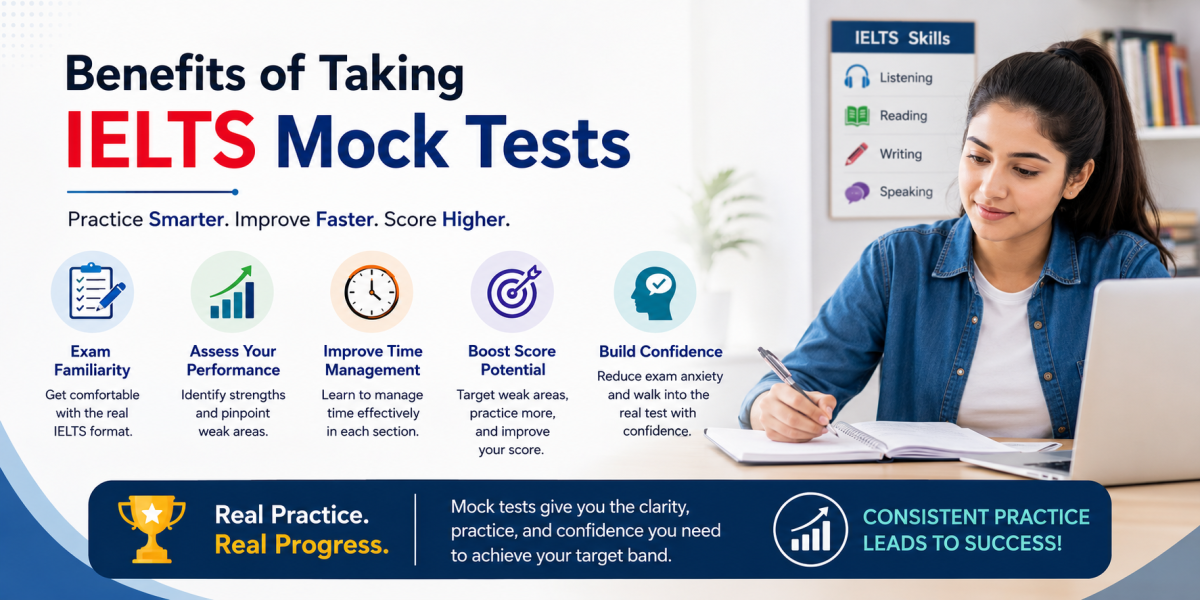
IELTS preparation requires more than reviewing question types and completing practice exercises. It also requires disciplined practice, accurate feedback, and deliberate correction between assessments. That process turns study time into measurable progress each cycle. A mock test creates a realistic setting where candidates can measure accuracy, pacing, concentration, and test-taking habits under time pressure.
Moreover, repeated mock tests reveal patterns that ordinary practice may not show. They also help candidates manage the four sections with greater confidence and control. When candidates review each attempt carefully and act on the results, mock tests become a practical tool for steady improvement.
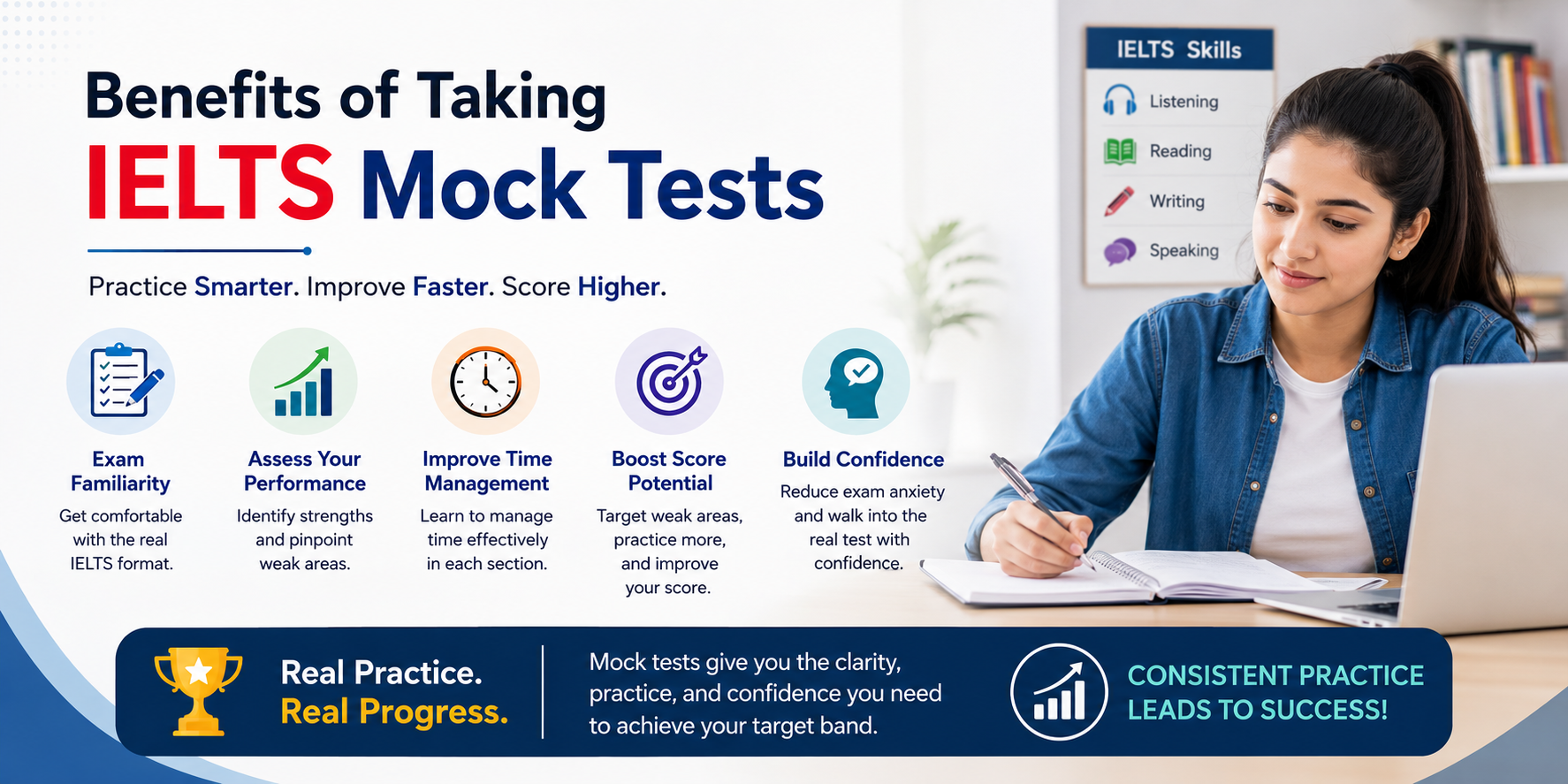
Benefits of Taking IELTS Mock Tests
IELTS mock tests provide a structured way to evaluate preparation before the official examination. Unlike isolated exercises, a full simulation requires candidates to manage multiple skills, changing task demands, and strict timing.
Get a Clear Performance Snapshot
A mock test provides a useful snapshot of current performance. Candidates can see where they perform consistently and where errors occur repeatedly. Consequently, preparation becomes more focused because study time can follow measurable needs rather than assumptions.
The results also create a baseline. After several simulations, candidates can compare scores and identify meaningful changes. In contrast, completing unrelated practice questions may make progress difficult to measure because each activity uses different conditions.
Become Familiar With Test Conditions
Familiarity can reduce uncertainty on test day. A realistic mock test exposes candidates to the sequence of sections, time limits, instructions, and mental demands associated with a complete IELTS session.
Moreover, repeated exposure helps candidates develop a predictable routine. They can practice checking instructions, moving through questions efficiently, and maintaining concentration when one task feels difficult. As a result, unfamiliar conditions become less distracting.
Improve Time Management
Time management strongly affects IELTS performance because candidates must complete demanding tasks within fixed limits. Strong language ability alone does not guarantee efficient completion.
Practice Pacing Across Sections
Mock tests show whether a candidate spends too much time on individual questions. For example, a difficult reading question can consume several minutes if the candidate keeps searching for one answer. A timed simulation makes that habit visible.
Consequently, candidates can develop pacing rules, such as moving forward after a reasonable attempt and returning to difficult questions when appropriate. These decisions become easier when practice repeatedly reinforces them.
Balance Speed and Accuracy
Fast completion does not automatically produce a higher score. Candidates need enough time to process information accurately while maintaining steady progress.
Therefore, mock tests can reveal whether speed causes careless mistakes or whether excessive caution leaves questions unfinished. Candidates can then adjust their approach through targeted practice rather than relying on guesswork.
Build Confidence Through Familiarity
Confidence should come from preparation, not from assuming that every task will feel easy. Mock tests provide repeated opportunities to perform under realistic pressure.
Reduce Test-Day Uncertainty
The official examination can feel demanding when candidates have never completed a full simulation. Mock tests remove some uncertainty by making the structure and timing familiar.
Furthermore, candidates can identify personal pressure points. Some may lose concentration during lengthy listening tasks, while others may become anxious when reading passages appear difficult. Recognizing these patterns allows candidates to prepare practical responses.
Strengthen Mental Stamina
A full IELTS session requires sustained attention. Mock tests train candidates to maintain effort across several sections instead of focusing only on short practice sessions.
Over time, candidates can develop better concentration habits. They also become more comfortable continuing after an imperfect response. Consequently, one difficult question becomes less likely to disrupt performance on later tasks.
Identify Strengths and Weaknesses
One of the most valuable benefits of mock testing involves identifying specific performance gaps.
Find Repeated Error Patterns
A single mistake may have little significance. However, repeated errors often indicate a skill that needs additional attention. Candidates should record recurring problems rather than treating every incorrect response as an isolated event.
Useful categories include:
- Vocabulary errors
- Grammar mistakes
- Misreading instructions
- Difficulty locating information
- Poor time allocation
- Weak response organization
- Spelling or punctuation errors
- Loss of concentration
This classification makes review more practical. Moreover, candidates can prioritize problems that appear frequently or affect several question types.
Protect Existing Strengths
Preparation should not focus exclusively on weaknesses. Strong areas also require maintenance because performance can decline when candidates neglect them for long periods.
For example, a candidate with strong listening performance can continue with shorter listening exercises while directing more study time toward writing or reading. This approach creates a balanced preparation routine.
Improve Reading Performance
IELTS Reading requires candidates to process passages efficiently, locate relevant information, interpret meaning, and make accurate decisions under strict timing.
Develop Faster Information Scanning
Mock tests provide repeated opportunities to practice locating names, dates, keywords, arguments, and supporting details. Candidates can compare the time they spend searching for information across different passages.
Additionally, reviewing incorrect answers can show whether the candidate missed information or selected an answer without sufficient evidence. Consequently, reading practice becomes more deliberate.
A focused IELTS exam reading practice test can also help candidates evaluate how well they handle realistic passage length and question density. The key value comes from reviewing performance afterward rather than simply completing the test.
Improve Question Selection
Some reading questions require more time than others. Mock tests help candidates recognize when a question deserves another attempt and when they should move forward.
As a result, candidates can build a flexible approach instead of following one rigid sequence for every passage.
Improve Listening Performance
IELTS Listening demands concentration because audio information continues moving forward. Candidates cannot pause the recording during the official test.
Strengthen Concentration
Full simulations help candidates maintain attention across the complete listening section. Moreover, they reveal whether concentration drops during particular parts of the recording.
If mistakes increase near the end, candidates can add longer listening sessions to their preparation. This strategy targets stamina rather than vocabulary alone.
Improve Prediction and Note-Taking
Before the audio begins, candidates can use available time to anticipate possible answers. Mock tests allow them to practice this process under realistic timing.
They can also evaluate note-taking habits. Excessive writing may cause missed information, while insufficient notes may make details difficult to recall. Therefore, review should focus on finding a practical balance.
Improve Writing Performance
Writing tasks require candidates to organize ideas, address the prompt, maintain appropriate language, and manage time effectively.
Practice Planning Under Pressure
Mock tests create a realistic deadline for planning, drafting, and reviewing. Candidates can track how much time each stage consumes.
Consequently, they can adjust their process. A candidate who spends too long planning may need a shorter planning routine, while someone who skips planning may benefit from a brief outline before writing.
Improve Task Completion
A strong response must address the required elements of the task. Mock test review can reveal whether candidates omit key points, provide limited support, or lose focus.
Moreover, reviewing completed responses against scoring criteria can make weaknesses more visible. Candidates can then practice specific improvements instead of rewriting entire responses without a clear purpose.
Improve Speaking Performance
Speaking practice benefits from realistic timing because candidates must respond spontaneously and maintain communication without lengthy pauses.
Build Response Fluency
Mock speaking sessions can reveal frequent hesitation, repetition, or incomplete answers. Candidates can then practice extending responses with relevant details, examples, and explanations.
In addition, recording practice responses can help candidates notice repeated habits. The goal should remain clear communication rather than memorizing fixed scripts.
Improve Pronunciation and Delivery
A mock session can highlight unclear sounds, uneven pacing, or excessive pauses. Candidates can address these issues through focused speaking drills.
However, candidates should avoid trying to change every aspect of delivery simultaneously. Prioritizing the most noticeable problems makes practice more manageable and measurable.
Develop Better Test-Taking Strategies
IELTS success depends partly on how effectively candidates approach tasks. Mock tests create a safe setting for testing strategies before the official examination.
Test Different Approaches
Candidates can compare different pacing methods, question orders, note-taking styles, and review habits. For example, one candidate may perform better by moving through easier reading questions first.
However, strategy changes should rely on evidence. A method that feels comfortable may not produce better accuracy. Mock results can show which approach actually supports stronger performance.
Build Decision-Making Skills
Unexpected difficulty can occur during any examination. A mock test helps candidates practice making quick decisions without allowing one difficult task to consume disproportionate time.
Consequently, candidates can become more adaptable. They practice moving forward, returning when possible, and maintaining concentration after an error.
Track Progress Over Multiple Tests
One mock test offers limited information. A series of tests provides a stronger picture of preparation.
Compare Scores and Subscores
Record each overall score along with section-level results. Over time, patterns may emerge that reveal which areas improve quickly and which require sustained attention.
Moreover, compare performance under similar conditions. A score increase matters more when candidates used comparable timing and test difficulty.
Monitor More Than Scores
Scores matter, but they should not provide the only measure of progress. Candidates should also track:
- Questions completed within time
- Repeated error categories
- Writing completion time
- Speaking hesitation
- Listening concentration
- Reading accuracy
- Confidence during timed work
These indicators can explain why a score changes and help candidates choose the next priority.
Conclusion
IELTS mock tests provide value far beyond a practice score. They help candidates measure performance, improve pacing, identify recurring weaknesses, strengthen mental stamina, and refine test-taking strategies. Moreover, repeated simulations create a clear feedback cycle: test, review, practice, and measure again. The strongest results come when candidates treat each mock as a diagnostic opportunity rather than a simple assessment. With focused review and targeted correction between tests, candidates can approach the official examination with greater control, stronger consistency, and a clearer preparation strategy. Candidates can also use each result to refine priorities, protect strong skills, and make every remaining study session more purposeful and efficient.
FAQs
1. Are IELTS mock tests useful for beginners?
Yes. A beginner can use an initial mock test as a diagnostic assessment. It can reveal the examination structure, timing demands, and areas that need attention. However, beginners should not judge their potential from one score. Instead, they should use the result to set realistic priorities for future practice.
2. How many IELTS mock tests should I take?
There is no universal number. Quality matters more than volume. Candidates should take enough full simulations to measure progress while leaving adequate time for targeted practice. A practical approach involves completing a mock, reviewing it carefully, addressing weaknesses, and then using another test to evaluate whether those changes worked.
3. Can mock tests improve my IELTS score?
Mock tests can contribute to score improvement when candidates use the results to correct weaknesses. Simply taking more tests does not guarantee better performance. Effective preparation combines realistic simulations with error analysis, focused practice, timing work, and repeated evaluation.
4. Should I take a mock test before studying IELTS?
An initial mock can provide a useful baseline. It shows candidates how they currently perform under realistic conditions and highlights areas that deserve attention. However, the score should function as a starting point rather than a final judgment. Subsequent practice can then target specific performance gaps.
5. How long should I wait between IELTS mock tests?
The gap should provide enough time to review mistakes and practice priority skills. Some candidates may benefit from several days, while others may need a full week. If repeated tests produce similar errors, extend the gap and dedicate more time to targeted correction before another simulation.
6. Should I review every IELTS mock test?
Yes. Review creates much of the value that mock testing provides. Candidates should examine incorrect answers, uncertain correct answers, timing problems, and weaknesses in writing or speaking. Consequently, each test can produce specific actions for the next preparation cycle.
7. Are online IELTS mock tests reliable?
An online mock can be useful when it closely reflects official task formats, timing, instructions, and difficulty. Candidates should focus on realistic conditions rather than treating every practice score as an exact prediction. Consistent results across multiple simulations provide more useful evidence than one single isolated score.
8. Can mock tests help with IELTS time management?
Yes. Timed simulations reveal where candidates spend too much time and where rushed decisions create errors. By reviewing timing alongside accuracy, candidates can adjust pacing strategies. Moreover, repeated practice can make time allocation more automatic, reducing the need to monitor the clock constantly.
9. Should I take a full mock test every day?
Usually, taking a full mock every day leaves insufficient time for correction. Candidates benefit more when they alternate assessment with targeted practice. Daily section-based exercises can maintain momentum, while full simulations can occur after candidates have addressed the main weaknesses identified in previous tests.
10. What should I do after getting a low mock score?
First, avoid reacting to the score alone. Review the test and identify the main causes of lost marks. Then prioritize the weaknesses that appear most frequently or affect multiple sections. After targeted practice, take another realistic simulation to determine whether your corrections produced measurable improvement.
Aman Singh