
Enterprise UX is not about making things look good. It is about making complex systems work for real people inside large organizations, where poor design costs time, money, and productivity.
Agencies that specialize in this space bring structured thinking, cross-functional experience, and a deep understanding of how enterprise software actually gets used day to day.
What Makes Enterprise UX Different From Regular Product Design
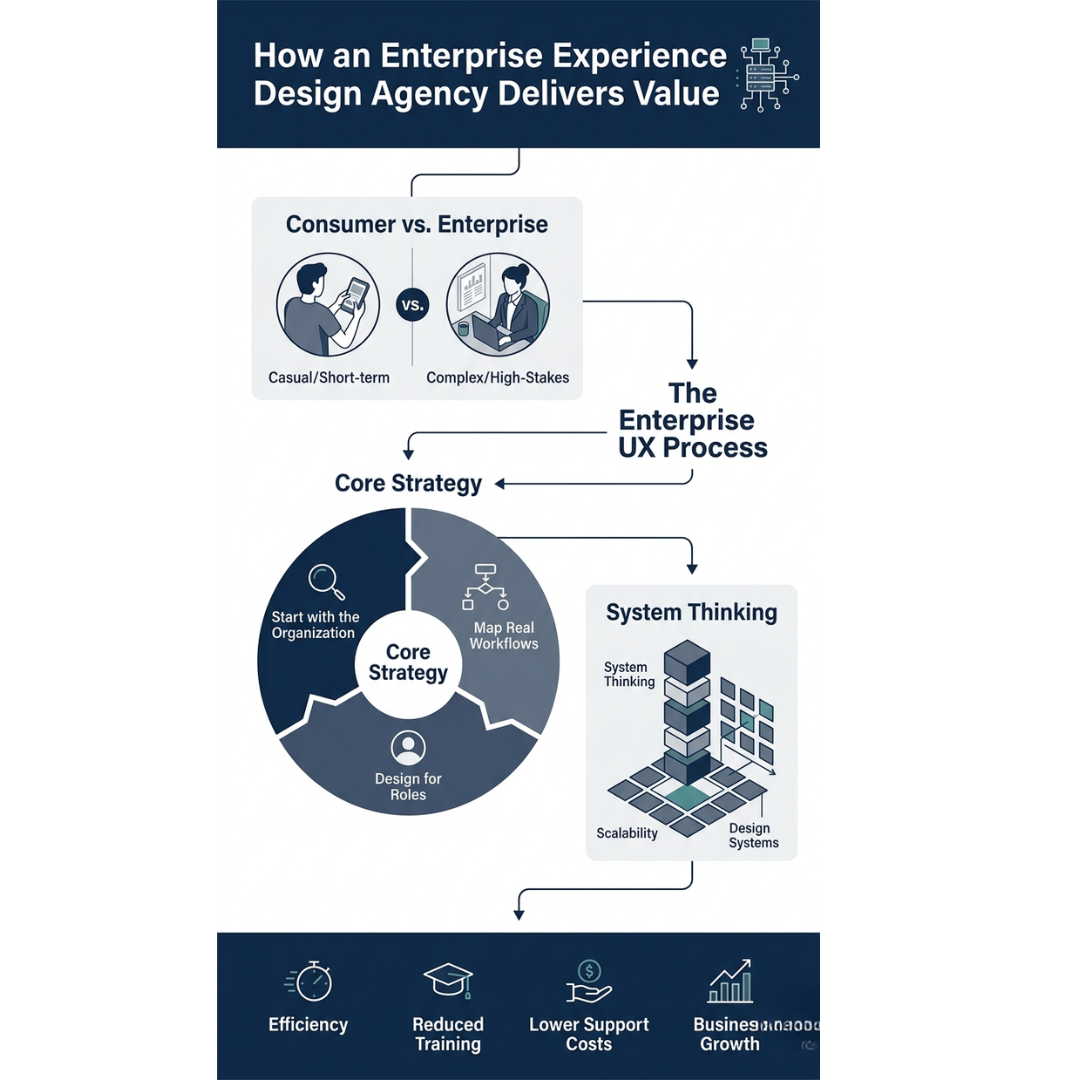
Consumer apps are designed for casual users. Enterprise systems are designed for professionals who use them for hours every day, often under pressure, often with limited training time.
The stakes are different. A confusing checkout flow loses a sale. A confusing procurement or ERP interface can delay operations, cause errors, or slow down entire departments.
Enterprise UX has to account for:
- Multiple user roles with different permission levels
- Legacy system dependencies that cannot simply be removed
- Compliance requirements that limit design decisions
- Large user bases with varying technical comfort levels
- Internal politics that affect what gets built and what gets cut
This is why working with an experienced enterprise experience design agency matters more than hiring a general design team.
How Agencies Actually Approach Enterprise UX Projects
They Start With the Organization, Not the Interface
Before any wireframe gets drawn, good agencies spend time understanding the business.
- Who are the actual users?
- What is their daily workflow?
- Where are the friction points?
- What does success look like for the business and for the end user?
This phase often involves stakeholder interviews, user shadowing sessions, and reviewing existing analytics or support tickets.
It is investigative work, not creative work yet.
They Map Real Workflows, Not Ideal Ones
Agencies that understand enterprise environments know that what the business says happens and what actually happens are often two different things.
A purchasing manager might say approvals take one day. The actual process might involve three email threads, a spreadsheet workaround, and a manual override.
Good UX design in enterprise contexts must reflect reality, not wishful thinking.
That means workflow mapping based on observation and conversation, not just process documentation from the IT team.
They Design for Roles, Not Just Use Cases
Enterprise systems serve many people differently.
A field technician, a finance controller, and a department head all use the same system for completely different reasons.
Designing one generic interface for all of them creates a product that works poorly for everyone.
Role-based design thinking is a core part of how professional agencies structure enterprise UX work.
Each role gets a clear, purposeful experience that fits how they actually work.
What Separates Strong Agency Work From Weak Execution
System Thinking Over Screen Thinking
Many design teams default to designing screens.
Strong enterprise UX teams design systems.
They think about:
- How information flows
- How errors get handled
- How users recover from mistakes
- How data connects across modules
This is a fundamentally different mindset, and it shows up clearly in the quality of the final product.
Usability Testing With Real Enterprise Users
Generic usability testing is fine for consumer products.
Enterprise testing requires recruiting the right people: actual employees who work in finance, operations, HR, or whatever domain the product serves.
Agencies that do this properly run sessions inside real work environments or create accurate simulations.
The insights from this kind of testing are far more useful than lab-based feedback from general users.
Scalability Built Into the Design System
Enterprise products grow.
- New modules get added
- New regions get added
- New compliance rules arrive
A design system that cannot handle this growth creates technical debt quickly.
Strong agencies build design systems with scalability in mind from the start.
This includes:
- Component libraries
- Token-based theming
- Clear documentation for internal development teams
Where F1Studioz Fits Into This Picture
F1Studioz works with organizations that need serious UX thinking applied to complex product environments.
Their process is grounded in business outcomes, not aesthetics, which makes them a relevant partner for enterprise digital transformation projects.
As an enterprise experience design agency, F1Studioz brings together product strategy, interaction design, and usability thinking into one cohesive engagement model.
Their focus on enterprise contexts means they understand the constraints, the stakeholders, and the long-term nature of these projects.
For organizations building or redesigning large-scale digital products, working with a team that has direct enterprise UX experience reduces risk significantly.
Conclusion
Enterprise UX is a specialized discipline that requires understanding organizations as much as it requires understanding design.
Agencies that do this well combine:
- Investigative research
- Role-based design thinking
- Real-world usability testing
- Scalable design systems
The value they deliver is not just better-looking software.
It is software that people can actually use efficiently, that reduces training costs, lowers support tickets, and supports the business outcomes that matter.
If your organization is facing a complex product design challenge, partnering with a team that has real enterprise UX experience is the most practical decision you can make.
FAQs
Q.1 What does an enterprise experience design agency actually do?
They research, design, and test digital products for large organizations, focusing on complex workflows, multiple user roles, and business-specific constraints rather than general consumer usability.
Q.2 How long does an enterprise UX project typically take?
Depending on the scope, enterprise UX projects usually run between three to nine months.
Discovery and research alone can take four to eight weeks for large systems.
Q.3 Why can’t an internal team handle enterprise UX design?
Internal teams can, but they often lack the bandwidth, external perspective, or specialized enterprise design experience needed for large transformation projects.
Agencies bring structured methodology and cross-industry exposure.
Q.4 How do agencies handle legacy system constraints in UX design?
They design within the constraints that exist, identifying what can change and what cannot.
Good agencies work alongside your technical team to find design solutions that fit within real technical boundaries.
Q.5 What should a company look for when hiring an enterprise UX agency?
Look for proven experience with complex digital products, a clear research process, examples of role-based design thinking, and the ability to work with both business stakeholders and technical teams.
Rita Sharma