
Online Advertising Market Size and Forecast 2025–2033
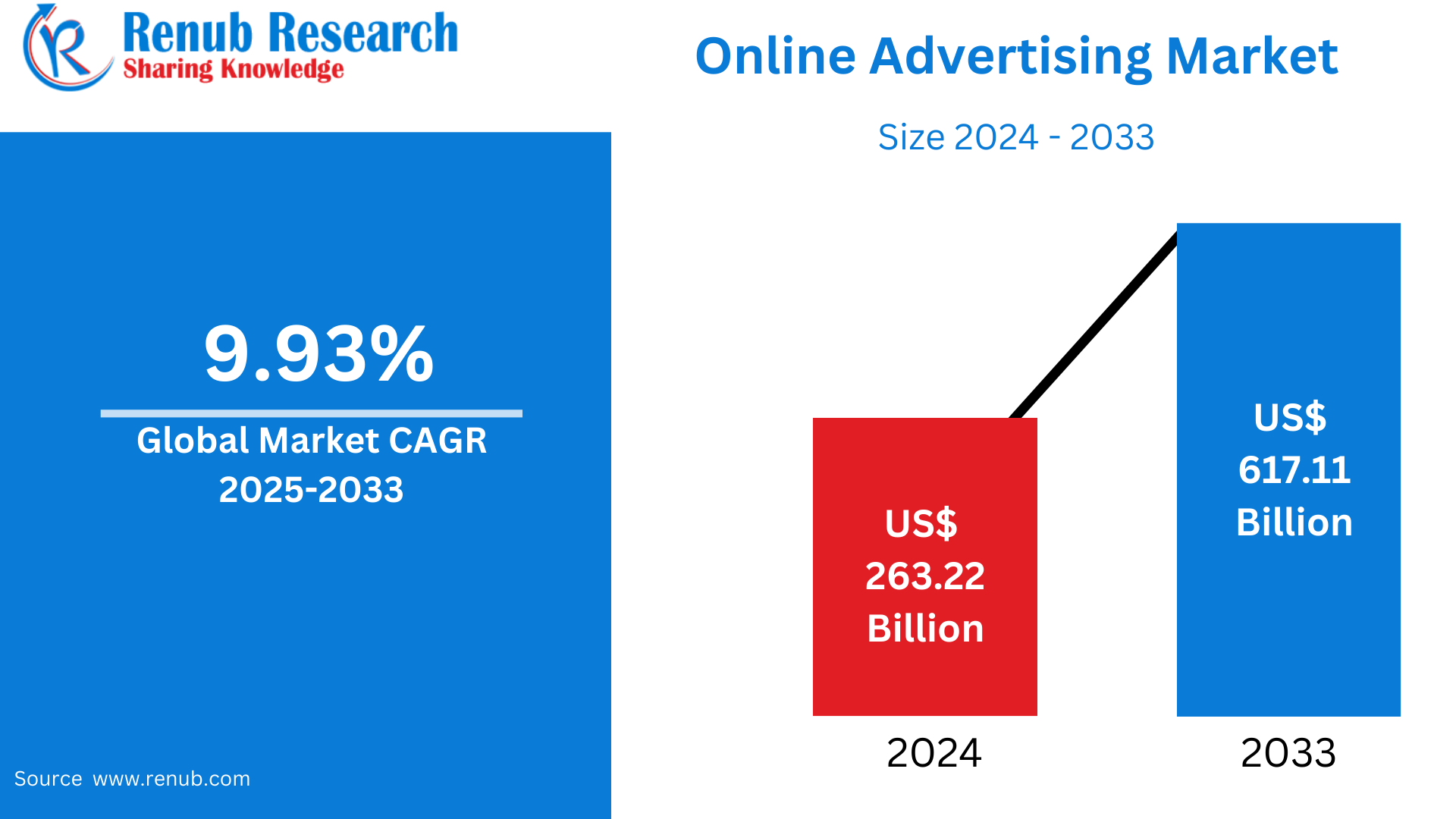
According to Renub Research global online advertising market is undergoing a phase of sustained and technology-driven expansion, supported by rising internet penetration, smartphone adoption, and the rapid digitalization of businesses across industries. The market was valued at US$ 263.22 billion in 2024 and is projected to reach US$ 617.11 billion by 2033, growing at a compound annual growth rate (CAGR) of 9.93% from 2025 to 2033. Online advertising has become the dominant channel for brand communication, customer acquisition, and performance-driven marketing due to its measurability, scalability, and precise targeting capabilities.
As consumers increasingly spend time on digital platforms, advertisers are reallocating budgets from traditional media to online channels such as search engines, social media, video streaming platforms, and mobile applications. Innovations in artificial intelligence, data analytics, and programmatic advertising are further enhancing campaign efficiency, making online advertising a core pillar of modern marketing strategies worldwide.
Online Advertising Industry Overview
Online advertising refers to the practice of delivering promotional messages to consumers through internet-based platforms. It includes a wide range of formats such as search engine ads, display banners, video advertisements, native ads, social media promotions, email marketing, and full-screen interstitials. Advertisers leverage data-driven tools to target audiences based on demographics, interests, online behavior, geographic location, and purchasing intent.
One of the defining advantages of online advertising is its ability to deliver measurable outcomes. Marketers can track impressions, clicks, conversions, engagement rates, and return on investment in real time, enabling continuous optimization of campaigns. Unlike traditional advertising, digital campaigns can be modified instantly based on performance metrics, audience response, or market conditions. This flexibility, combined with cost efficiency and global reach, makes online advertising an indispensable component of today’s digital promotional ecosystem.
The industry is evolving rapidly with the integration of AI, machine learning, and automation. These technologies support real-time bidding, predictive targeting, creative optimization, and advanced audience segmentation, significantly improving advertising effectiveness across platforms.
Request a free sample copy of the report:https://www.renub.com/request-sample-page.php?gturl=online-advertising-market-p.php
Growth Drivers for the Online Advertising Market
Rising Internet and Smartphone Penetration
The increasing penetration of the internet and smartphones is a primary driver of the online advertising market. A majority of the global population now has access to the internet, with mobile devices accounting for most digital traffic. Affordable smartphones and low-cost data plans have accelerated connectivity, particularly in emerging economies.
This always-connected audience enables advertisers to reach consumers across multiple touchpoints throughout the day. Mobile-first behavior has prompted brands to prioritize mobile advertising formats such as in-app ads, mobile video, and social media promotions. As digital consumption continues to rise, advertisers are increasingly shifting budgets toward online channels, fueling market growth.
Expansion of E-commerce and Digital Marketplaces
The rapid growth of e-commerce has significantly strengthened the online advertising ecosystem. Consumers increasingly discover, evaluate, and purchase products online, creating valuable opportunities for targeted advertising within digital shopping environments. Brands are investing heavily in ads across marketplaces, retail websites, and shopping apps to influence purchasing decisions at critical moments.
Retail media networks—advertising platforms operated by e-commerce companies—allow advertisers to leverage first-party data and deliver highly personalized ads. These ads are closely tied to consumer purchase behavior, resulting in higher conversion rates and measurable returns. As online shopping continues to expand globally, the intersection of e-commerce and digital advertising is expected to remain a major growth catalyst.
Advanced Targeting and Data Analytics Capabilities
Sophisticated targeting technologies are transforming how advertisers reach and engage audiences. AI-driven algorithms analyze vast amounts of data to identify user preferences, predict intent, and deliver personalized ad experiences. Advertisers can segment audiences with high precision based on browsing behavior, content consumption, location, and transaction history.
Advancements in automation and performance-based advertising models reduce wasted impressions and improve campaign efficiency. New campaign formats powered by AI enable advertisers to manage creative assets, bidding strategies, and audience targeting through unified platforms. These innovations are driving higher adoption of data-driven advertising solutions across businesses of all sizes.
Challenges in the Online Advertising Market
Ad Fraud and Invalid Traffic
Ad fraud remains a significant challenge in the online advertising industry. Fraudulent activities such as fake clicks, bot-generated impressions, and invalid traffic drain advertising budgets and distort performance metrics. These practices reduce trust between advertisers and platforms and make it difficult to accurately measure campaign effectiveness.
Despite improvements in fraud detection technologies, cybercriminals continue to develop more sophisticated techniques. Combating ad fraud requires continuous investment in verification tools, transparency initiatives, and industry collaboration. Addressing this challenge is essential to protect advertiser spending and ensure the credibility of digital advertising ecosystems.
Consumer Privacy and Regulatory Compliance
Growing concerns about consumer privacy are reshaping the online advertising landscape. Users are becoming more aware of how their data is collected, stored, and used, leading to increased demand for transparency and control. Regulatory frameworks such as data protection and privacy laws impose strict requirements on data usage and consent management.
Changes in browser policies, including restrictions on third-party cookies, are limiting traditional tracking methods. Advertisers must now adopt privacy-centric strategies such as first-party data utilization, contextual advertising, and consent-based targeting. Balancing personalization with privacy compliance is a key challenge that requires innovation and responsible data practices.
United States Online Advertising Market
The United States represents one of the most mature and dynamic online advertising markets globally. High internet penetration, advanced digital infrastructure, and widespread adoption of programmatic advertising contribute to strong market performance. Brands in the U.S. активно invest in search, social media, video, and connected TV advertising to reach fragmented audiences.
The market is characterized by rapid adoption of AI-powered tools that enhance creative efficiency, audience targeting, and campaign measurement. Innovations in automation and generative technologies are reshaping content creation and ad personalization, reinforcing the United States’ leadership in digital advertising innovation.
Germany Online Advertising Market
Germany’s online advertising market is expanding steadily, driven by increasing digital media consumption and technological advancements. Advertisers are shifting budgets from traditional media to digital channels, particularly mobile and programmatic advertising. Retail media and e-commerce advertising are gaining momentum as brands seek to engage consumers closer to the point of purchase.
While traditional media still maintains a notable presence, its dominance is gradually declining as digital platforms offer better targeting and measurable outcomes. Advertisers in Germany are increasingly adopting immersive and interactive ad formats to engage a tech-savvy audience.
India Online Advertising Market
India’s online advertising market is one of the fastest-growing globally, supported by mobile-first behavior, expanding internet access, and a large, diverse consumer base. Social media, online video, and influencer marketing account for a significant share of ad spending due to high engagement with short-form and interactive content.
Brands are leveraging AI-driven personalization and hyper-local targeting to connect with users across regions and languages. Emerging formats such as connected TV, augmented reality, and immersive experiences are gaining traction. Regulatory developments and increased oversight highlight the evolving and complex nature of India’s digital advertising environment.
Saudi Arabia Online Advertising Market
Saudi Arabia’s online advertising market is growing rapidly, fueled by high internet penetration, a young population, and government-led digital transformation initiatives. The country’s Vision 2030 strategy has accelerated digital adoption across sectors, encouraging businesses to invest more in online marketing.
Mobile-first consumption and widespread social media usage create strong demand for targeted and engaging digital ads. Advances in data analytics and machine learning enable advertisers to deliver personalized campaigns with higher impact. As digital infrastructure continues to improve, Saudi Arabia is emerging as a key online advertising market in the Middle East.
Recent Developments in the Online Advertising Market
The online advertising industry continues to evolve through platform innovations, regulatory changes, and new ad formats. Companies are introducing tools that enhance storytelling, improve creative efficiency, and align advertising with real-time commerce. Updates in data usage policies and consent frameworks are prompting advertisers to rethink targeting strategies and invest in compliant, privacy-first solutions. Partnerships between social platforms and e-commerce marketplaces are also enabling shoppable advertising experiences linked directly to inventory availability.
Online Advertising Market Segmentation Analysis
By Type
Video Advertising
Display Advertising
Native Advertising
Full-Screen Interstitials
Others
By Platform
Mobiles
Laptops, Desktops & Tablets
Others
By End User
Automotive
Retail and E-commerce
Healthcare and Pharma
BFSI
Telecom
Others
By Region and Country
North America: United States, Canada
Europe: France, Germany, Italy, Spain, United Kingdom, Belgium, Netherlands, Turkey
Asia Pacific: China, Japan, India, Australia, South Korea, Thailand, Malaysia, Indonesia, New Zealand
Latin America: Brazil, Mexico, Argentina
Middle East & Africa: South Africa, United Arab Emirates, Saudi Arabia
Competitive Landscape and Key Players Analysis
The global online advertising market is highly competitive, with technology giants and digital platforms continuously innovating to expand reach and improve targeting capabilities. Companies are assessed based on company overview, leadership, recent developments, SWOT analysis, and sales performance.
Key players operating in the global online advertising market include Google LLC, Meta Platforms Inc., Amazon.com Inc., Microsoft Corporation, ByteDance Ltd., Alibaba Group, Tencent Holdings Ltd., Baidu Inc., and Snap Inc..
Conclusion
The global online advertising market is set for strong and sustained growth through 2033, driven by increasing digital consumption, e-commerce expansion, and continuous innovation in targeting and analytics. While challenges related to ad fraud and privacy regulations persist, the industry is adapting through AI-powered solutions, privacy-first strategies, and new engagement formats. As businesses increasingly seek measurable, cost-effective, and targeted marketing solutions, online advertising will remain a central force in the global digital economy.
renubresearch